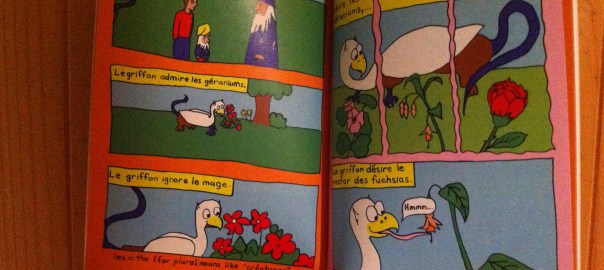
There isn’t really just one way of starting out with reading in a language that you want to learn. Through my observations and reflections, I have found the following different approaches for absolute beginners and near beginners.
- All new words are illustrated. This can be a book that is like an illustrated dictionary, such as some board books I have read. Alternatively, it can be like Le Français par la méthode nature, where new words are slowly added and the text slowly becomes more complicated.
- Assume exact cognates (words with similar appearance and meaning) to give a starting pool of vocabulary, then introduce new words gradually. This is the approach in Gnomeville. Unlike the previous option, this one requires an assumption about the first language of the learner. But the benefit is a greater starting vocabulary, allowing for more interesting content. It only works well with related language pairs, like French and English.
- Small vocabulary stories with much repetition. This is the TPRS/Wayside publishing approach, and it’s valuable for absorbing language thanks to the repetition. These also tend to use cognates, which mean there is an assumption about the first language of the learner.
- Parallel texts. Some people are really keen on these. It can be like your own personal Rosetta Stone (the stone, not the app), which can be fun – especially where there is a different writing system. I think these are most useful where the text in the language being learnt isn’t too hard, so that the translation is just used to check things occasionally.
- Reading a story you know well in your first language. This is a bit like using parallel texts. I think it is too difficult for starting out but some people like to intensively read (that is, slowly, with translation and lookups of unfamiliar words) a favourite book rather than fluently read something easier. The argument against the approach is that very little text is read per minute, reducing the opportunity to be exposed to more text.
- Bootstrapping a text. This is an idea that I have explored a few times. The idea is to filter a book’s sentences based on difficulty, starting with the easiest sentences and gradually adding more complex sentences and vocabulary. Finally, you read the full book. My earlier experiments with this idea were not successful. My current version is “Bootstrapping the Three Musketeers“, which starts with mostly one-word sentences consisting of names, interjections and a few cognates, and slowly builds vocabulary. As more is added, the book snippets get a bit longer, being either multiple sentences or longer sentences. The bootstrap book is organised like a form of spaced repetition, where new words occur several times in the chapters. So far, the extracts are not long enough to allow people to deduce the meaning of words through context, so there are short (5-8 word) glossaries at the start of each chapter.
- Another approach that has been used on occasion is to start a story in the person’s main language and slowly add more of the target language words, resulting in a mixture of both languages. I have seen this done to teach Chinese characters in a story written in English. I’ve also read a paper on the approach being applied to English-German. In a way it is not too different to the Gnomeville method of adding a new word periodically, in a cognate-rich text, except in Gnomeville you are reading the target language immediately. For more distant languages, such as Chinese and English, the approach is necessarily different.
- Related to the previous idea, it might be possible to have text that is in the learner’s main language but structured according to the target language. This might only work where there is enough similarity or simplicity in the target language. For example, you could have sentences like “I it to him have given”, to provide the flow of the language but with fully understandable vocabulary. Then, as for the other graded readers that incrementally increase their difficulty, words could be switched from main language to target language.
Is there a best approach? The research emphasises that time spent reading and interest in what you are reading are the most important factors. As for level of difficulty, the optimal is considered to be 95-98% knowledge of the vocabulary in the text. But there is quite a spread for this across individuals. The main factor seems to be whether you are comfortable with the amount you don’t know, and are happy inferring meaning despite not knowing the definition of some words. It is a skill worth developing. I think we have it as children and lose it at some point, and then need to regain the skill for language learning. Certainly my recollection in childhood was of happily reading comics in Dutch without knowing the meaning of every word. Then a couple of decades later, being frustrated that there were so many words I didn’t know in Dutch children’s books. I’m now back to reading books without stressing about unknown words in Dutch, French and German. For other languages, I still need beginner material.

