Category Archives: Writing

Posts about writing, mostly related to writing easy readers for language learning.

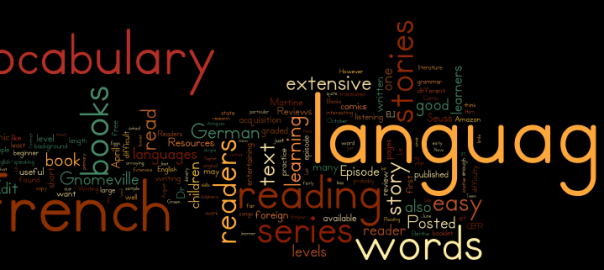
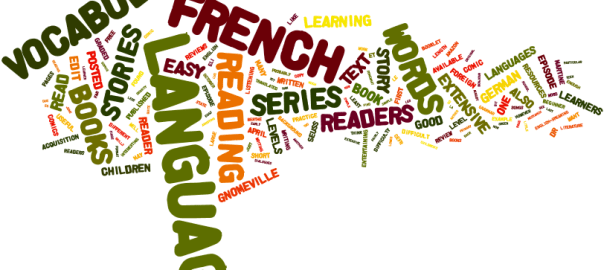
A word cloud based on the blog. The most prominent words are: language, French, and Vocabulary.

On Re-Reading Graded Readers

After having read a few novels in French, I have been concurrently re-reading my collection of graded readers. Here are my observations.

  • Even though my vocabulary is much greater now, and the A1-A2 graded readers feel relatively easy, there are still many gaps in my vocabulary that haven’t been filled. I have learnt that Hachette allow their authors to choose 20% of the vocabulary to suit their story, which may be a reason that there are always many unfamiliar words and expressions. I’m sure other publishers of graded readers have similar rules. (In contrast to that, the rules for the Gnomeville comics are that only the already introduced and defined words are used, plus French-English cognates.)
  • As with my previous reading, there are many graded readers that are sufficiently entertaining, but a few stick in my memory. The CLE International adaptation to a vocabulary of 500 words of En Famille by Hector Malot is one that engaged me the most so far. While tastes vary, if you enjoy historical stories about orphans, I thoroughly recommend this one.

One conclusion that I draw from this is that waiting until you know all the vocabulary that occurs in a particular level of graded reader is pointless. You will end up not getting enough practice at more complex grammar. Your interest in the story and whether you know enough to follow the story without being frustrated are your best guides as to whether something is worth reading.

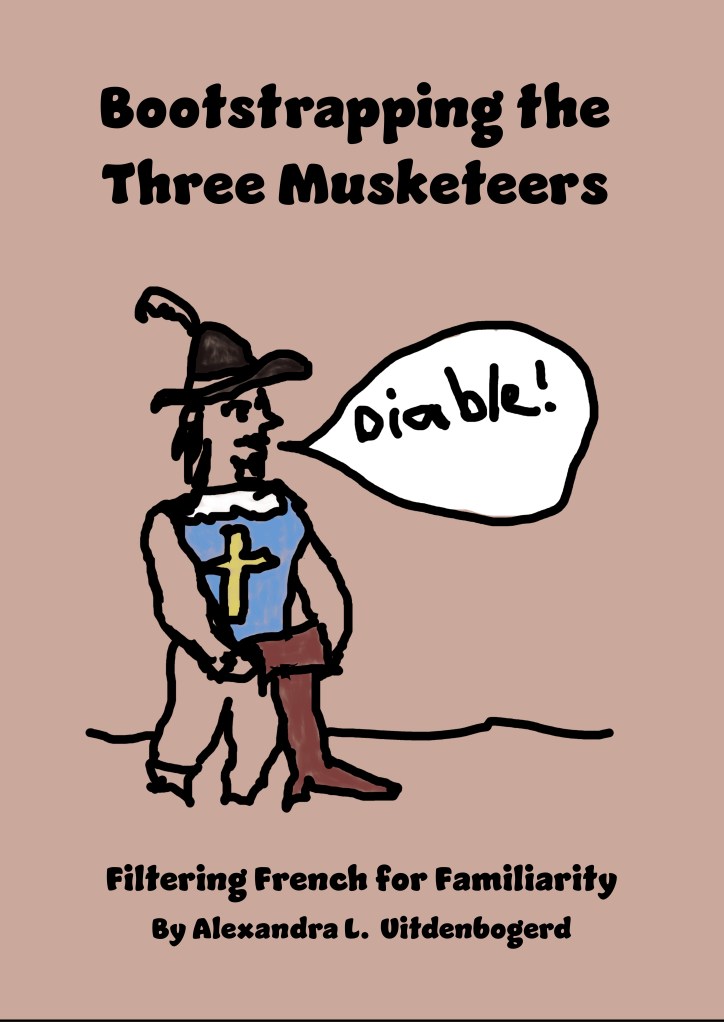
Book cover with musketeer holding a boot, saying "Diable !"

Repetition in Graded Readers

There is a class of graded readers that make much use of repetition in order to give learners the best chance of picking up vocabulary via their reading. This is the approach used by TPRS, Wayside Publishing, and the Old English book Osweald Bera. On re-reading Otto Bond’s Sept d’un Coup, published in 1936, I noticed that a similar technique was used, albeit more subtly, so it is not a new idea.

My observation of reading books with lots of repetition is that on the first read this is fine and helpful, but on rereading it becomes extra tedious. If things get too dull, the learner won’t engage. It occurs to me that my approach in the Gnomeville comics saves people from rereading unless they really want to, via their design.

The first couple of episodes of Gnomeville are moderately repetitive, in that they are not the most repetitive French graded readers around (Bootstrapping the Three Musketeers is the most repetitive I know of, followed by Le français par la methode nature, followed by Édi l’élephant), but they are more repetitive than other books, based on analyses of the first roughly 100 words. I try to ensure at least five occurrences of each new vocabulary word in the comic but I don’t force it into the Gnomeville story. Instead, I have a separate story (La Question du Moment), which uses any words that haven’t had enough repetition yet. Then the following episode has a revision page at the start, which recaps the story so far, using all the vocabulary and grammar used so far. Learners can read this and decide whether they are familiar with everything or need to revisit the previous episode. When revisiting, learners can skip La Question with all its repetition and just reread the Gnomeville story. Or they can use some other method of checking the words that are still unfamiliar.

When rereading the first few chapters of Osweald Bera, which I do periodically because I only dip into the book occasionally in my world of many demands, commitments and distractions, I have been wishing for a summary for each chapter, which summarises the story so far and includes all the vocabulary I should have picked up from it without the additional repetition. I consider it my “homework” to create this for my own use. For languages like French, Italian, German and Spanish, there are quite a few options for reading material, so it is probably better to read something else instead of trying to reread these often long, verbose, repetitive books. For Old English, however, Osweald is the only reader of its kind, so rereading is likely to be inevitable.

Book cover with musketeer holding a boot, saying "Diable !"

Bootstrapping the Three Musketeers

Those who have visited my blog this year will know that I have put up some “filtered French”, such as a list of the most common one-word sentences in French classic literature, and sentences that fit the highly constrained vocabulary of my comic books. After musing on language acquisition, in particular how babies learn, not to mention our experience of picking up a few words and phrases in a foreign language by ear, I thought I’d try a different approach. This has resulted in producing a book (with more volumes to come) where I filter Les trois mousquetaires, and add vocabulary one word at a time based on which word will complete the most sentences. Using a combination of manual and automatic filtering, I have created extracts that have sufficient repetition in their vocabulary for people to become familiar with the words.

It has been fascinating to see what happens as I add each new word. The algorithm tends to find dialogue first, gradually increasing in average sentence length, then short non-dialogue sentences – after the 93rd word of vocabulary was added.

Anyway, if you’d like to have a look, it’s on Amazon, with a substantial preview.

(Affiliate links in this post.)

Musing about Ratings

My comics get the full range of ratings and that’s ok. Sure, the first time I got a 1-star rating it hurt, and I did some soul searching to try to figure out why someone would do that. But it is a reader’s right to rate as they will.

A year or two ago I read a BookBub blog written by a successful independent author. He was very passionate in his belief that nobody should give low ratings to books, even if that is a sincere rating. It can have a negative impact on the author, both in their ability and motivation to create, and on their income. In my experience, my motivation to follow my creative spark is easily impacted by both negative and positive comments that I receive. Fortunately the positive comments can counteract the negative ones.

Having gone through the academic life of submitting research papers to be reviewed, I have developed a more philosophical stance regarding ratings. As long as someone is given feedback that they can act on in order to improve, a negative review is ok. Therefore my preference is this. Give a 1-star rating if you honestly feel that way and want to express that for whatever reason, but please give a review with it, so the author has some idea about why you feel that way. It can be just one or two words. Here are some one-word examples:

  • boring
  • dated
  • unoriginal
  • clichéed
  • inconsistent
  • blokey
  • girly
  • kid-lit
  • misleading
  • plotless
  • characterless
  • suspenseless
  • unedited
  • illiterate
  • ungrammatical

Given one of these one-word reviews, the author will know whether to work on plot, characterisation, writing, or factual content. If the review is “blokey”, “girly”, “kid-lit” or similar, the story may still be ok. Perhaps its nature wasn’t clearly indicated in the blurb for the story, leading to the wrong audience finding the work. The better the blurb gives clues as to the type of work, the greater the chance that reviews received will be higher, since those who are not the intended audience will give it a miss, and its intended audience will be more likely to find it.

Reading books for beginners

I’ve been looking at (and writing) phonics and other beginner books for learning to read and wanted to make a few notes here.

Most systematic controlled beginner reading books are based on phonics, slowly introducing the different letter-sound combinations in the English language. (I say English, as I haven’t looked thoroughly or found books for other languages). There is more than one systematic phonics system out there, starting with slightly different sets of letters and words, but they all achieve a similar goal of gently and methodically introducing children (and sometimes illiterate adults) to the skill of reading.

Amongst some interesting innovations I have seen are the book Cat and Rat by Doug Oglesby, Melinda Thompson, and Melissa Ferrell. This book tells the story, which is well indicated by the illustrations, first with pictures only (where the child tells the story in their own words), then by gradually adding more words each read. Designed by the authors to help a child with reading difficulties, it is no doubt useful for many in the same situation.

A second innovative book series I have seen are published by Usborne. I read Pirate Pat by Mairi Mackinnon, which is a book that allows a child to read with an adult, with each taking a page in turn. The child would be able to handle their pages after only two weeks of Phase 2 in the Letters & Sounds phonics system plus the word “I”. The alternating pages approach allows a more complicated story to be told than possible with the letters s a t p i n m d constrained to words of up to three letters in length.

Most other phonics readers start with stories that are told via the illustrations, but with captions or short sentences that are possible with the highly constrained set of words and letters. As a result, one ends up with variations on “The cat sat on the mat” (for which the earliest reference I have found is 1863), many stories being OK, but some being clever. Stories get a bit easier to write by the end of Phase 3. The constraints tend to continue in that authors try to ensure enough repetition of the target letter-sounds (grapheme-phonemes) of the stage, such as “A win at the well”, a story written to introduce “w”.

For all these beginner readers, it is crucial to have attractive illustrations and some narrative. After all, we want beginners to be motivated to read more.

Function word frustrations

I recently re-watched Dilili in Paris, which is a fabulous animation movie for children, with French dialogue that is slow enough for French language learners to follow. I originally watched the movie during the Melbourne French Film Festival and considered buying the movie later so I could try watching it without English subtitles.

Frustration 1: Memory

There is a frequently repeated phrase when Dilili meets new people: “Je suis heureuse de vous rencontrer”. It was semi-humorous, and certainly designed to be remembered, to teach how to be polite when meeting someone new. However, what I actually remembered after a week or two was: “Je suis heureuse __ vous rencontrer.” Despite being exposed to many occurrences, the function word was lost. Function words don’t provide semantic content and therefore appear to be harder to retain. There is certainly research evidence that concrete nouns are easier to remember than various other types of words. This movie brought that home to me in a big way.

Frustration 2: Resources

(Not really about function words…)

I bought the DVD of the movie, and then when viewing it, discovered that the subtitles could not be switch off, and that the only subtitles were in English. I don’t know who makes these decisions when preparing DVDs for sale, but perhaps they don’t really consider their audience carefully enough. A French movie sold in Australia would have various audience segments: French ex-pats – possibly including some French people who are hard of hearing, Australian francophiles, Australians learning French. To me, movies and TV episodes are highly useful for practising comprehension of the spoken language. Ideally it can be done at three levels of difficulty (with the example given for L2 referring to the language being learnt and L1 referring to the native language):

  1. L2 audio with L1 subtitles,
  2. L2 audio with L2 subtitles,
  3. L2 audio without subtitles

I even do this with DVDs that were originally in English. I’ve watched two entire series of Perry Mason with French audio, which was quite illuminating. If you are short of practice material, check your DVD collection for audio in your target language. You may be pleasantly surprised to find a good selection amongst your favourite shows.

Frustration 3: Vocabulary Size

(Function words are frequent words…)

One of the excellent things about some graded readers was that they were designed for a specific vocabulary size. For me, vocabulary makes all the difference between a readable text and an unreadable one.  CLE International used to publish books targeting a specific vocabulary size. For example, Niveau 1 had vocabularies of 400-700 words. Through extensive reading, I have successfully moved from 300-word vocabulary books to 700-1000 word ones, and I hope to continue to progress through further reading. However, as with other publishers, the publications have now been converted to CEFR levels: A1, A2 etc. and as far as I can tell, the subtleties of vocabulary size have been removed from the book information.

I have completed a CEFR B1 in French, yet I’m most comfortable reading A1 texts (and texts with less than 1000 word vocabularies) and with few exceptions they are not easy apart from the grammar, which is too easy for me, but the books are still sometimes challenging vocabulary-wise. What frustrates me is that A2 covers such a wide range of vocabularies, depending on the source material, from readable to incomprehensible. Published vocabulary sizes for A2, where they occur at all, vary from 400 to >1200 words. The level of frustration with some of these graded readers is the same as for texts written for native speakers. I oscillate between A1, A2, native texts and back again. The original memoirs of Céleste de Chabrillan are as easy and more exciting than many A2 texts.

CEFR is designed, as far as I can tell, to describe a person’s practical skill in a language, and for that it is useful. However, the jumps between levels are quite large, so that the defined levels are not very useful for the learner themselves. Some publishers solve this by dividing up levels. ELI uses A0, A1, A1.1. The Danish Teen Readers/Easy Readers also divide up the levels, and still appear to quote target vocabulary sizes. Indie publishers tend to ignore vocabulary size in their writing. However, writers and publishers should remember that:

  1. Extensive reading is at its best if learners are reading at a comfortable level while not being familiar with all vocabulary. Ideally learners should know 98% of the words in text they are reading.
  2. Readability of text largely consists of grammar and vocabulary components.
  3. The more readable AND interesting reading material is, the more learners will read, the better their vocabularies will become, and the better their skill in a language will be.
  4. Publishing vocabulary levels required for 95-98% coverage of the text will assist learners in finding materials of the right level for them at any point. Vocabulary levels should be (loosely) based on general word frequency.

This is why I write my comic books for language learners. This is why I research extensive reading, readability and language acquisition.

A word cloud based on the blog. The most prominent words are: language, French, and Vocabulary.

Ford & Hicks’s Elementary New French Reader – a review

Ford & Hicks published this reader back in 1939, with the intention of making an easier graded reader than their other book, “A New French Reader”, by using present tense to start with, and introducing the other verb tenses in later stories.

The stories are mostly interesting, with a couple sourced from books I have not encountered before (“Deux jeunes aviateurs” and “Le secret du château”). It also includes Cosette, which had me sighing “not again”, since every publisher does stories from Les Misérables. However, Ford & Hicks may have been one of the first to make a simplified reader from it, so I shouldn’t grumble. What I will grumble about is the extract from Comte de Monte Cristo. You may recall in my review of Otto Bond’s series, that the escape episode of this was a highlight, and made me want to read more.

In the Ford & Hicks version, we get the initial backstory in English before reading the scene that led to the unjust incarceration of Dantès. The story then includes more English breaks between sections of French, and given the Otto Bond version, I don’t see the purpose of these interruptions to immersive reading. The Ford & Hicks version covers more of the story, and at the end summarises the remaining plot. Then they end the summary with the statement “The interest of the story weakens after the discovery of the treasure”. Unlike Bond’s version, which had me wanting to read on, this version annoyed me with the English interruptions and further annoyed me by taking away my interest in reading more of the story.

Recent trends in language acquisition research have focused on “translanguaging”, which seems to be what I’ve done most of my life, which is mixing languages together in order to keep communicating fluently with my level of knowledge (of Dutch). There seem to be benefits to doing so, but I’m starting to think it might not be so good for reading. This is the opposite of my previous thoughts on the topic, where I supervised the building of prototype bilingual ereaders that present foreign language stories, having the most difficult parts presented in the native language of the person reading it.

What may be more beneficial is reading foreign language text that resembles the native language of the speaker. That is, using cognates, simple non-idiomatic forms of expression and sentence structures that are not too unusual. This is what happens with stories in French written for native English speakers such as my Gnomeville series (Episode 1 and Episode 2 currently available), and the books by Otto Bond, and Ford & Hicks. It also happens to a large extent in stories by non-native writers. For example, I’ve seen some English graded readers written by a Chinese author, where the English is very Chinese in style, so would not be classed as “good English”. However, as long as it is known to not be “English” English, it is probably helpful to start with for people with a Chinese-speaking background. Then there should be a transition to more English-like English at a later stage. I’m somewhat more forgiving of this idea currently than I was previously.

It’s never as authentic as a native speaker

I have my moments of doubt with my French comic book project. It is virtually impossible to write something that is absolutely correct French in terms of the expressions used if one is not a native speaker. Grammar is relatively easy to get right, apart from minor slip-ups, but having something sound like natural French, especially while intentionally writing in a constrained vocabulary is almost impossible.

I’ve been attempting to get Episode 3 of my comic book ready this month, spurred on by a potential launch date at the language-themed concert I’m involved with, happening tomorrow, as well as #inktober. However, before finalising my comic it was important to get it checked by a native speaker of French. This happened today, and as usual there are errors that need to be fixed, and unlike text that is free to vary without consequences, this means making decisions about whether to leave out phrases or whole sentences, find an alternative French-English cognate, or an alternative way of saying the same thing. As I also try to ensure there are a certain number of repetitions of key words, phrases, or grammatical points, further changes also need to be made. Then there’s the crossword… As a result, I will need to delay the release of Episode 3 for a bit longer.

Unfortunately, despite multiple checks by francophone proofreaders, some things do get missed. I appear to have an error in Episode 2, which has already been published. I may need to set up an errata page here, and perhaps release a second edition at some point. It’s all a little discouraging, but I’m not giving up yet.

A Lesson in Suspense

Reading graded readers can be quite educational on how to write good stories. Previously I wrote an article about a graded reader “Hall of Shame“, in which I highlighted various problems I had observed within the genre, and then provided a summary of recommendations on how to write better graded readers. Elsewhere I wrote another summary of advice on writing graded readers (I called them Easy Readers in my earlier posts.)

In this article I’d like to talk about suspense. I think I was in my twenties when I first really thought about suspense at all when reading. A fine simple example that crystallised it for me was Dirk Gently’s Detective Agency by Douglas Adams. Two memorable simple bits of suspense occurred in it. The first is the sofa stuck in the staircase, which is explained toward the end of the story. The second, which amazed me in its simplicity was explaining two of three things, and not answering the third one until late in the book. I was reading on, wondering what the third thing was. This illustrated that it didn’t really matter what the suspense is, as long as it’s suspense. It doesn’t need to be figuring out who committed a crime, or whether the romance concludes happily. It can be pretty much anything.

The next observation, which inspired the way I’ve organised my Gnomeville comics, was the use of cliff-hangers. I was reading a collection of X-Men comics, and noticed that they always ended with a cliffhanger and unanswered questions. By never fully ending the story, people get hooked and need to read the next issue. Soap operas seem to work the same way. It struck me that this is a very good strategy for graded readers, since we want to motivate people to keep reading to improve their language skill.

I buy and read graded readers by other authors, and I was struck by the contrast suspense made between two otherwise very similar stories by the same author, Sylvie Lainé.

Voyage en France tells of an English couple who go to France, because Louis is reminded of a creative project he commenced with his best friend decades earlier, who later moved to France, and with whom he had lost contact. The project was a movie about an old man trying to find an old friend, echoing the current situation. Louis wants to see how the story will end, by finding his old friend. We read the story of Louis and Melba as they follow a series of clues to find Louis’s old friend. This suspense worked for me, as I wanted to know how the story would end. I also wanted to know whether they tried to finish the movie, but that question wasn’t answered. I read the story quickly, despite many chapters of fairly mundane travel activities, all because of the suspense.

Contrast the above story with Voyage à Marseille. This contains the same two main characters, doing the same things, that is, travelling through France to get to a destination. However, it lacks the suspense of wondering whether they will find the person they are looking for. The first bit of excitement happens quite late, the disappearance of the car, and is resolved quite quickly. There is another unanswered question that had potential as a simple bit of suspense, the title of the biography of Louis’s friend that they were visiting. Unfortunately that wasn’t answered in the final chapter. It took me a lot longer to finish this story, because there wasn’t anything I wanted to know the answer to.

So, when writing graded readers, please provide suspense. It makes a lot of difference to the reading experience.


Nabokov’s Favourite Word is Mauve – my kind of book

I recently noticed an article in an issue of Reader’s Digest while in a waiting room. It was discussing the vocabulary of Green Eggs and Ham, and other statistical aspects of writing. It was an extract of Ben Blatt’s book “Nabokov’s Favourite Word is Mauve”. Since the article was about a lot of the things that I work on, I felt compelled to get the book, and immediately read it.

The book compares a set of literary classics, best sellers and fan fiction via quantitative statistics. The author used my old friend Natural Language ToolKit (NLTK) for Part of Speech tagging etc. for the text analysis.

The first chapter looks at adverbs, which are frowned upon in writing. The next looks at statistical differences in writing by each gender. Chapter 3 discusses the history of authorship attribution, as played out with the Federalist Papers. The relative frequency of different function words tends to be like a fingerprint for an author’s writing. He uses this on co-authored works to figure out who wrote what. Next up is seeing if authors follow their own advice on writing. Then comes the chapter I saw in Reader’s Digest, that discusses Dr Seuss and readability measures. In the same chapter he notes that the average reading age of bestsellers is decreasing, from grade 8 in the 1960’s to grade 6.

Next up is a comparison of UK and US writing, including an interesting comparison on the loudness of Americans compared to English people. Chapter 7 looks at clichés – another area I have researched, albeit in lyrics instead of novels. The remaining chapters look at book covers, first sentences, and text generation.

This book did a lot of things that are closely related to my own tinkerings, as well as some of my published research. The author is a journalist and statistician, and several of the chapters, if written in an academic rather than journalistic manner, would have made good quantitative linguistics papers, with the amount of research within the book possibly being enough for a PhD in the field.

I only had one gripe about the book, and that is one sentence in which he assumes his reader knows nothing about statistics and says so. It’s one thing to explain something clearly starting from scratch or to state that something is left to an appendix for those interested. It’s quite another to tell the reader that they don’t know enough statistics. While some readers may not be insulted (eg. the “for dummies” series was popular), I usually am. I may not be the world’s expert on statistics, but I have a working knowledge, and I am capable of learning. I had a similar experience when I wanted to learn about the premise behind the Zone diet, and read a book on it, only to be constantly told by the authors that I’m fat (I’m not). The moral is: explain things clearly, but don’t insult the audience.

All in all, this was a book that’s exactly the kind of thing that I enjoy.