Most pages I’ve seen that try to answer the question “What are the best French comics for beginners?” only include comics written for native speakers. That is fine, and it is easier to follow a francophone comic than a novel, thanks to the pictures. However, if Astérix is still beyond you, there are easier alternatives to start with.
Based on the principles of extensive reading, you want comics where you know the meaning of 95-98% of the words you read, to read fluently, enjoy what you’re reading, and gain language capability from exposure to lots of text. Of course, you also need to enjoy what you’re reading to benefit from it, so if something doesn’t appeal to you, it would be better to find something else to read.
Materials written for native speakers of French will have much richer vocabularies and grammatical constructions than those written for learners. If you want to start on something written for you the learner, rather than a francophone, here are a few options to look at.
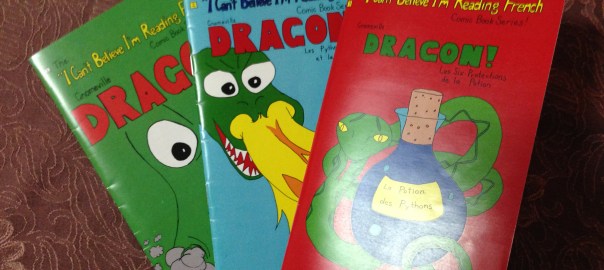
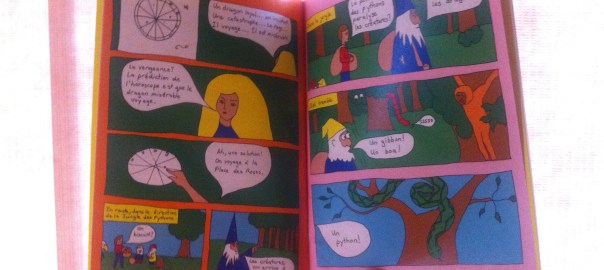
- Gnomeville episodes 1-4. These assume no knowledge of French and tell an entertaining tale about gnomes, a griffon and a mage going on a quest to capture a dragon. The focus is on introducing the most frequent words in French while using cognates (words that are the same in both languages, in this case, English and French) and pictures to make the story entertaining. Suits ages 8 and above. Available from Amazon as ebook or on Square as a physical comic book.
- Various offerings from My Generation of Polyglots. I’ve only looked at the sample of the graphic novel, which is of Chapter 7. It is more like a picture book in format than comic book/bande dessinée. The language is very simple and every word has a translation at the bottom of the page. There is only a small amount of text on each page, so it has a high picture to text ratio, making it a comfortable beginner book, despite it being a 110-page text. If the sample chapter is anything to go by, each chapter is a complete story. There are other comic books available at the website too. The language level seems to be tied to school levels 1 and 2. The stories appear to suit young adolescents. Definitely worth a look for beginners who want to read in French.
- languagecomics.com have a series of comics published on-line that are written for learners. There are a few available for free to try out and the rest can be accessed via a subscription. Episodes are a page or two long, with links for difficult words, as well as other resources. These also appear to be targeted at adolescent learners of French. Definitely worth trying if you find comics for native speakers daunting.
- Luc et Sophie. These are beginner comics, suited to 7-11 year olds who are learning French. I found them a bit annoying, but if you like young sibling rivalry antics, they may suit you. Vocabulary is found at the back of each short comic. If you feel daunted by long texts and want to feel a sense of achievement at finishing something, these very short comics (up to 70 words in the first set) will be an ideal start.
- Mary Glasgow’s Bibliobus books and others. Unfortunately these are out of print, but if you can get them (I scored a few second hand, and also borrowed some via inter-library loan), they are reasonably easy to read. Some are quite entertaining, while others are a little contrived or annoying. The contrivedness disappears as you go up the levels, as the authors have more freedom to express themselves. My favourites are Le chapeau rouge and Le gangster et le chat. Note that Bibliobus is also the name of a series of French books for French children, so make sure you are getting what you expect.
- The Lire Davantage series published by Heinemann has a comic book format for many of the books. As with the Glasgow ones, some are entertaining, while others are a bit dull or contrived. Yet others are informative non-fiction. My favourite is “Fichez-moi la paix !”
I believe these are also out of print, but seem to be available secondhand. Probably suits ages 10+.
- There are a few textbooks that include a comic book format story in each lesson. Ça Bouge by Michael Sedunary is one of these, aimed at young adolescents and is fairly entertaining.
- ELI publish a magazine for learners of various ages/levels. Each issue of series Voilà (young children), C’est facile (A1-A2), Môme (A2-B1), and Jeunes (B1-B2), contain comics. If the format hasn’t changed since I last grabbed copies, it is two pages of comic in a 16-page magazine. The rest is filled with activities, quizzes, and articles.
- Aquila Communications have comics/bandes dessinnées for beginners to intermediate. Normally they only sell to schools but they might agree to sell to an individual if you contact them directly. Either way, you can read some pages from some books on the website for practice and to get an idea of what they’re like. I don’t have their comics but have enjoyed some of their books for low-intermediate to intermediate in the past.
It’s all down to how comfortable you feel with the language you don’t know. If you are confident, then dive straight into the classics: Lucky Luke, Tintin and Astérix. Then venture beyond those based on your tastes or language goals. But if they are still at your frustration level, start with those that are written for beginners and work your way up.
A fun web comic that isn’t too hard is Pepper & Carrot.
Once you are confident enough to read comics written for native speakers, it is worth having a look at those available to read for free from comicbookplus.com. I haven’t looked at many yet but the Baby Journal might be easier given it is aimed at children. The comics have ratings, which may make choosing easier. Le Fanchon de Soeur Bourgeoys dramatises a bit of history from the early days of Québec.
Note to authors of French comic books for learners: if I haven’t got your offerings on my list, please let me know. I’d be very happy to add them.
(Last updated 1 June, 2026. Now with affiliate links again (2025).)