Tag Archives: comprehensible input

Gnomeville Comics are Easier than I Thought

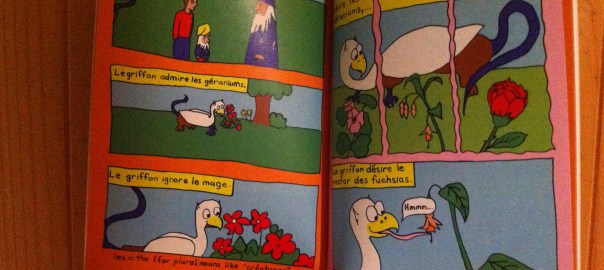
On reviewing my readability measure results for various items in my collection, I suddenly thought, “hang on, how can the expected vocabulary size for Gnomeville Episode 1 be 25 when only 12 very frequent words are introduced?” Clearly something had gone wrong somewhere.

I blame the fact that part of my analysis is manual, and I probably didn’t follow the procedure very well. I run various scripts to produce a ranked list of words in the text in the frequency order of a large corpus of written French (mostly from Project Gutenberg). The manual bit is counting up cognates, or at least starting at the least frequent word end and counting up until I find 5% of the words that are not cognates or names. I think I went astray previously by having a less reliable process.

Results can differ depending on decisions that are made, such as whether to include titles (which I treat as sentences), the “Présentation” section that has brief notes about each character, and what is counted as a cognate. It is reasonably clear-cut for Gnomeville, but for other texts, it is less clear. Should “habiter” be considered a cognate due to its similarity to “inhabit”? And there are other words that are cognates in the linguistic sense but not particularly obvious from a learner perspective. The choice of general frequency list will also make a difference. Spoken text has different characteristics to written text, especially in French. Also, the very frequent words used for Episode 1 and 2 are the 20 most frequent in French newspapers, which is not the same set of words as any other corpus of text. The text I use for calculating expected vocabulary size has some of those words at lower ranks (“se” at 25, “au” at 31, and “on” at 40), which explains why there was the potential for the expected vocabulary size to be larger than the number of words introduced. But unless those words made up about 5% of the extract it was unlikely they would receive those scores.

Anyway, on revisiting my incorrect assessments of the Gnomeville episodes, I have the following updated vocabulary sizes.

EpisodeOld Expected Vocab SizeNew Expected Vocab SizeNew Readability Score
12532.20
216143.23
340173.83
4153.66

You may notice that Episode 4 has a lower expected vocabulary size at 95% and a lower readability score than Episode 3. There’s not a lot in it, but Episode 3 had longer sentences in the extract.

Well, there you are. Gnomeville’s expected vocabulary size is much smaller than originally calculated – at least for Episodes 1 and 3.

Review: Le Français par la méthode nature

I’ve seen this book by Arthur M. Jensen mentioned a few times and I thought it was worth a look, given its philosophy. This book, which was originally published in 1958 (and still in copyright, according to the death+70 rule), is a reading-based introduction to French, with the pronunciation of the text in IPA under each line. The text is quite mundane and repetititve, but the repetition is intentional to allow the language to be acquired by reading. Things get a little more interesting after a dozen or so chapters. A similar approach is used in several (relatively entertaining) stories in French, such as those by Wayside Publishing and TPRS, in addition to other languages. It is also used for an engaging story in Old English called Osweald Bera.

Jensen’s book makes no assumption about the learner’s first language. There are no glosses or definitions in another language. There are pictures to illustrate nouns that are introduced and names of characters talked about. This makes it a good choice for those with a language background that is not English, since many books assume English (or another common European language). It may be less useful for those who have no prior exposure to the Roman alphabet. That would need to be learnt first.

I ran my usual analysis on the first approximately 100 words and confirmed that based on my measures, it is easy French. Its type-token ratio (measure of repetition and learnability from text) is the lowest I have found so far, meaning there is a high chance of learning the vocabulary when reading the text. Its overall score, encompassing expected vocabulary at 95% coverage and sentence length (assuming that the text above and below the pictures on the first page, such as “une fille”, were sentences) was 4.84, making it the 7th easiest in my small table of the readability of French texts for learners.

One weakness of the text is that it is a bit old-fashioned. A lot of the conversation examples are not how people speak nowadays. Also, some of the words are more what would be read rather than spoken, such as “demeurer”, which I only come across in texts, whereas to my knowledge, “habiter” has been the most common verb to use for decades.

Ayan Academy has audio of many chapters on Youtube. This can be useful simple audio comprehensible input.

In summary, its strengths are that there is no assumption of first language, it is comprehensive, and there is a high chance of learning the language from reading due to its high level of repetitivness. Its weaknesses are it is dull and dated.

Gnomeville Episode 4 Soon to be Released!

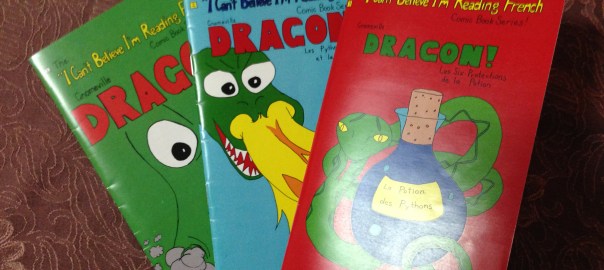
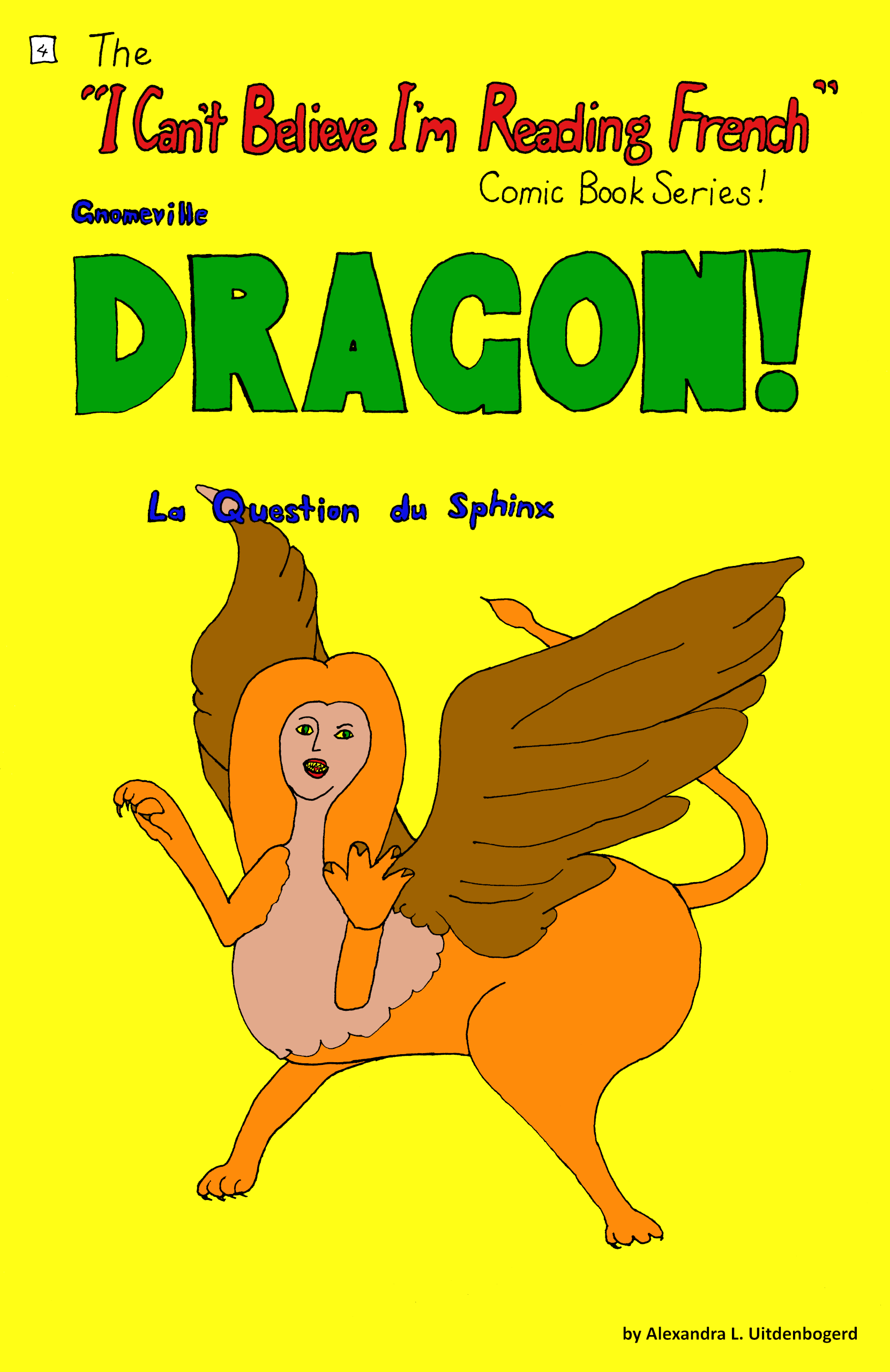
Slowly (6 years!) but surely, my next comic for learners of French has been completed! I am holding a launch party for it on Sunday, where attendees will hear the Gnomeville songs performed, and have the opportunity to buy the comics at greatly reduced prices. Then, the physical comics will appear in the Square store, and not too much later, I intend to publish the ebook “wide”, as they call it, meaning it will be available from Kobo, Apple, and other ebook platforms. I intend to make Episodes 1 to 3 available in a bundle format for the platforms that haven’t had the comics before. So, more work to do. But first, we have the launch on Sunday!

Extensive Listening

Mostly I have focused on extensive reading, both in my research and practice. This is obvious from my DELF results, where listening, and especially speaking, were much worse than my reading and writing results in French. To build skill in listening requires suitable comprehensible input. There are various podcast and youtube channels that are recommended. Some have beginner content, others intermediate, and others cater to multiple skill levels. Partly for my own benefit and partly as a resource for others, I thought I’d list those I have found out about.

I should also mention that if something is too hard to comprehend because of the speed, you can always slow it down. If it is too hard because you are unfamiliar with most of the words, it is best to start with something easier and/or do more reading first. (Also, if it is too easy, you can speed it up).

Beginner channels.

There are also a few easy songs you can listen to (based on repetitiousness and vocabulary size). I’ve also become aware of a few easy children’s programmes.

Intermediate channels

For the intermediate channels, you may need to have developed your vocabulary a bit more via extensive reading with graded readers and the like.

At the intermediate level, the innerfrench.com is the most recommended. It starts slowly and has many episodes, which generally become gradually more difficult, apart from a few exceptions. There are some interesting topics amongst the series.

Another that has some interesting comprehensible content is Français avec Fluidité. There is an A2+ playlist (start here) as well as various interesting topic playlists. I feel as though it is slightly more difficult than the innerfrench podcasts but still quite comprehensible for an intermediate.

Little Talk in Slow French is beginner-intermediate level but has some words translated into English during the podcast.

Lingua.com has recordings that are labelled with CEFR competence levels, from A1 to B2, with questions to test your comprehension. They also have resources for other languages.

Elsewhere

Since creating this post, I have learnt that there is a comprehensible input wiki with resources for many languages. The French list of listening resources is more comprehensive than what I list here, so worth checking out.

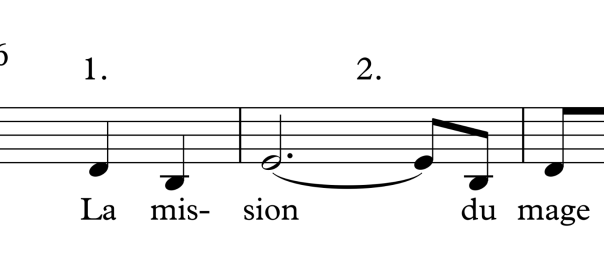
Excerpt of sheet music for the song La Mission by Uitdenbogerd

The Easiest Songs in French

Someone recently asked whether there were any A0 songs in French for improving listening skills. There may be some learner songs. I wrote a few to go with my comic books but they are optimised for reading, not listening.

So what would be the criteria for easy songs? I think that the easiest would have a very small set of words and be repetitive. Where two songs equate in vocabulary and repetition, perhaps the one with the easiest grammar or the most standard expressions would be ranked easier.

I cannot comment on whether there are any easy popular songs. Most have extensive lyrics, with only the chorus being repetitive. However, in the collection of children’s songs (comptines) and folk songs, several can be found. Some were printed in my old Horan and Wheeler textbooks. Others I have found elsewhere. Given the above criteria, here is my list and a rough sequence of difficulty based on vocabulary size; type-token ratio, which captures repetitiveness; and a grammar scale. Beginners will probably want to read the lyrics for the first few listens.

SongVocabulary SizeLyrics LengthType Token RatioGrammar LevelMeasure
Bonsoir mes amis3210.14300.06
Savez-vous planter les choux ?191180.16110.23
Frère Jacques7140.50010.25
Sur le pont d’Avignon231300.17710.27
Alouette13960.13530.28
Quand trois poules14290.48310.29
Dansons la capucine
(or more seriously)
26910.28610.32
J’ai mangé un croissant10200.50010.32
Au petit pas militaire12390.3130.33
J’ai mangé un croissant remix19560.33930.39
Didi et Dada32720.44410.41
J’ai du bon tabac341110.30630.48
La mission33480.68810.49
Au clair de la lune701330.52640.86