While exploring French readability and the fact that sentence length is a key factor for English speakers learning French, I thought I’d take it to the extreme and see what are the most common one-word sentences in French literature. Here is the top 20. Note that it is highly influenced by Les Trois Mousquetaires, which is a sizeable portion of the corpus and responsible for about half the occurrences of “diable”.
Ah
Oh
Non
Hélas
Oui
Quoi
Eh
Comment
Pourquoi
Diable
Bah
Tiens
Amen
Moi
Bon
Vraiment
Monsieur
Jamais
Pardieu
Hé
In a different corpus less dominated by Les Trois Mousquetaires, the following were also found in the top 20:
Allons
Bien
Adieu
Rien
Jamais
In a modern corpus I think we would find different expletive-like exclamations than “Diable”, “Parbleu”, and “Pardieu”. A common one these days seems to be “Putain!”, or somewhat less extreme “Punaise!”. Maybe I’ll try to process the French movie subtitle corpus at some point to get a more up to date glimpse at one-word sentences in French.
One of the weird things about studying French is that we seem to have three levels:
Beginners use present tense, imperatives, infinitives, and future proche;
Intermediate learners use passé composé, imparfait, future and conditional tenses
Advanced learners use passé simple and subjonctif
Yet, if we look at picture books written for French children, many use passé simple straight off.
I remember when I started reading (in English) in Grade 1 of primary school, one thing I had to get used to was constructs like “said Dora”. It doesn’t happen in spoken English, so felt a little weird. But it wasn’t overly difficult. Perhaps people from English-speaking backgrounds who had stories read to them would have been familiar with that already before reading it. The same thing must be true for French children reading or hearing passé simple. It’s a little different but not hard.
I recently read three French picture books. The first (Le Grand Antonio by Élise Gravel) was a fairly easy one with few words, written in present tense. The second (Quel est mon superpouvoir? by Aviaq Johnston) was a translation from English, written in passé simple (and imparfait). It was a comfortable read for me. The third (Dounia by Marya Zarif) was (mostly) written in present tense but was more difficult due to its vocabulary and more descriptive text. It is obvious to me that it is possible for texts in passé simple to be easier than those in the easiest tenses.
The thing is, you don’t need to know how to conjugate passé simple to read it. You just need to recognise the endings of third person singular (3ps) and plural (3pp) for regular verbs plus know a few of the irregular verbs. Here they are.
For -er verbs, 3ps ends in -a and 3pp ends in -èrent. For -ir and -re verbs, 3ps ends in -it and 3pp in -irent. You may come across a few -oir verbs, which have -ut and -urent.
The main irregular verbs to watch out for are:
être: fut, furent faire: fit, firent avoir: eut, eurent
The regular ones should not pose any problems. The avoir ones are recognisable thanks to already knowing the past participle of avoir (eu). The main difficulty is not mixing up the être and faire words. A simple rule is that faire has an ‘i’ in it, and so does its passé simple conjugation.
Years ago I was tinkering with creating my beginner comic book in French, and then researching what made things easy to read in French for those with English speaking background. I learnt that the two main aspects that characterise text difficulty are grammar and vocabulary, with other aspects usually having a much smaller role to play. Through my own research, inspired by my own frustration and anecdotal experience, I learnt that for French the typical readability measures that use word length or even how common a word is for vocabulary difficulty just don’t work for people with English speaking backgrounds. This is because so many of the longer “difficult” words in French are identical to those in English, or close enough not to matter. My experiment demonstrated that you may as well just use sentence length to decide on difficulty, being the simplest measure of grammatical complexity. Despite this, vocabulary matters. It’s just that the words that are difficult are differently distributed than for languages that don’t have this peculiar French-English relationship.
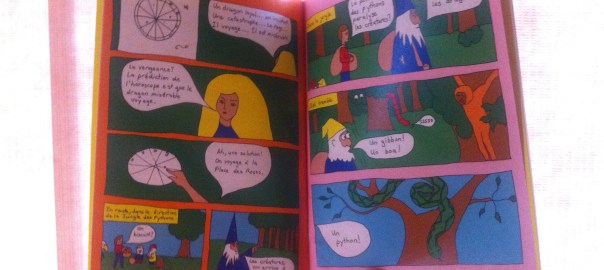
Excerpt from Episode 2 of Gnomeville: Dragon! – a series of comic books written in French for beginners with an English speaking background. Episode 2 only assumes that you know the following words that are covered in Episode 1: le, la, les, et, est, de, du, des, un, une, que, se. The story so far is summarised on the first page of Episode 2.
Recently I have been reading a few comics in French, mainly by French-Canadian authors, or translated by them. The target audience for most of them is children and young adults. It had me thinking again about how best to grade comics in terms of difficulty.
My experience in attempting to read various Japanese books for children or learners showed me that it is possible to read a picture book that is really just an illustrated vocabulary without knowing any of the words beforehand. At the other extreme, it is theoretically possible to read everything in a parallel text, since the translation is right there to refer to, just very slow if every sentence needs to be analysed. That is known as “intensive reading”, which has been shown to be less useful than “extensive reading” for language acquisition. Complete glosses similarly make it possible to read a text without prior knowledge of the language, albeit with lots of interruptions to look things up.
Translations and glosses aside, a comic book will be easier than its text presented without illustration, since the illustrations provide clues to what is happening. It is also easier than text describing the same scenes provided by illustrations – a point that was made elsewhere in favour of learning language from comic books. In other words, “a picture paints a thousand words”.
In general, there is more dialogue and less descriptive text in comics, compared to novels, so the sentences are shorter on average. (This also applies to scripts of plays.) In addition, the pictures give clues as to what the text is about. A further benefit is that it often provides more examples of speech than would be found in a novel – or at least, as a proportion of the text read. This can be useful for absorbing speech patterns, particularly for people who are not exposed to much speech directly.
While the shorter average sentence length means that comic book text will generally be scored as easier than text from novels by readability measures, I think that a measure of difficulty of a comic may need to consider whether concrete nouns are illustrated when used. For example, a picture containing a wild boar with the text clearly indicating that it is “un sanglier” could be almost as easy as reading a French-English cognate, such as “village”. Or perhaps it is roughly equivalent to having a gloss entry, albeit introduced in the story instead of in a footnote.
Either way, comic books should be easier to read than books that have no illustrations. See my list of easy comic books in French for some that are a good starting point for beginners.
Today I came across the book Kill the French by Vincent Serrano Guerra in a list of recommendations on Amazon and thought I would have a look. It appears to follow similar principles to others that do strict vocabulary control, pioneered by Michael West in the early years of the 20th century: restrict to cognates, introduce frequently occurring words first, include repetition, and slowly build up the assumed vocabulary. The author has also followed the principle of spaced repetition with the goal that readers will retain vocabulary at optimum levels. So how does it compare to other books and comics that do the same thing? Let’s have a look.
I have analysed approximately the first 100 words, which covers the Day 1 text and the title of the Day 2 text. According to Style, it has an average sentence length of 8.8 words and an average word length of 4.3. Word lengths don’t really tell us much for French, since longer words tend to often be easy for those with an English-speaking background. Sentence lengths do, however, have a stronger impact on readability.
Other stats on the sample: vocabulary is 45 words out of 95 words of text, making a vocabulary density (type-token ratio) of 0.47. Naturally the author has made heavy use of cognates. Some of these are exact cognates, such as “lion”, and in other cases they are more challenging without context, such as “musée”. If we assume that all cognates are known, then the assumed vocabulary size for 95% coverage is 41 (when words are ranked in general frequency order), which is an excellent achievement. The only books in my collection that achieve that level or better are:
So from the perspective of readability in French for people with an English-speaking background, I put it at the same level as Gnomeville 3 initially, as they both have similar sentence lengths as well as vocabulary coverage.
Unfortunately, like many graded readers out there, the text of Kill the French is quite dull. I checked the 18th day in the sample to see if it was more interesting, having gained extra vocabulary. Sadly, no. I can’t comment on the final stories in the book, which may be more interesting, since I have only examined the sample.
So, here is my conclusion. If you are an absolute beginner in French and are a huge fan of spaced repetition-based learning and willing to put up with texts that are mildly interesting at best, then this is an excellent graded reader for getting you to become familiar with the 500 most frequent French words efficiently. It certainly beats just memorising vocabulary in isolation. The Gnomeville comics may be more exciting and fun, but unfortunately they currently only take you to a frequent vocabulary of about 30, until the author gets cracking with the rest of the series. Perhaps the best approach at this stage is to use both together.
The first day of Kill the French uses frequent words that are introduced in Gnomeville Episodes 1 to 3. All except “avec” are introduced in the first two episodes. Day 2 introduces two words occurring in Episode 1, one from Episode 2, and one that doesn’t feature in the Gnomeville series yet, since it is far less frequent in text. Gnomeville‘s first two episodes introduce the twenty most frequent words occurring in French newspapers, which is a slightly different frequency profile to spoken language, and somewhat different to other text corpora. Kill the French introduces words in an order that doesn’t resemble any specific corpus frequency list but they are still frequent words. For example, the second day includes the word “aussi”, which in movie vocabulary ranks about 91, in books at 78, and in the Minnesota spoken corpus, at 79. But, it is still a frequent word, and I know from personal experience that being a bit flexible about the order of introduced words makes it easier to produce a coherent story.
Given that the order of word introduction varies enough that words will be introduced in one book and not the other, it doesn’t really matter too much which you read first. You could, for example, read Day 1, then reward yourself with Episode 1, then after Day 2, do the same with Episode 2. Day 3 is where the two texts diverge the most in terms of vocabulary, but there is still overlap. After that, you are stuck with Kill the French. But at some point you might be able to switch to Première Étape: Basic French Readings: Alternate Series by Otto Bond (published 1937), if you can locate a copy. According to my stats the expected vocabulary works out to 316, but it is another principled graded reader, using cognates, frequent words, and slowly adding new words as you read. It’s also an entertaining read. However, from memory, it does use more difficult tenses typically found in French literature right from the start, so can be challenging grammatically. The average sentence length is also quite long, making it potentially daunting.
In summary, I recommend using Kill the French in the following manner: for the first three days, read the day’s material and follow it with an episode of Gnomeville. After that, if you can keep going with the spaced repetition from Kill the French for about 100 days, you then might be able to start reading Première Étape: Basic French Readings: Alternate Series, which is interesting right from the start with an initial vocabulary of 97 frequent words and Si Nous Lisions, which starts being interesting from Chapter 6 with a vocabulary of about 100 words. Best of luck!
Most pages I’ve seen that try to answer the question “What are the best French comics for beginners?” only include comics written for native speakers. That is fine, and it is easier to follow a francophone comic than a novel, thanks to the pictures. However, if Astérix is still beyond you, there are easier alternatives to start with.
Based on the principles of extensive reading, you want comics where you know the meaning of 95-98% of the words you read, to read fluently, enjoy what you’re reading, and gain language capability from exposure to lots of text. Of course, you also need to enjoy what you’re reading to benefit from it, so if something doesn’t appeal to you, it would be better to find something else to read.
Materials written for native speakers of French will have much richer vocabularies and grammatical constructions than those written for learners. If you want to start on something written for you the learner, rather than a francophone, here are a few options to look at.
Gnomeville episodes 1-4. These assume no knowledge of French and tell an entertaining tale about gnomes, a griffon and a mage going on a quest to capture a dragon. The focus is on introducing the most frequent words in French while using cognates (words that are the same in both languages, in this case, English and French) and pictures to make the story entertaining. Suits ages 8 and above. Available from Amazon as ebook or on Square as a physical comic book.
Various offerings from My Generation of Polyglots. I’ve only looked at the sample of the graphic novel, which is of Chapter 7. It is more like a picture book in format than comic book/bande dessinée. The language is very simple and every word has a translation at the bottom of the page. There is only a small amount of text on each page, so it has a high picture to text ratio, making it a comfortable beginner book, despite it being a 110-page text. If the sample chapter is anything to go by, each chapter is a complete story. There are other comic books available at the website too. The language level seems to be tied to school levels 1 and 2. The stories appear to suit young adolescents. Definitely worth a look for beginners who want to read in French.
languagecomics.com have a series of comics published on-line that are written for learners. There are a few available for free to try out and the rest can be accessed via a subscription. Episodes are a page or two long, with links for difficult words, as well as other resources. These also appear to be targeted at adolescent learners of French. Definitely worth trying if you find comics for native speakers daunting.
Luc et Sophie. These are beginner comics, suited to 7-11 year olds who are learning French. I found them a bit annoying, but if you like young sibling rivalry antics, they may suit you. Vocabulary is found at the back of each short comic. If you feel daunted by long texts and want to feel a sense of achievement at finishing something, these very short comics (up to 70 words in the first set) will be an ideal start.
Mary Glasgow’s Bibliobus books and others. Unfortunately these are out of print, but if you can get them (I scored a few second hand, and also borrowed some via inter-library loan), they are reasonably easy to read. Some are quite entertaining, while others are a little contrived or annoying. The contrivedness disappears as you go up the levels, as the authors have more freedom to express themselves. My favourites are Le chapeau rouge and Le gangster et le chat. Note that Bibliobus is also the name of a series of French books for French children, so make sure you are getting what you expect.
The Lire Davantage series published by Heinemann has a comic book format for many of the books. As with the Glasgow ones, some are entertaining, while others are a bit dull or contrived. Yet others are informative non-fiction. My favourite is “Fichez-moi la paix !” I believe these are also out of print, but seem to be available secondhand. Probably suits ages 10+.
There are a few textbooks that include a comic book format story in each lesson. Ça Bouge by Michael Sedunary is one of these, aimed at young adolescents and is fairly entertaining.
ELI publish a magazine for learners of various ages/levels. Each issue of series Voilà (young children), C’est facile (A1-A2), Môme (A2-B1), and Jeunes (B1-B2), contain comics. If the format hasn’t changed since I last grabbed copies, it is two pages of comic in a 16-page magazine. The rest is filled with activities, quizzes, and articles.
Aquila Communications have comics/bandes dessinnées for beginners to intermediate. Normally they only sell to schools but they might agree to sell to an individual if you contact them directly. Either way, you can read some pages from some books on the website for practice and to get an idea of what they’re like. I don’t have their comics but have enjoyed some of their books for low-intermediate to intermediate in the past.
It’s all down to how comfortable you feel with the language you don’t know. If you are confident, then dive straight into the classics: Lucky Luke, Tintin and Astérix. Then venture beyond those based on your tastes or language goals. But if they are still at your frustration level, start with those that are written for beginners and work your way up.
Once you are confident enough to read comics written for native speakers, it is worth having a look at those available to read for free from comicbookplus.com. I haven’t looked at many yet but the Baby Journal might be easier given it is aimed at children. The comics have ratings, which may make choosing easier. Le Fanchon de Soeur Bourgeoys dramatises a bit of history from the early days of Québec.
Note to authors of French comic books for learners: if I haven’t got your offerings on my list, please let me know. I’d be very happy to add them.
(Last updated 1 June, 2026. Now with affiliate links again (2025).)
I thought I’d share Theo’s post on Japanese language study. It has a great list of resources and tips for learning Japanese based on his experience. He is producing a game for learning hiragana and katakana, which should be released this year. I’m looking forward to it, since I could do with improving my katakana recognition. Apparently the game is sufficiently entertaining that even native Japanese speakers enjoy it. This is similar to my goal with my Gnomeville comics for French.
I agree with Theo’s comment about flash cards and Anki. There is a difference between knowing a word (learning) and using it (acquisition). This is why focusing on the four skills of reading, writing, listening and speaking are important, with extensive reading being the way to get maximum comprehensible input, if done properly.
One additional resource I would mention for reading in Japanese at the early stages is the Tadoku extensive reading books. I use extensive reading principles in all the languages I learn. Japanese is the most challenging of these for me, since it has a different writing system to European languages. At my current beginner level I read level 0 and 1 of the Tadoku.org books (assumed vocabulary of 350 characters) with some difficulty, so really the books are just a little more difficult than the ideal for extensive reading, but I read them anyway. Fortunately the level 0 ones are designed so that you can follow most of the stories via the pictures, so can deduce what some of the words mean from context, especially where it is a retelling of a well-known fable or folk tale. I have a range of other books from Australian and New Zealand publishers that are easier, but less entertaining. To supplement this I have some Japanese children’s books (ehon). The Kimono Japanese textbook series for adolescents also has entertaining comics in each chapter, which can be used to supplement reading.
I certainly pick up vocabulary through the repetition of reading, despite not trying to translate everything. For example, the Tadoku books frequently use 言いました (iimashita = said), which I picked up through reading them, and the Level 0 books have several that are about daily life in Japan, providing essential phrases and cultural knowledge. The children’s picture books taught me animal names and noises, as well as some colours and expressions. Maybe they’re not as important for adults as other vocabulary, but they’re part of language nevertheless.
The best approach to extensive reading for vocabulary acquisition still isn’t clear, but it does improve language, and surprisingly, not just reading skill. One study found that it even improved speaking, more than some traditional methods of language teaching. Also, just 10 minutes per day pretty much guarantees at least some improvement, with more likely to be better. So keep reading, but don’t stress about unknown words or grammar. Look up meanings if you want to, as you will retain vocabulary better that way – especially if you try to guess the meaning first, but don’t let it slow down your reading too much.
I recently re-watched Dilili in Paris, which is a fabulous animation movie for children, with French dialogue that is slow enough for French language learners to follow. I originally watched the movie during the Melbourne French Film Festival and considered buying the movie later so I could try watching it without English subtitles.
Frustration 1: Memory
There is a frequently repeated phrase when Dilili meets new people: “Je suis heureuse de vous rencontrer”. It was semi-humorous, and certainly designed to be remembered, to teach how to be polite when meeting someone new. However, what I actually remembered after a week or two was: “Je suis heureuse __ vous rencontrer.” Despite being exposed to many occurrences, the function word was lost. Function words don’t provide semantic content and therefore appear to be harder to retain. There is certainly research evidence that concrete nouns are easier to remember than various other types of words. This movie brought that home to me in a big way.
Frustration 2: Resources
(Not really about function words…)
I bought the DVD of the movie, and then when viewing it, discovered that the subtitles could not be switch off, and that the only subtitles were in English. I don’t know who makes these decisions when preparing DVDs for sale, but perhaps they don’t really consider their audience carefully enough. A French movie sold in Australia would have various audience segments: French ex-pats – possibly including some French people who are hard of hearing, Australian francophiles, Australians learning French. To me, movies and TV episodes are highly useful for practising comprehension of the spoken language. Ideally it can be done at three levels of difficulty (with the example given for L2 referring to the language being learnt and L1 referring to the native language):
L2 audio with L1 subtitles,
L2 audio with L2 subtitles,
L2 audio without subtitles
I even do this with DVDs that were originally in English. I’ve watched two entire series of Perry Mason with French audio, which was quite illuminating. If you are short of practice material, check your DVD collection for audio in your target language. You may be pleasantly surprised to find a good selection amongst your favourite shows.
Frustration 3: Vocabulary Size
(Function words are frequent words…)
One of the excellent things about some graded readers was that they were designed for a specific vocabulary size. For me, vocabulary makes all the difference between a readable text and an unreadable one. CLE International used to publish books targeting a specific vocabulary size. For example, Niveau 1 had vocabularies of 400-700 words. Through extensive reading, I have successfully moved from 300-word vocabulary books to 700-1000 word ones, and I hope to continue to progress through further reading. However, as with other publishers, the publications have now been converted to CEFR levels: A1, A2 etc. and as far as I can tell, the subtleties of vocabulary size have been removed from the book information.
I have completed a CEFR B1 in French, yet I’m most comfortable reading A1 texts (and texts with less than 1000 word vocabularies) and with few exceptions they are not easy apart from the grammar, which is too easy for me, but the books are still sometimes challenging vocabulary-wise. What frustrates me is that A2 covers such a wide range of vocabularies, depending on the source material, from readable to incomprehensible. Published vocabulary sizes for A2, where they occur at all, vary from 400 to >1200 words. The level of frustration with some of these graded readers is the same as for texts written for native speakers. I oscillate between A1, A2, native texts and back again. The original memoirs of Céleste de Chabrillan are as easy and more exciting than many A2 texts.
CEFR is designed, as far as I can tell, to describe a person’s practical skill in a language, and for that it is useful. However, the jumps between levels are quite large, so that the defined levels are not very useful for the learner themselves. Some publishers solve this by dividing up levels. ELI uses A0, A1, A1.1. The Danish Teen Readers/Easy Readers also divide up the levels, and still appear to quote target vocabulary sizes. Indie publishers tend to ignore vocabulary size in their writing. However, writers and publishers should remember that:
Extensive reading is at its best if learners are reading at a comfortable level while not being familiar with all vocabulary. Ideally learners should know 98% of the words in text they are reading.
Readability of text largely consists of grammar and vocabulary components.
The more readable AND interesting reading material is, the more learners will read, the better their vocabularies will become, and the better their skill in a language will be.
Publishing vocabulary levels required for 95-98% coverage of the text will assist learners in finding materials of the right level for them at any point. Vocabulary levels should be (loosely) based on general word frequency.
This is why I write my comic books for language learners. This is why I research extensive reading, readability and language acquisition.