Tag Archives: extensive reading

Reader Levels: Thoughts as I do another Tadoku month

Level 0: Single-word nouns or adjectives – if the book is nicely illustrated in a way that makes the words identifiable, not too long, and maybe has some punchline equivalent at the end, as some do, then these are good for practising an unfamiliar alphabet such as hiragana and katakana.  The words are typically not high priority words, but tend to recur in stories anyway.  I have had enough repetition of certain animal words that I know them, even though they are not very useful for me when communicating to others.

Level 1: Repeated sentence structure – as above, these are excellent reading practice, and can help people learn some basic grammatical structures, while a story of some kind is told via the repeated sentence having different substituted nouns that are identifiably illustrated.  The LOTE series by Nelson Price Milburn are very good in this regard.  If they were longer than they are, then they would be tedious, but there are about 6-7 repetitions with minor variations, followed by a punchline of some sort.  The books by Evrat Jones, published by PCS Publications, are not as good, largely because of the illustrations.  Maybe I’m biased against old-fashioned repetitive images that look like dorky Grade 1 readers from the sixties, but their lack of appeal makes them more of a chore to read through.  They would also benefit from a glossary at the back.

Level 2: Small vocabulary and a small set of grammatical constructions.  Here is where the typical vocabulary-controlled reader fits into the scheme of things.  Within this level are all the stages of most published reading schemes, taking readers from around 300 words of vocabulary to 2,000, and from present tense to all the normal grammatical constructions.

Level 3: Native text.

Reading at levels 0 and 1 for the past week or so has me thinking there is a niche for books at these levels for adults.  Given an adult’s greater world knowledge and sophistication, it should be possible to create a more interesting narrative with these levels than is currently seen.

Children’s Books

In my French reading, partly to continue using extensive reading, and also partly research for my writing of comic books in French, I’ve started reading more children’s books.  The J’Aime Lire series from Bayard was an excellent place to start.  They publish for specific ages: 6, 7, 8, 9, etc.  While the difficulty for a foreign language learner varies sometimes, the books for 6-8 year-olds mostly work for me, and seem to match a ~1000 word vocabulary or A2/B1 level.

One thing I found with reading children’s fantasy novels is that they are very vivid, and it is easy to become engrossed in this fantasy world, with a feeling of wonder.  I had the same experience when reading the first volume of Harry Potter (and as a child when reading Enid Blyton).  My comic book also has this vividness about it – partly because it is a brightly-coloured comic book.  I’m not sure if it is the fantasy element, the illustrations or a property of the writing that makes it so.  In the case of Harry Potter it can only have been created via the text, as I read it before seeing any movies of it.

Easy Reader Genres

I’ve been taking part in the Tadoku competition again this month, in French, Japanese and German.

My Japanese is pretty basic, so I’m reading beginner readers that have only a couple of sentences on each page at most, with the majority of them being repetitious in order to give practice at certain phrases.  Only a few of these are particularly enjoyable in terms of text content: The Shinkansen series previously published by Heinemann are good.  The DEE Publications readers are good practice and have nice illustrations, but can’t be classed as particularly entertaining.  The interesting part of those books are actually the cultural notes at the end in English.  Some Japanese little books for very young children that I acquired in Japan are amusing, partly for their innovative layout (Inai inai baa!).

In French I’ve been reading books at the 700-1000 word vocabulary level, plus a few other books of a similar level of difficulty.  After reading quite a few books for adolescents about adventures and mysteries etc, I seem to have hit saturation point with the genre.  I’m still enjoying crime mysteries and some classic stories (though not all), but my new interest is stories from Africa.  There is a series of African stories published by Heinemann in 5 levels of difficulty.  I stumbled across these when visiting a Dutch shopping site, and ordered a couple at Niveau 3 to try.  They are a refreshing change from the fodder I’ve been reading recently.  They don’t pull any punches though.  I’ve read La Valise Ensorcelée, which has an element of magic to it, as well as a moral.  I’ve also read “L’usine de la Mort”. This book shocked me a little, but I’m glad I read it.  I don’t think it’s great literature by any stretch, but certainly interesting, moving, and sufficiently different for the jaded easy reader reader.  As a result I’ve bought more books from the series.

An extract of my French comic book is now available

I have finally produced an extract of the comic book for people to look at.  It contains 12 of the 28 pages, with images reduced to readable low resolution.

The extract contains all the text that explains the rationale for the approach, as well as showing a summary of the language covered in the first episode.  There are 3 pages of the Gnomeville story in the extract.  The first two show how the story begins with no prior French knowledge, and how the language is introduced.  The third page shows how the text increases in complexity and length later in the story, with a very short word definition on the page, so that the person reading is not slowed down too much in their reading in French.

Note that the extract doesn’t show the true page format, as it is an ordinary A4 pdf file, whereas normally the pages are processed into book form, re-numbered appropriately and trimmed to size.  The story pages are colour right to the edge of the paper in the physical copies.

All the Drama

I’ve been reading a lot of easy readers in French and German of late, and some of the recent ones are of the Lectures CLE en français facile series.  I’m now at a point where reading the 500-600 word vocab ones are easy enough for the story to be enjoyed.

In the past I’ve not looked forward to reading abridged and adapted versions of classics, either because I wanted to read the original at some point, or just because I found them uninteresting.  However, I’ve changed my mind.  The CLE 500-word vocabulary adaptations of En Famille (by Hector Malot) and La Guerre des Boutons (by Louis Pergaud) were both thoroughly engaging.  I’m now reading Jacquou le croquant by Eugene le Roy, which is a 600-word vocab adaptation.  There seems to be a lot of 19th century French literature about people living in poverty and hard times, and CLE has made it accessible to learners of French.  I find the lengths of the books to be about right too, at about 50 pages of story – probably about 12,000 words all up.

I hope that I can find a similar resource for German. 

Gnomeville Episode 1 is done!

Having given myself a hard deadline of Friday so it would be ready for launching at a concert of French music, it is done!

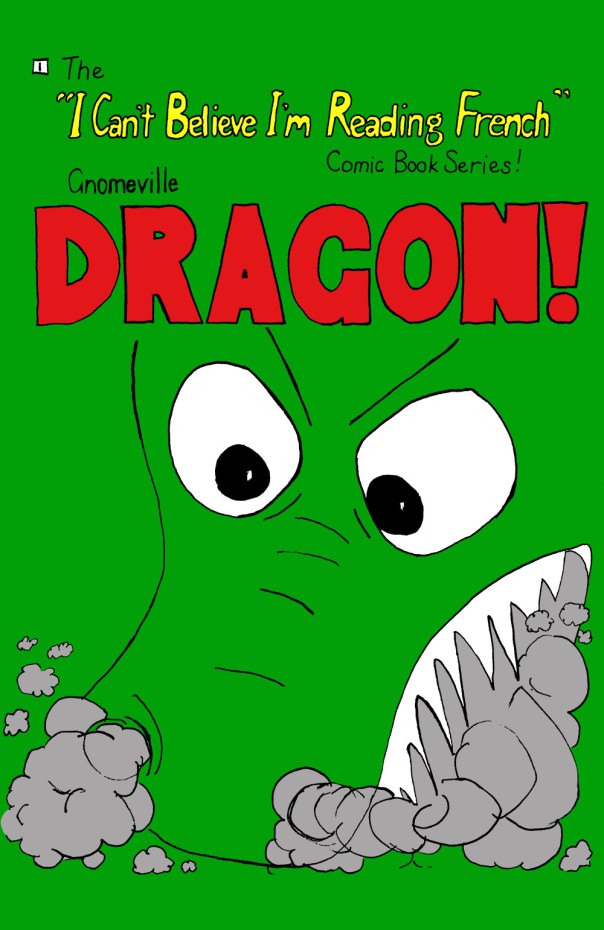
The “I Can’t Believe I’m Reading French” Comic Book Series, Episode 1: Gnomeville: Dragon!

Gnomeville comic book cover containing head of dragon with smoke billowing out of its mouth and the title "DRAGON!" in large red letters

  • 28-page booklet plus audio CD containing 3 stories in comic book format, a crossword, a song and a language summary.
  • Assumes no prior knowledge of French but a native or near-native English speaking background.
  • Introduces 12 of the twenty most commonly occurring words in French newspapers, one new word per page of the Gnomeville story.
  • Uses the words that are common to French and English to ensure that all words in the stories are familiar, such as “dragon”, “gnome”, “arrive”.
  • The Fido story provides further reading practice, ensuring each target word has been read at least 5 times.
  • The crossword allows you to actively use the language to increase retention
  • The songs provide further practice, including pronunciation
  • The narration provides pronunciation information and listening practice
  • The Taxi story is a nice easy story to read after the other stories.
  • The audio CD contains the stories read by a native speaker, plus two songs related to the stories.
  • $20 plus postage from Melbourne Australia
  • Currently only available from me directly, but stay tuned for updates.

Green Eggs and Ham

Continuing my articles on easy readers, today’s post is dedicated to Dr Seuss.  His first constrained vocabulary book was The Cat in the Hat, which was released in 1957.  It had a vocabulary of 236 words (though other sources state slightly different numbers) , and yet was entertaining.  Dr Seuss then went on to write other books with a reduced vocabulary, including Green Eggs and Ham, which has only 50 different words.  Wikipedia lists the words used as: a, am, and, anywhere, are, be, boat, box, car, could, dark, do, eat, eggs, fox, goat, good, green, ham, here, house, I, if, in, let, like, may, me, mouse, not, on, or, rain, Sam, say, see, so, thank, that, the, them, there, they, train, tree, try, will, with, would, you.

These books are truly brilliant, in that they make children want to keep reading, while being easy for them to read.  A 50 word vocabulary is an amazing achievement.

Green Eggs and Ham has been translated into many languages.  We have a copy in Italian: “Prosciutto e uova verdi”.  However, once translated, the number of distinct words increased to about 127.  A translator has to somehow convey the original story as well as the rhyme and rhythm.  I’m not sure if the translator considered the goal of using the smallest vocabulary possible, as 127 for a text length of 620 words seems quite high.

I’m reminded of a section in the book “Gödel, Escher, Bach: an eternal golden braid” by Douglas Hofstadter, which looks at German and French translations of Lewis Carroll’s Jabberwocky poem.  The original has many made-up words that hint at meanings due to their phonetic similarity to other words.  For example “slithy” hints at “slimy” and “slither”, among other words.  It is translated to “lubricilleux” in the French and “schlichten” in the German version.  Combining made-up words with rhyme and meter makes it a very difficult translation challenge.

But back to easy readers.  While it may be useful to translate an easy reader to another language – particularly when they are as entertaining as those of Dr Seuss –  I think the best work can be achieved by exploiting the quirks of the original language.  Design your easy reader for your specific target language.


Writing Easy Readers

There has been a lot of research over the past few decades on the use of extensive reading for language learning, with Paul Nation being a prominent name in the research community.  Out of all this research has come some general guidelines on how to use extensive reading to improve your language learning skills, but also how to write or adapt stories to suit language learners.  Here’s my version of the basic requirements.

  1. Decide what your core vocabulary will be, for example 1,000 word families.  You may also want to decide what grammatical repertoire you are going to include – at least for lower levels of language skill.
  2. Decide whether you want to teach a particular set of vocabulary in the story (eg. colours).
  3. Ensure that at least 95% of the text consists of words from your core vocabulary or proper nouns.
  4. For words in your original draft that are outside of the core vocabulary, consider changing them to ones that are within the core vocabulary.
  5. For the remaining out of vocabulary words that occur less than 5 times (say) in your story, provide a gloss.  (Also for any idiomatic expressions.)
  6. For words that you want to teach, ensure they occur at least 5 times in the story, but in a way that doesn’t ruin the story.  It would be better to have fewer occurrences than to make the story less entertaining.
  7. Use illustrations, as they help the learner retain meaning.

Here’s a vocabulary checker for stories in English.

Easy Reader Hall of Shame

Having finished reading yet another boring German easy reader, I thought I’d dedicate today’s post to easy readers that should never have existed.

Authors of easy readers are trying to trick language learners into learning target language while being entertained with a story.  However, some authors don’t do enough entertaining, and it is transparently obvious that the story (or part of it) is just a vehicle for exposure to vocabulary or, in the case of CEFR-based books, practising common scenarios required for surviving in the target language.

So here is my list of the worst easy readers I’ve read:

  1. “Sur les Routes de France” by G. Colquhoun and E. Guergady, published by John Murray, (French).
    Not only was this boring but it was long: 137 pages of tedium.  It is basically a story of a family going on holiday in France, following their trek through different locations.  I read this over a number of weeks as it took enormous willpower to finish it.  Happily this is out of print.  I thought that I must have the last copy in the world, but a quick Google search reveals that there are second-hand copies on the market.  What amazes me is that this work, that was first published in 1959, got reprinted several times.  I have a second edition copy from 1964, but I see on-line that there was a 1973 3rd edition .  That means that at least 14 years of students had to suffer this text!  Steer clear of this one.  There are many better stories to read.
  2. “Lustige Dialoge” by Harry A. Walbruck, published by National Textbook Company in 1985 (German).
    This contains 30 short dialogues that are “humorous”.  My Goodreads review states it succinctly: “Full of annoying anecdotes involving dated stereotypes passed off as humour. I really struggled to finish the book.
    To be fair, some of the dialogues were somewhat humorous, but for the purpose of providing extensive reading material it fails, as the individual dialogues are too short, and there is no motivating reason to read the next one.
  3. “Deuxième Acte” by O.M. Fordham and V.L.R.Lewis, published by Harrap in 1965 (French).
    This book is a sequence of letters written between members of two families.  The content of the letters, as well as the dialogues in the back of the book are very mundane.  It was another book that was difficult to finish, but was mercifully short (compared to no. 1) at 76 pages, including exercises that I tend to skip over.  One thing that I have found too many of is stories of typical traditional nuclear families doing ordinary things, such as the mother in the kitchen or doing the shopping, the father coming home from work, blah blah.  Admittedly some of these books are old, the authors of the various books probably didn’t know of each others work, and the average student wouldn’t have been exposed to more than one of these, but I’m rather sick of the genre.
  4. “Glück gehabt” by Theo Scherling and Elke Burger, published by Langenscheidt in 2010 (German).
    There are many other books I could list that are like no. 3 in their irksomeness, but I’ve decided to go for variety rather than comprehensiveness.  Langenscheidt do a good job at making their text and their audio easy.  They also do well in avoiding stereotypes for their characters.  For example, in Leo & Co, one of the regular characters is a single mother who is a car mechanic, working with her dad, while Leo himself is an artist who runs a pub/eatery.  On the down side, the stories are a bit on the mundane side, with this particular one being the worst I’ve read so far.  The story mostly follows the lead character in the act of getting a new apartment.  While listening to it I kept waiting for the plot to start, but nothing really happens other than finding out about an apartment, getting it, then moving into it, with a small side story of a colleague hurting their back.  Skip this one unless you’re desperate for the practice.
  5. “Technik und Natur” by Mike Lynch, published by Heinemann 1996.
    I’ve chosen this reading booklet as an example of another problem that often occurs with supposedly easy readers.  Some authors control the grammar but use far too much difficult vocabulary.  This particular booklet has interesting subject matter for those interested in science and technology, but the percentage of difficult words is too high.  There is vocabulary support, but text should really be written in a way that less than 5% of the words require it, since it interrupts the flow of reading.

I think that will do for now.  So the moral of the story is, when writing for language language learners:

  • Don’t be boring,
  • Optimise the length of the text to allow a good reading session,
  • Don’t inundate with vocabulary.

It is possible to do the above.  There are many examples.  I love some of the stories in the Découverte series, such as “Dans la Maison Bleue”, which are full of imagination, and have illustrations that complement the stories.  Here’s hoping there are more interesting books in the future.  I hope mine will also be enjoyed.  I’ve had good feedback so far.

Easy Readers

I’m a big fan of Extensive Reading as a means of improving one’s foreign language skills, due to it providing large quantities of language exposure – particularly useful for when the language you are learning is not spoken where you are living.
I’ve collected and read many books that were written for language learners, and would like to impart my opinions and advice for others wanting to learn by reading.
The two factors to consider when choosing text to read is its difficulty and its interest for you. If you don’t find it interesting then it will be hard to continue reading it. If it is too difficult you also won’t want to keep reading.
Text difficulty has two main factors: vocabulary and grammar. Many publishers state a vocabulary size for the books in their collection. The smallest vocabulary available is about 100 words (for example, ELI primary school age series level A0), and the largest tends to go to about 3500. Grammar difficulty tends to increase with the vocabulary level, with the easiest levels sticking to present tense, and higher levels adding more tenses and grammatical subtleties.
Ideally you should know 95-98% of the words in the text you are reading, i.e., there should only be one word in 20-50 that you don’t already know. This allows you to guess meaning from context and also not be too frustrated while reading. Publishers and writers vary in terms of how well they control the vocabulary in the texts.

My recommendations amongst currently available books at the early levels are:

Absolute beginners:
For English speakers wanting to learn French: Gnomeville. It assumes zero French knowledge, but good English knowledge.
ELI A0 (available in French, German, Italian and Spanish) – though beware – the same stories are in each language, so if learning multiple languages be selective. The stories by Jane Cadwallader cleverly introduce vocabulary as an integral part of the story – unlike some other stories out there that interrupt the narrative with contrived situations for vocabulary introduction.
150 words: La Spiga is cheap and fairly simple, but tends to have very little suspense.
200 words: ELI A1.1
300 words: ELI A1.2, teen readers A0 300 words
400 words:

  • ELI A2 primary school series. The teenage and adult series are much harder and less engaging – at least the two I’ve looked at are.
  • Teen readers 400 words

Among series that don’t state a vocabulary size I recommend CLE’s Collection Découverte for French. It has 6 levels and interesting stories. Hachette also do some fairly good stories in their Lire En Français Facile series.
In German, Langenscheidt publish a range of readers. I find the Leo & Co ones a little dull, but I still read them. I like the Inspector Müller series a bit better, but my favourite German reader is Kopftuch published in the Teen Readers series.

Many readers in European languages now state CEFR levels rather than vocabulary/grammar levels. For example A2 CEFR level can have readers with vocabularies of 400-1200 and also abridged native texts (with some vocab support). This is largely due to the way the levels are defined, which is based on practical skills rather than grammatical and vocabulary knowledge. However, as learners we really want a gentle transition between levels, and that is partly achieved by progressing up slowly through different vocabulary levels (and grammar levels) in our reading. Among series that only state a CEFR level, the CIDEB series contains some good stories. I found the vocabulary more difficult than Teen Readers of the same CEFR level, however.

For readers that assume English language knowledge, the Cambridge Serie Rouge is good, as are books pubished by EMC and the National Textbook Company (eg. Aventure in Normandie). Some of these are no longer available. Likewise, my favourite easy French reader, originally published by Mary Glasgow publications: Le Chapeau Rouge: Le Chien Disparu.
Aquila publishes good readers too, but do not sell to individuals.

If you want to see my ratings for specific books, head to: Goodreads user Dr Dabbler. In the end it doesn’t matter too much what level of text you’re reading, as long as you keep reading.

What I have learnt from reading stories intended for language learners is that a good story should have suspense and seamless vocabulary introduction. I apply this to my comic books, which are going for the niche of people with English language at a native/near-native level, and are beginning to read French. I’ve taken the tip from comics like X-Men and series like Dr Who, by having a cliff-hanger at the end of each episode, to encourage the learner to read the next episode. I’ve written 3.5 episodes so far and published three of them. La saga continue!