While searching for books that are simple enough for me to read in Japanese, I’ve been musing about the attributes that make these suitable for language learners.
If starting from scratch you need repetitious text with obviously illustrated nouns. This describes some of the books I purchased. The downside of the simplest books is that they become an illustrated list of nouns (or adjectives like colours), and therefore have no narrative.
In Japanese you have the added complication of the writing system. Beginner books use hiragana only. Then there are some that have katakana with hiragana transliterations. Then there are a few that use both the alphabets without guides. At the next level kanji are included with hiragana guides. The level of support for kanji varies.
All posts by Sandra Bogerd
Recent language learning experiences.
Recently I sat my French B1 exam. In preparation I had conversations with colleagues and friends in French over a few drinks, switched my various gadgets and accounts to French, read books in French, did a few exercises from textbooks, revised a few points of grammar, tried duolingo, and did some practice exams. Looking at my results, my main weakness is speaking. My French colleague says that my main problem is being hesitant. Add a few drinks and I’m more fluent.
Currently my obsession is Japanese, while I’m in Japan for a conference. I’m getting a bit better at katakana and kanji thanks to repeated efforts at reading signs.
Constrained Writing
In 1996 I first heard about a book written without the letter E (Gadsby, by Wright, published 1939). Then a couple of years later I met a French colleague and was telling him about my comic book in French that exclusively uses French-English cognates and one new French word per page. It reminded him of constrained writing, particularly “lipograms”, and he introduced me to the work of Georges Perec, who wrote various works with or without certain vowels. We exchanged DNA poetry. More recently I dabbled in pilish, adding the constraint of writing in haiku verses.
A recent blog post about OULIPO reminded me about my fascination with such things.
The experience of writing my comic in French is quite different to my dabblings in German and Dutch, due to the differences in cognates (similar looking words with similar meaning) in the different languages. In French it is hard to generate much text initially, but there is soon an abundance of identically spelt nouns, adjectives and verbs (albeit with slightly different endings). In Dutch and to a lesser extent in German it is possible to write 20-odd words of meaningful text entirely using exact cognates. But eventually you hit a wall where there are not many verbs to work with. I’m still figuring out how to get past that wall before I commit to drawing the (publishable) artwork for and publishing a first episode in those languages.
Mots Croisés (Crosswords)
I was recently in Perth for a couple of weeks, so made the most of the opportunity to visit le forum in Fremantle. It is a lovely little French bookstore in an almost abandoned small shopping mall at the edge of the shopping area of the city.
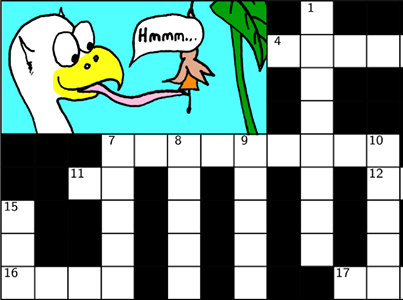
I came away with a large bundle of books, mostly for reading as a foreign language, but also a couple of crossword books for children. People may have the impression that crossword books for 8-year olds would be easy for language learners, but that is not the case. Children seem to be exposed to and know many more nouns than the typical language learner. I worked my way through a few crosswords in my new Mots Fléchés book for 8-year olds and it revealed the huge gaps in my vocabulary. Each crossword had a particular theme. I did ok on common animals (lion, tigre, zebre, léopard, éléphant), European cities and words about Asia (sumo, sushi, sari, panda), but completely failed on words about the snow, medicine or the kitchen.
My other purchase, “Jeux de mots” for 8+, was easier, due to the dense French-style crossword grids that have clues like “the first and 4th letters of the alphabet”, “double vowel”, “the first two letters of italien”, “the second person singular of the present tense of avoir”. (I’ve translated the clues here.) These provide lots of hints for the other words of the puzzle. There were also many more core vocabulary words like man, woman, place, with, pretty etc.
I’ve done other crosswords in French or for French in the past. One book starts with small crossword triangles with simple words up to 3 letters long and 3 clues in total, and works its way up to 12 by 12 grids and the more difficult verb tenses. I seem to have lost the original though, so I can’t tell you its name or publisher. ELI has a book entitled “Jeux faciles en français”, which is for primary school children. They have a page of vocabulary, such as the numbers from 1 to 10, then a join the word to the item, followed by a crossword and word search. This pattern repeats for each set of vocabulary. I remember enjoying this kind of activity as a 5-year-old, so perhaps it works for young kids.
I have a couple of books of vocabulary games including crosswords by Maurie N. Taylor, published by the National Textbook Company. These are for English-speaking students of French, and are not immersive, but can help cement vocabulary. However, I think that given the amount of vocabulary and language knowledge assumed in the books, that less English could have been used in the book to give more practice.
I also do crosswords in Dutch sometimes. The children’s ones are possibly marginally easier for me than the simplest adult ones, but again, the adult ones usually provide more cross-clues, which offsets the slightly more difficult language.
I believe it is possible to create immersive crosswords for use at the earliest stages of language learning – certainly for European languages. I do this in my comic book. The crossword uses the episode’s target vocabulary and incidental cognate vocabulary, as well as the sentences in the story that have just been read, to provide reading practice and vocabulary production practice without reverting to English.
My first sale
All the Drama
I’ve been reading a lot of easy readers in French and German of late, and some of the recent ones are of the Lectures CLE en français facile series. I’m now at a point where reading the 500-600 word vocab ones are easy enough for the story to be enjoyed.
In the past I’ve not looked forward to reading abridged and adapted versions of classics, either because I wanted to read the original at some point, or just because I found them uninteresting. However, I’ve changed my mind. The CLE 500-word vocabulary adaptations of En Famille (by Hector Malot) and La Guerre des Boutons (by Louis Pergaud) were both thoroughly engaging. I’m now reading Jacquou le croquant by Eugene le Roy, which is a 600-word vocab adaptation. There seems to be a lot of 19th century French literature about people living in poverty and hard times, and CLE has made it accessible to learners of French. I find the lengths of the books to be about right too, at about 50 pages of story – probably about 12,000 words all up.
I hope that I can find a similar resource for German.
Gnomeville Episode 1 is done!
Having given myself a hard deadline of Friday so it would be ready for launching at a concert of French music, it is done!
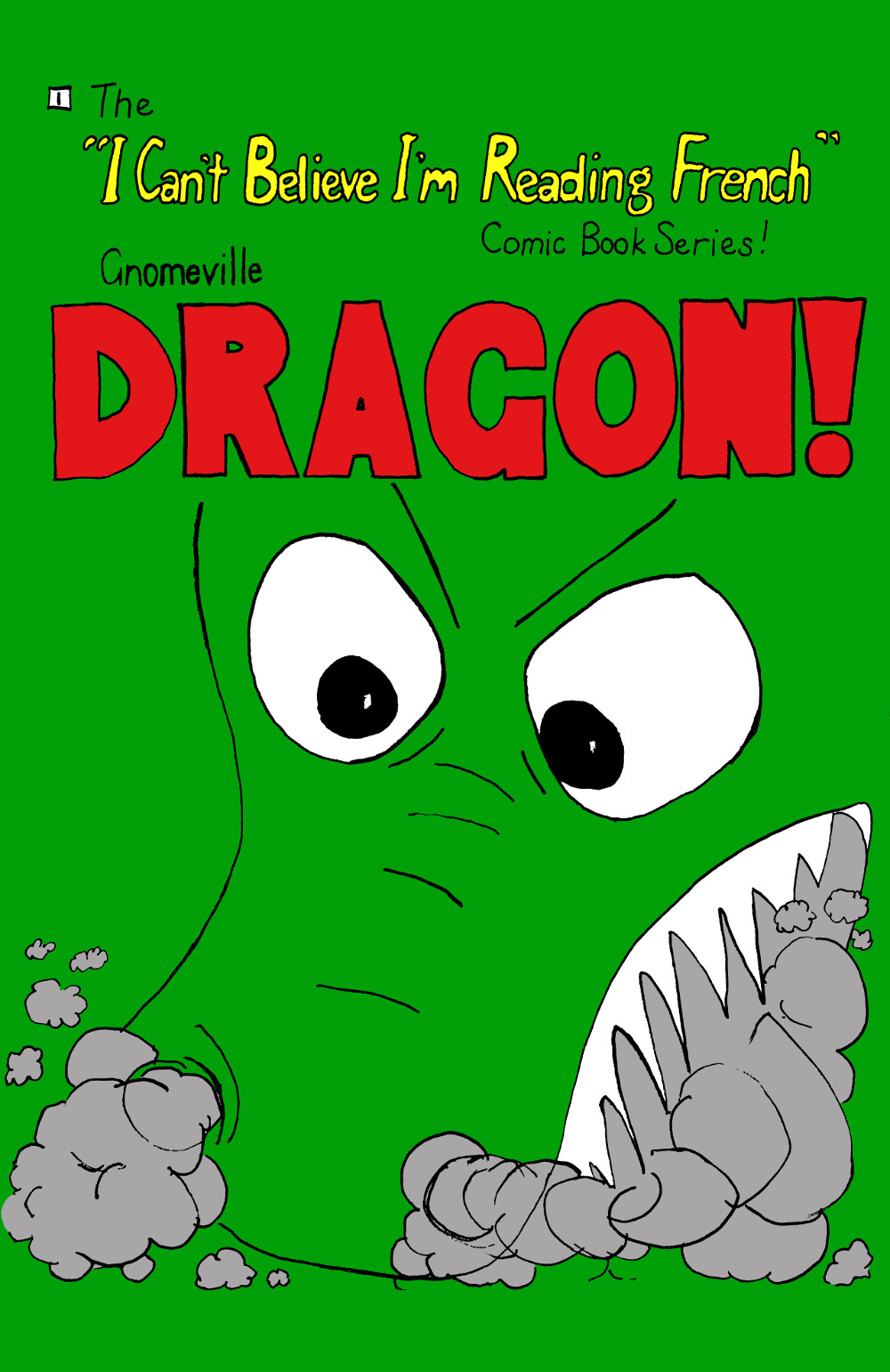
The “I Can’t Believe I’m Reading French” Comic Book Series, Episode 1: Gnomeville: Dragon!
- 28-page booklet plus audio CD containing 3 stories in comic book format, a crossword, a song and a language summary.
- Assumes no prior knowledge of French but a native or near-native English speaking background.
- Introduces 12 of the twenty most commonly occurring words in French newspapers, one new word per page of the Gnomeville story.
- Uses the words that are common to French and English to ensure that all words in the stories are familiar, such as “dragon”, “gnome”, “arrive”.
- The Fido story provides further reading practice, ensuring each target word has been read at least 5 times.
- The crossword allows you to actively use the language to increase retention
- The songs provide further practice, including pronunciation
- The narration provides pronunciation information and listening practice
- The Taxi story is a nice easy story to read after the other stories.
- The audio CD contains the stories read by a native speaker, plus two songs related to the stories.
- $20 plus postage from Melbourne Australia
- Currently only available from me directly, but stay tuned for updates.
Top French Movies
One of the ways that I pick up foreign language listening skills is watching movies and TV series in the language. For Italian I took it one step further in that I made bingo sheets of common expressions to encourage listening instead of just reading subtitles.
I will probably do the same for French at some point. Here is a list from 2011 that I found, of the top 10 French films.
- Bienvenue chez les Ch’tis
- La Grande vadrouille
- Astérix et Obélix : Mission Cléopâtre
- Les Visiteurs
- Le Petit monde de Don Camillo
- Corniaud
- Taxi 2
- 3 hommes et un couffin
- Les Bronzés 3 amis pour la vie
Oops, one missing from the top 10. Maybe I misunderstood the last paragraph of the article.
Green Eggs and Ham
Continuing my articles on easy readers, today’s post is dedicated to Dr Seuss. His first constrained vocabulary book was The Cat in the Hat, which was released in 1957. It had a vocabulary of 236 words (though other sources state slightly different numbers) , and yet was entertaining. Dr Seuss then went on to write other books with a reduced vocabulary, including Green Eggs and Ham, which has only 50 different words. Wikipedia lists the words used as: a, am, and, anywhere, are, be, boat, box, car, could, dark, do, eat, eggs, fox, goat, good, green, ham, here, house, I, if, in, let, like, may, me, mouse, not, on, or, rain, Sam, say, see, so, thank, that, the, them, there, they, train, tree, try, will, with, would, you.
These books are truly brilliant, in that they make children want to keep reading, while being easy for them to read. A 50 word vocabulary is an amazing achievement.
Green Eggs and Ham has been translated into many languages. We have a copy in Italian: “Prosciutto e uova verdi”. However, once translated, the number of distinct words increased to about 127. A translator has to somehow convey the original story as well as the rhyme and rhythm. I’m not sure if the translator considered the goal of using the smallest vocabulary possible, as 127 for a text length of 620 words seems quite high.
I’m reminded of a section in the book “Gödel, Escher, Bach: an eternal golden braid” by Douglas Hofstadter, which looks at German and French translations of Lewis Carroll’s Jabberwocky poem. The original has many made-up words that hint at meanings due to their phonetic similarity to other words. For example “slithy” hints at “slimy” and “slither”, among other words. It is translated to “lubricilleux” in the French and “schlichten” in the German version. Combining made-up words with rhyme and meter makes it a very difficult translation challenge.
But back to easy readers. While it may be useful to translate an easy reader to another language – particularly when they are as entertaining as those of Dr Seuss – I think the best work can be achieved by exploiting the quirks of the original language. Design your easy reader for your specific target language.
Writing Easy Readers
There has been a lot of research over the past few decades on the use of extensive reading for language learning, with Paul Nation being a prominent name in the research community. Out of all this research has come some general guidelines on how to use extensive reading to improve your language learning skills, but also how to write or adapt stories to suit language learners. Here’s my version of the basic requirements.
- Decide what your core vocabulary will be, for example 1,000 word families. You may also want to decide what grammatical repertoire you are going to include – at least for lower levels of language skill.
- Decide whether you want to teach a particular set of vocabulary in the story (eg. colours).
- Ensure that at least 95% of the text consists of words from your core vocabulary or proper nouns.
- For words in your original draft that are outside of the core vocabulary, consider changing them to ones that are within the core vocabulary.
- For the remaining out of vocabulary words that occur less than 5 times (say) in your story, provide a gloss. (Also for any idiomatic expressions.)
- For words that you want to teach, ensure they occur at least 5 times in the story, but in a way that doesn’t ruin the story. It would be better to have fewer occurrences than to make the story less entertaining.
- Use illustrations, as they help the learner retain meaning.
Here’s a vocabulary checker for stories in English.