Tag Archives: French

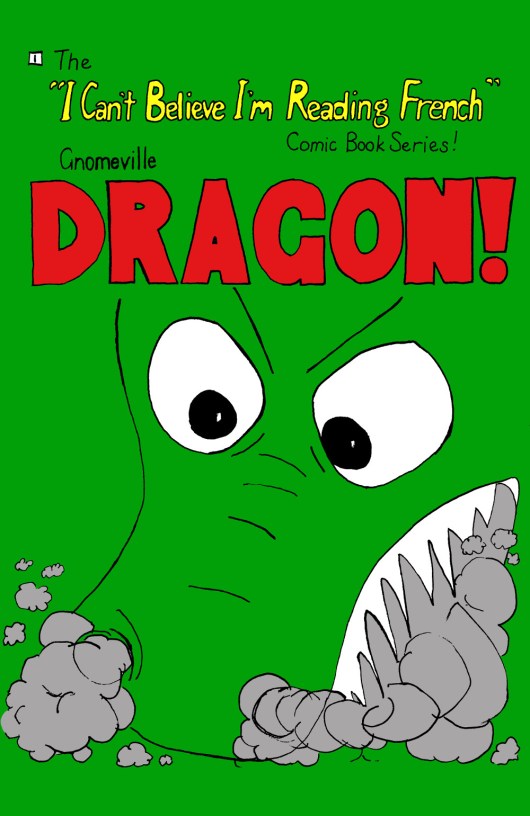
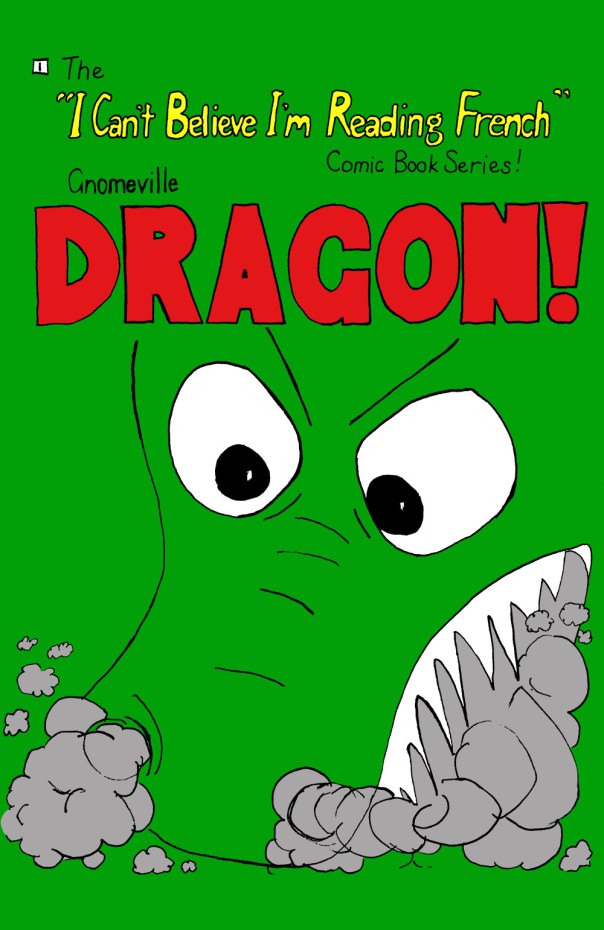
Gnomeville comic book cover containing head of dragon with smoke billowing out of its mouth and the title "DRAGON!" in large red letters

Episode 1 Progress

I’m very happy that people are starting to buy the ebook edition of my comic for learners of French with an English-speaking background. I’ve had purchases from UK, Canada and USA, as well as some kindle unlimited reads. It can be deflating when nobody buys the work you’ve put your heart and soul into, but then when they do, you are inspired to keep going with the vision.

On my Facebook page, I made a special offer for people who have read the comic book to write an Amazon review in order to receive a free copy of the narration by native French speaker Jeremy Marozeau.  This offer expires at the end of the month.

It’s also not too late to receive all audio tracks on mailing magnifica@gnomevillecomics.com the Amazon kindle receipt showing purchase of episode 1.

Meanwhile, the first additional resource for episode 1 is now available. I decided to focus on fashion and celebrity for this one.  It’s mainly pictures and links to articles in French about “le total look”. I hope it’s useful for beginners in French with an interest in fashion.

Where’s the Quality?

As a conscientious writer with an academic background I tend to try very hard to write correctly in all my publications and communications. Obviously sometimes one is rushed or typing on a small smartphone, so a few typos get by the self-editing phase. Occasionally I’m surprised at myself that I have typed the wrong spelling for a word, such as “their” for “they’re”, when I know very well the correct word to use, but in my haste the wrong word came out of my fingers. This seems to happen even for parts of words, where I always mistype some words the first time because they contain a sequence of characters that occurs frequently that leads me to follow with an incorrect one. An example for me is words that end in “in”, which will often automatically get a “g” after them, which I then need to backspace.

Some people don’t care about editing, and so be it. However there are some situations when I think it is our responsibility to be as correct in our writing as we can be. One of those situations is in resources for language learners. I have learnt through my attempts to write in another language that it is nearly impossible to write like a native speaker of the language. Languages are just too large to know all the phrases and collocations, let alone the vocabulary and grammar that most people manage to master. So, if you care about quality then the thing to do is to have a native-speaking proof-reader for your work. Some of the books in my collection have clearly made use of colleagues to do language checking, and that gives me a bit more faith in the authenticity of the language that I’m being exposed to. But in my recent scan of language books on Smashwords I was horrified at the poor quality writing, even just in the introductory blurb. There were some very poorly written English stories aimed at the Chinese ESL market. On the plus side, Chinese students of English would find them easier to read than stories with more English-like English, but it doesn’t give them the chance to absorb correct English grammar as they read. Likewise I found a Canadian book in French that, even with my B1-level French I could tell had incorrect grammar in the blurb.

So, advice to those writing stories for language learners (and anyone wanting to write as well as possible in a foreign language):

  1. Write stories in your own native (or best) language. It’s more likely to be correct.
  2. If you write in a foreign language (as I do), then it is imperative that you have a native speaker check it for you. You can’t trust (old) dictionaries, or sometimes even textbooks, to help you write correctly.
  3. Some techniques that can help you write correctly (before you get it checked) is to use a corpus-based dictionary, a concordancer, and a search engine. Check that words you want to use are actually used in the way you intend. Check the preposition that is normally used.
  4. Software is being developed that helps users improve or check their writing. MS Word has a grammar checker, so it can be useful for checking (but you can’t rely on it completely). Other prototype systems are being developed, some of which I saw at CoLing 2016 in Osaka recently, and another at the English Australia 2016 Conference in Hobart. Use the tools available to you.

The first time I had a near-native speaker check my comic book draft it was an eye-opener. I learnt that I couldn’t trust my old Cassells French-English dictionary, and that I couldn’t trust my high school textbook. The second (or was it third) time I had a native speaker read through the story she picked up an error that the first proof-reader didn’t. The final proof-reader was my narrator, who only remarked upon one phrase which remains in the comic “Le total?”, which occurs when a native speaker is more likely to use the expression “l’addition”. It is grammatically and semantically correct but unusual. I’ve allowed that expression to remain.

The sad thing for those who aim for quality writing is that there is possibly not much reward in it. There are many stories on Amazon and Smashwords that are full of grammatical errors, but they probably still earn dollars. Producing quality work takes more time and effort. Hopefully my comic book will find its audience that recognises the quality of the work and that it is worth the cover price.


Gnomeville eBook is Finally Here!

After many years in development, and release in physical form in 2014, my comic is finally available as an eBook.

Gnomeville comic book cover containing head of dragon with smoke billowing out of its mouth and the title "DRAGON!" in large red letters
Cover of Gnomeville Dragon! Episode 1.

This is the first episode in what is arguably the easiest book in French for native English speakers. Designed to introduce one or two new words or concepts per page, and to exploit the over 1,000 words that are the same in French and English, you learn the most frequently occurring words in French, while being entertained with a story about gnomes, mages and dragons. While the series is optimised for language learning, by using sight gags and visual humour it still manages to be entertaining from the first few pages. Follow the story of Jacques, Magnifica the mage, the gnomes Didi and Dada, and the griffon as they commence a quest to capture a rogue dragon.

The book includes further stories to reinforce the vocabulary learnt so far, as well as a crossword and songs. The mp3 file of the narration by a native French speaker of the Gnomeville Episode 1 story is available from the author on email of the receipt as proof of purchase (first 500 buyers). The first 10 customers will receive all audio tracks of Episode 1 (3 stories, 2 songs), while the first 100 customers will receive the narration and one song.

The comic book has been checked by three native/near-native speakers of French to ensure authenticity. It exploits several principles of language acquisition:

  • language can be acquired by reading extensively at a comfortable level of difficulty;
  • images increase retention of language;
  • glosses increase vocabulary retention;
  • repeated occurrences of new vocabulary increase vocabulary retention;
  • comprehension-based activities (eg. crossword) related to the reading improves retention of language;
  • once ~95% vocabulary coverage is achieved (episode 2), then it is possible to guess the meaning of new words, and confirm by checking the gloss after guessing, which further increases vocabulary retention.

In summary, this is a well-researched, well-edited, entertaining introduction to reading French via an extremely easy to read comic book. Read it before you read anything else in French. Read it now!

Children’s Books

In my French reading, partly to continue using extensive reading, and also partly research for my writing of comic books in French, I’ve started reading more children’s books.  The J’Aime Lire series from Bayard was an excellent place to start.  They publish for specific ages: 6, 7, 8, 9, etc.  While the difficulty for a foreign language learner varies sometimes, the books for 6-8 year-olds mostly work for me, and seem to match a ~1000 word vocabulary or A2/B1 level.

One thing I found with reading children’s fantasy novels is that they are very vivid, and it is easy to become engrossed in this fantasy world, with a feeling of wonder.  I had the same experience when reading the first volume of Harry Potter (and as a child when reading Enid Blyton).  My comic book also has this vividness about it – partly because it is a brightly-coloured comic book.  I’m not sure if it is the fantasy element, the illustrations or a property of the writing that makes it so.  In the case of Harry Potter it can only have been created via the text, as I read it before seeing any movies of it.

Easy Reader Genres

I’ve been taking part in the Tadoku competition again this month, in French, Japanese and German.

My Japanese is pretty basic, so I’m reading beginner readers that have only a couple of sentences on each page at most, with the majority of them being repetitious in order to give practice at certain phrases.  Only a few of these are particularly enjoyable in terms of text content: The Shinkansen series previously published by Heinemann are good.  The DEE Publications readers are good practice and have nice illustrations, but can’t be classed as particularly entertaining.  The interesting part of those books are actually the cultural notes at the end in English.  Some Japanese little books for very young children that I acquired in Japan are amusing, partly for their innovative layout (Inai inai baa!).

In French I’ve been reading books at the 700-1000 word vocabulary level, plus a few other books of a similar level of difficulty.  After reading quite a few books for adolescents about adventures and mysteries etc, I seem to have hit saturation point with the genre.  I’m still enjoying crime mysteries and some classic stories (though not all), but my new interest is stories from Africa.  There is a series of African stories published by Heinemann in 5 levels of difficulty.  I stumbled across these when visiting a Dutch shopping site, and ordered a couple at Niveau 3 to try.  They are a refreshing change from the fodder I’ve been reading recently.  They don’t pull any punches though.  I’ve read La Valise Ensorcelée, which has an element of magic to it, as well as a moral.  I’ve also read “L’usine de la Mort”. This book shocked me a little, but I’m glad I read it.  I don’t think it’s great literature by any stretch, but certainly interesting, moving, and sufficiently different for the jaded easy reader reader.  As a result I’ve bought more books from the series.

An extract of my French comic book is now available

I have finally produced an extract of the comic book for people to look at.  It contains 12 of the 28 pages, with images reduced to readable low resolution.

The extract contains all the text that explains the rationale for the approach, as well as showing a summary of the language covered in the first episode.  There are 3 pages of the Gnomeville story in the extract.  The first two show how the story begins with no prior French knowledge, and how the language is introduced.  The third page shows how the text increases in complexity and length later in the story, with a very short word definition on the page, so that the person reading is not slowed down too much in their reading in French.

Note that the extract doesn’t show the true page format, as it is an ordinary A4 pdf file, whereas normally the pages are processed into book form, re-numbered appropriately and trimmed to size.  The story pages are colour right to the edge of the paper in the physical copies.

Top French Movies

One of the ways that I pick up foreign language listening skills is watching movies and TV series in the language.  For Italian I took it one step further in that I made bingo sheets of common expressions to encourage listening instead of just reading subtitles.

I will probably do the same for French at some point.  Here is a list from 2011 that I found, of the top 10 French films.

  1. Bienvenue chez les Ch’tis
  2. La Grande vadrouille
  3. Astérix et Obélix : Mission Cléopâtre
  4. Les Visiteurs
  5. Le Petit monde de Don Camillo
  6. Corniaud
  7. Taxi 2
  8. 3 hommes et un couffin
  9. Les Bronzés 3 amis pour la vie

Oops, one missing from the top 10.  Maybe I misunderstood the last paragraph of the article.

Pronunciation songs

While preparing my choir for a concert of French music I have been inspired to write some rounds and short songs in French to help choristers to produce the correct vowel sounds, and to have a bit of an idea about how to pronounce French.  I’ve written one round for each vowel so far, and am now writing songs for various consonants.  Today I finished a song for the letter G.  I’ll probably publish these as a booklet for choirs and classes.

Language Qualifications

As I write a comic book in French for language learners I thought it would be a good idea to update my qualifications.  A long time ago I did senior high school French and the corresponding Alliance Française exams.  A few years ago I did a few courses at the Alliance Française.  This year I sat the (CEFR) A2 exam – a fairly low level exam just so I could see how it all works, and because I haven’t done an exam for a few years. 

Europe has a set of standards for language skill, known in English as the “Common European Framework of Reference” (CEFR).  The 6 levels go from A1 to C2, and reflect practical skills in listening, speaking, reading and writing, rather than just grammatical skills.  I hope to do the B1 exam soon, which is still a lower level than expected by international students entering TAFE in Australia, so I have a bit of a way to go.  B2/C1 is needed for tertiary study.

http://en.wikipedia.org/wiki/Common_European_Framework_of_Reference_for_Languages