Tag Archives: comics

Gnomeville eBook is Finally Here!

After many years in development, and release in physical form in 2014, my comic is finally available as an eBook.

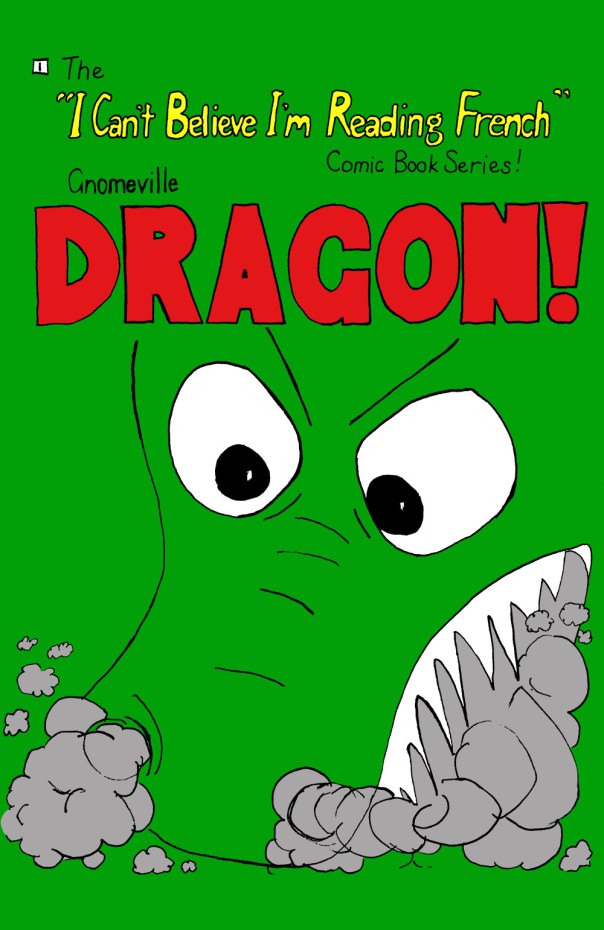
Gnomeville comic book cover containing head of dragon with smoke billowing out of its mouth and the title "DRAGON!" in large red letters
Cover of Gnomeville Dragon! Episode 1.

This is the first episode in what is arguably the easiest book in French for native English speakers. Designed to introduce one or two new words or concepts per page, and to exploit the over 1,000 words that are the same in French and English, you learn the most frequently occurring words in French, while being entertained with a story about gnomes, mages and dragons. While the series is optimised for language learning, by using sight gags and visual humour it still manages to be entertaining from the first few pages. Follow the story of Jacques, Magnifica the mage, the gnomes Didi and Dada, and the griffon as they commence a quest to capture a rogue dragon.

The book includes further stories to reinforce the vocabulary learnt so far, as well as a crossword and songs. The mp3 file of the narration by a native French speaker of the Gnomeville Episode 1 story is available from the author on email of the receipt as proof of purchase (first 500 buyers). The first 10 customers will receive all audio tracks of Episode 1 (3 stories, 2 songs), while the first 100 customers will receive the narration and one song.

The comic book has been checked by three native/near-native speakers of French to ensure authenticity. It exploits several principles of language acquisition:

  • language can be acquired by reading extensively at a comfortable level of difficulty;
  • images increase retention of language;
  • glosses increase vocabulary retention;
  • repeated occurrences of new vocabulary increase vocabulary retention;
  • comprehension-based activities (eg. crossword) related to the reading improves retention of language;
  • once ~95% vocabulary coverage is achieved (episode 2), then it is possible to guess the meaning of new words, and confirm by checking the gloss after guessing, which further increases vocabulary retention.

In summary, this is a well-researched, well-edited, entertaining introduction to reading French via an extremely easy to read comic book. Read it before you read anything else in French. Read it now!

An extract of my French comic book is now available

I have finally produced an extract of the comic book for people to look at.  It contains 12 of the 28 pages, with images reduced to readable low resolution.

The extract contains all the text that explains the rationale for the approach, as well as showing a summary of the language covered in the first episode.  There are 3 pages of the Gnomeville story in the extract.  The first two show how the story begins with no prior French knowledge, and how the language is introduced.  The third page shows how the text increases in complexity and length later in the story, with a very short word definition on the page, so that the person reading is not slowed down too much in their reading in French.

Note that the extract doesn’t show the true page format, as it is an ordinary A4 pdf file, whereas normally the pages are processed into book form, re-numbered appropriately and trimmed to size.  The story pages are colour right to the edge of the paper in the physical copies.

Constrained Writing

In 1996 I first heard about a book written without the letter E (Gadsby, by Wright, published 1939). Then a couple of years later I met a French colleague and was telling him about my comic book in French that exclusively uses French-English cognates and one new French word per page. It reminded him of constrained writing, particularly “lipograms”, and he introduced me to the work of Georges Perec, who wrote various works with or without certain vowels. We exchanged DNA poetry. More recently I dabbled in pilish, adding the constraint of writing in haiku verses.

A recent blog post about OULIPO reminded me about my fascination with such things.

The experience of writing my comic in French is quite different to my dabblings in German and Dutch, due to the differences in cognates (similar looking words with similar meaning) in the different languages.  In French it is hard to generate much text initially, but there is soon an abundance of identically spelt nouns, adjectives and verbs (albeit with slightly different endings).  In Dutch and to a lesser extent in German it is possible to write 20-odd words of meaningful text entirely using exact cognates.  But eventually you hit a wall where there are not many verbs to work with.  I’m still figuring out how to get past that wall before I commit to drawing the (publishable) artwork for and publishing a first episode in those languages.


Gnomeville Episode 1 is done!

Having given myself a hard deadline of Friday so it would be ready for launching at a concert of French music, it is done!

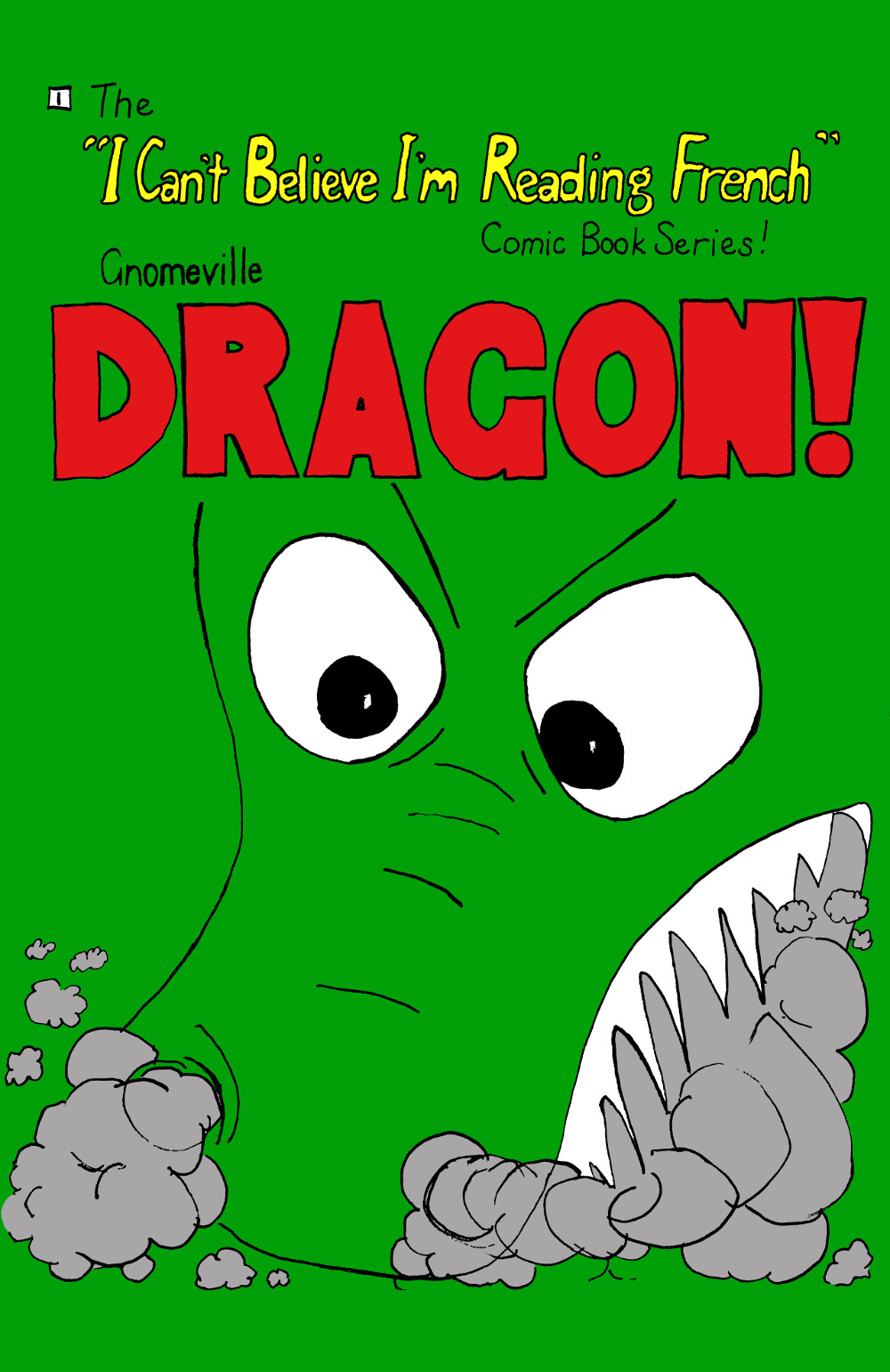
The “I Can’t Believe I’m Reading French” Comic Book Series, Episode 1: Gnomeville: Dragon!

Gnomeville comic book cover containing head of dragon with smoke billowing out of its mouth and the title "DRAGON!" in large red letters

  • 28-page booklet plus audio CD containing 3 stories in comic book format, a crossword, a song and a language summary.
  • Assumes no prior knowledge of French but a native or near-native English speaking background.
  • Introduces 12 of the twenty most commonly occurring words in French newspapers, one new word per page of the Gnomeville story.
  • Uses the words that are common to French and English to ensure that all words in the stories are familiar, such as “dragon”, “gnome”, “arrive”.
  • The Fido story provides further reading practice, ensuring each target word has been read at least 5 times.
  • The crossword allows you to actively use the language to increase retention
  • The songs provide further practice, including pronunciation
  • The narration provides pronunciation information and listening practice
  • The Taxi story is a nice easy story to read after the other stories.
  • The audio CD contains the stories read by a native speaker, plus two songs related to the stories.
  • $20 plus postage from Melbourne Australia
  • Currently only available from me directly, but stay tuned for updates.

Easy Readers

I’m a big fan of Extensive Reading as a means of improving one’s foreign language skills, due to it providing large quantities of language exposure – particularly useful for when the language you are learning is not spoken where you are living.
I’ve collected and read many books that were written for language learners, and would like to impart my opinions and advice for others wanting to learn by reading.
The two factors to consider when choosing text to read is its difficulty and its interest for you. If you don’t find it interesting then it will be hard to continue reading it. If it is too difficult you also won’t want to keep reading.
Text difficulty has two main factors: vocabulary and grammar. Many publishers state a vocabulary size for the books in their collection. The smallest vocabulary available is about 100 words (for example, ELI primary school age series level A0), and the largest tends to go to about 3500. Grammar difficulty tends to increase with the vocabulary level, with the easiest levels sticking to present tense, and higher levels adding more tenses and grammatical subtleties.
Ideally you should know 95-98% of the words in the text you are reading, i.e., there should only be one word in 20-50 that you don’t already know. This allows you to guess meaning from context and also not be too frustrated while reading. Publishers and writers vary in terms of how well they control the vocabulary in the texts.

My recommendations amongst currently available books at the early levels are:

Absolute beginners:
For English speakers wanting to learn French: Gnomeville. It assumes zero French knowledge, but good English knowledge.
ELI A0 (available in French, German, Italian and Spanish) – though beware – the same stories are in each language, so if learning multiple languages be selective. The stories by Jane Cadwallader cleverly introduce vocabulary as an integral part of the story – unlike some other stories out there that interrupt the narrative with contrived situations for vocabulary introduction.
150 words: La Spiga is cheap and fairly simple, but tends to have very little suspense.
200 words: ELI A1.1
300 words: ELI A1.2, teen readers A0 300 words
400 words:

  • ELI A2 primary school series. The teenage and adult series are much harder and less engaging – at least the two I’ve looked at are.
  • Teen readers 400 words

Among series that don’t state a vocabulary size I recommend CLE’s Collection Découverte for French. It has 6 levels and interesting stories. Hachette also do some fairly good stories in their Lire En Français Facile series.
In German, Langenscheidt publish a range of readers. I find the Leo & Co ones a little dull, but I still read them. I like the Inspector Müller series a bit better, but my favourite German reader is Kopftuch published in the Teen Readers series.

Many readers in European languages now state CEFR levels rather than vocabulary/grammar levels. For example A2 CEFR level can have readers with vocabularies of 400-1200 and also abridged native texts (with some vocab support). This is largely due to the way the levels are defined, which is based on practical skills rather than grammatical and vocabulary knowledge. However, as learners we really want a gentle transition between levels, and that is partly achieved by progressing up slowly through different vocabulary levels (and grammar levels) in our reading. Among series that only state a CEFR level, the CIDEB series contains some good stories. I found the vocabulary more difficult than Teen Readers of the same CEFR level, however.

For readers that assume English language knowledge, the Cambridge Serie Rouge is good, as are books pubished by EMC and the National Textbook Company (eg. Aventure in Normandie). Some of these are no longer available. Likewise, my favourite easy French reader, originally published by Mary Glasgow publications: Le Chapeau Rouge: Le Chien Disparu.
Aquila publishes good readers too, but do not sell to individuals.

If you want to see my ratings for specific books, head to: Goodreads user Dr Dabbler. In the end it doesn’t matter too much what level of text you’re reading, as long as you keep reading.

What I have learnt from reading stories intended for language learners is that a good story should have suspense and seamless vocabulary introduction. I apply this to my comic books, which are going for the niche of people with English language at a native/near-native level, and are beginning to read French. I’ve taken the tip from comics like X-Men and series like Dr Who, by having a cliff-hanger at the end of each episode, to encourage the learner to read the next episode. I’ve written 3.5 episodes so far and published three of them. La saga continue!