Category Archives: Reviews

These articles review books and language resources.

Review of Easy French Reader by Roussy de Sales

Here’s my Goodreads review of the book…

Three distinct sections in this reader, at different levels of difficulty.
1. Beginner French, with very simple grammar, but school vocabulary assumed. Progresses through the chapters. Not overly interesting.
2. History. Written in present tense. I enjoyed reading about the ancient history more than the modern. I had read some of these before in Roussy de Sales’s earlier publications, where these were separate books. Again, there is quite a bit of vocabulary here.
3. Famous short stories. These include perfect and imperfect tense, so grammatically suitable for the intermediate student. For some reason I don’t really enjoy these stories, though I think I understood more of them in my most recent reading than when I read them over 10 years ago in other editions.
There is still quite a vocabulary burden when reading these, so their suitability will depend on how comfortable people are with unknown words, and the size of their current vocabulary.

Further info on an extract of the text.

Chapter 1 is 87 words (tokens) and  43 distinct words (types), which makes a type-token ratio of 0.49, which is suitably low for beginners. This compares favourably with other beginner stories, like Bonjour Berthe, and Gnomeville Episodes 1 and 2, but is aimed at an older audience.

Chapter 1 gives a reasonable amount of repetition for de, est and il. Other words would need to be encountered more frequently to be acquired via reading.

In summary, it is good that these stories are still available, as they certainly have their place for French extensive reading.


Wordle

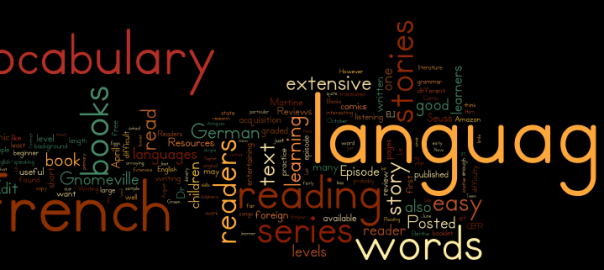
I’ve been playing with Wordle recently. It creates word clouds, showing the most frequently occurring words in a given block of text after a set of stop words, such as “the”, are removed, with font size indicating the relative frequency of words. It’s a fancier version of the tag cloud. Here is a wordle for my blog.

gnomevilleblog5

They’re pretty good at giving an idea of what something is about. Perhaps they can also help the language learner.

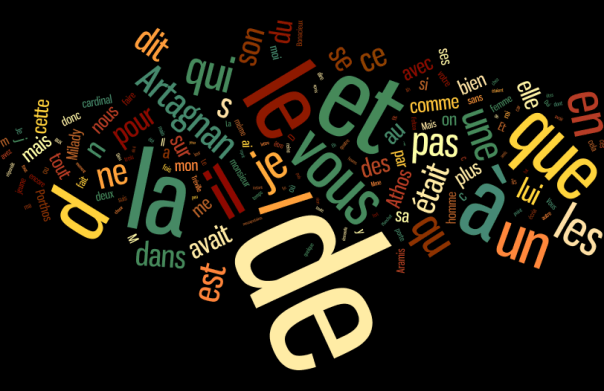
Here is a wordle word cloud for Les Trois Mousquetaires.

troismousq

This shows who are the main characters, and a few common words that don’t appear to have been excluded via the stop list. When no words are filtered, we get something like this.

troismousq_common

Really it’s just a pretty word frequency list, and frequency is one consideration for deciding whether a word is worth learning. If you want to get some idea of what are the important words to know for a particular text and you have the text handy, Wordle is an aesthetically pleasing way to find out.

Luc et Sophie – a review

In my recent exploration of graded readers intended for children, I found the Luc et Sophie series. I have the première partie, and read through all 14 booklets.

Each booklet has 6 pages of story, a page of vocabulary, and a colouring in page with blank speech bubbles. The text is entirely conversation, shown in speech bubbles. The booklets are neatly presented in full colour, with a consistent style across the series.

The first booklet “Bonjour” has ~33 words (tokens), and ~20 different words (types).  The average sentence length is 2.2 words (according to “style”). The last (14th) booklet “Où est ma trousse?” has 71 tokens and 37 types. The average sentence length is 7.3 words. The low type-token ratio (61% and  52% respectively) provides for sufficient repetition for language acquisition, and with a large set of booklets, they can provide good extensive reading practice in the early stages.

The stories centre around a brother and sister who are 7/8 and 6 years old respectively. The brother is annoying. The punch-line of the stories is usually something to do with the annoying brother.

I find the series generally annoying – perhaps it is reminding me of my own childhood and sibling issues. The artwork bugs me, but I’m not sure why. While it’s a comprehensive series, it is too narrow in style and theme for it to be the only books for children to read. I prefer the Berthe witch series (admittedly based on a sample of one book), but that could just be my preference for a touch of the magical and the unusual in stories. It would be best to have the class library contain a variety of stories to cater to different tastes – Luc et Sophie for the realists and Berthe for the dreamers, and hopefully other stories for yet other children. Gnomeville might fit into such a library, but may be a bit complex for the very young, due to the difficult French-English cognates (eg. se matérialise, utilise, vulnérable) in it. It seems to suit 11-year-olds well enough.

Bonjour Berthe! Charming Beginner French Stories

I recently bought a copy of Bonjour Berthe by Gwen Brookes, which is a beginner French reader aimed at young children. I found the book charming, and I believe it would appeal to children in early primary school.

The book is a soft cover pamphlet with glossy pages. There are 13 pages of story, with each page having a large illustration and 1-2 sentences. The font is large and the quantity of text is minimal, at approximately 80 words in total. The sentences are in present tense with simple structures. The vocabulary density is around 50%, which indicates enough repetition to allow some learning of vocabulary. However, the text is so short that the only words to get at least 5 appearances are “est” and “elle”, so many books would need to be read to provide learning purely from reading. Instead, the book includes activities (a wordsearch and a game) to improve vocabulary retention. All words are translated in a glossary at the end of the story.

If you are looking for books for early primary school aged children learning French, this series is a good choice.

Using Martine by Marlier for French Extensive Reading Practice

The Martine series was recently recommended to me for children learning French. I managed to purchase a couple of books from the series from FNAC. My review is of course biased by my own preferences in reading (and writing), and clearly I am not in the 5-12 age range for whom they were recommended, but hopefully it will be useful nevertheless.

I read Martine à la ferme, which is one of about 60 books in the series, which tell the adventures of Martine, a young girl. This particular book is about Martine visiting a farm with her friend Lucie.

From a story perspective, there is no driving narrative. It’s just a bunch of twee pastoral scenes with text. It is beautifully presented, and for children who love animals and dream of interacting with them, it may be an enjoyable experience. I found it dull, however.

From a language perspective, the series can be quite useful. It is authentic French in present tense, so great for learners to get reading practice without getting bogged down in passé simple. Plus, with 60 volumes to go through, that’s a good amount of practice at the level of the books – if you enjoy the genre.

There are 18 pages of illustrated text to read in the book, with about 60 words per page, making approximately 1000 words per book. The vocabulary and language appear to be sufficiently generic to be useful, and easier than other French children’s books I have seen in that regard. Sentences are fairly straightforward, and rarely longer than 15 words in length.

Vocabulary will be the main difficulty for foreign language learners. A sample of the first ~130 words had a vocabulary of 94 (including names and apostrophe’d words as separate words), making a vocabulary density of ~72% (unique words divided by total words). To put this into context, here are some vocabulary densities on the first ~100 words of other texts.

Consuelo 76%
Le Petit Prince 74%
Minnesota spoken corpus 68%
Gnomeville Episode 3 (not yet released) 58%
The French Bible 52%
Gnomeville Episode 2 46%
Gnomeville episode 1 43%

Basically, any normal native French text is likely to have a vocabulary density of about 75% in a sample of ~100. (The density typically drops a little as the length of the text sample increases.) Conversation (eg. Minnesota corpus) seems to be lower, and translations may also be lower. To get lower than that requires stories that are intentionally written with a small vocabulary, such as the Gnomeville comics listed above, and some Dr Seuss stories (in English) – especially Green Eggs and Ham.

So, in summary, if you are after authentic French text that has easy grammar, then the Martine series will be very useful for those who enjoy the genre. The books are also fairly short, allowing children to feel a sense of achievement in finishing them sooner than for a longer work like Le Petit Prince. Personally I would prefer to read more books that are specifically written for language learners until my vocabulary was large enough to read books that are more entertaining. The J’Aime Lire series of books for French children is much more entertaining and written for the 7-11 age group. The difficulty of the text does vary quite a lot though, depending on the author, so expect to occasionally struggle or skip stories. My current recommended sequence for primary-aged children is:

  1. Gnomeville series (for English-speaking background only)
  2. Mary Glasgow series (English-speaking background)
  3. EMC’s À l’aventure! Readers (English-speaking background)
  4. Aquila’s readers (English-speaking)
  5. CLE International’s Collection Découverte
  6. La Spiga Grand Débutant series (150 word vocabulary)
  7. ELI for children
  8. Martine or J’Aime Lire books

These are not a strict reading sequence, since the various series overlap in levels of difficulty (except Gnomeville). There are other series out there, such as CIDEB, Edition Maison des Langues. There are more books for adolescents, such as Teen Readers, and the adolescent FLE series by Hachette.

I will publish more detailed up to date lists as I become aware of more books and series. Stay tuned.


Two Great Language Acquisition Resources

German Extensive Reading Stories

I’ve recently been reading the ebooks by André Klein. He provides a collection of reading material in authentic German for beginners and intermediate learners, with comprehensive glosses of expressions used in the stories.

I have now finished reading the first four in his Dino lernt Deutsch series for beginners. I think they are a fantastic resource for German learners. Now, as a caveat, I must say that I’m a false beginner for German, since my Dutch background makes German pretty easy to understand, so how it reads for someone of purely English-speaking background or other language backgrounds I can’t comment.

Each book consists of ten short stories, but all follow the adventures of Dino, as he lives in and travels through Germany. I’m guessing the format is as it is, so that when commencing reading, the learner can feel that they have achieved something by reading one short story.

The stories are not greatly dumbed down, in that there are smatterings of dialect (also translated), which somewhat increase the load on the learner. As I’m generally interested in language, I find this quite interesting. However, it may make the stories somewhat more challenging for the beginner.

He also has a couple of picture story books. These have little text and the language is not necessarily easier in terms of vocabulary load and grammar. They are, however, pleasant reads. I think the language is somewhat more constrained in the Dino series, so they are probably more useful for extensive reading.

André Klein’s books are found on Amazon, Smashwords and elsewhere. He also has more language resources on his website.

French Listening Resources

I’ve been floating around some Facebook groups about languages lately. One provided a link to the series Extra French. I hadn’t come across this before, but for me it is entertaining, in sit com format, and simple enough to follow. It’s probably a good place to start for listening practice, other than the practice of listening to stories while following the written text.

Another resource I’ve heard about recently is related to specific CEFR levels. Find French oral comprehension activities there. Good practice for those wanting to sit DELF/DALF exams.

Reader Levels: Thoughts as I do another Tadoku month

Level 0: Single-word nouns or adjectives – if the book is nicely illustrated in a way that makes the words identifiable, not too long, and maybe has some punchline equivalent at the end, as some do, then these are good for practising an unfamiliar alphabet such as hiragana and katakana.  The words are typically not high priority words, but tend to recur in stories anyway.  I have had enough repetition of certain animal words that I know them, even though they are not very useful for me when communicating to others.

Level 1: Repeated sentence structure – as above, these are excellent reading practice, and can help people learn some basic grammatical structures, while a story of some kind is told via the repeated sentence having different substituted nouns that are identifiably illustrated.  The LOTE series by Nelson Price Milburn are very good in this regard.  If they were longer than they are, then they would be tedious, but there are about 6-7 repetitions with minor variations, followed by a punchline of some sort.  The books by Evrat Jones, published by PCS Publications, are not as good, largely because of the illustrations.  Maybe I’m biased against old-fashioned repetitive images that look like dorky Grade 1 readers from the sixties, but their lack of appeal makes them more of a chore to read through.  They would also benefit from a glossary at the back.

Level 2: Small vocabulary and a small set of grammatical constructions.  Here is where the typical vocabulary-controlled reader fits into the scheme of things.  Within this level are all the stages of most published reading schemes, taking readers from around 300 words of vocabulary to 2,000, and from present tense to all the normal grammatical constructions.

Level 3: Native text.

Reading at levels 0 and 1 for the past week or so has me thinking there is a niche for books at these levels for adults.  Given an adult’s greater world knowledge and sophistication, it should be possible to create a more interesting narrative with these levels than is currently seen.

Thoughts on Up Goer Five and Constrained Vocabulary Writing

When I first saw the Up Goer Five comic by xkcd, I loved it.  It epitomised what I do with my comic book and my research, and is a convenient example to show people, when explaining the idea of constrained vocabulary writing.

Fans figured out that the 1,000 words used by xkcd for it were the contemporary fiction list, shown in Wiktionary.  This frequency list is based on over 9 million words of on-line contemporary fiction.  It combines plurals and simple verb forms into one listed word (lemmas), which is a good choice, since if the root word is known, then the plurals with s, and simple verb forms are usually also understood.

As someone who writes using lists generated based on frequency, I’ve noticed that several problems arise.  One is that, typically, male pronouns and nouns occur at higher frequencies than female ones.  The Wiktionary list is not overly biased in this way, possibly because it is based on contemporary fiction.  “he” is ranked at 8, “her” and “she” at 12 and 13 respectively, and “his” at 16.  However, we find “man” at 163 and “woman” at 452, but “girl” is at 133 and “boy” at 217.  This hints at what has been termed the systemic “infantilization” of women in society.  The figures are probably quite different due to the common pairing of “guy” (at 178) with “girl” in colloquial speech.  Google’s auto-suggest, which is also based on frequency, has occasionally come up with phrases that are considered racist, sexist or otherwise problematic – and it is purely a reflection of what we as a society tend to write.  When writing in a principled manner for language learners, it may be important to balance what word frequency lists tell us, with what is a more equitable representation.  I didn’t really think very much about this when I started writing Gnomeville years ago, but have become more aware of these issues thanks to some of my friends who are more knowledgeable in them.

Another issue that needs to be considered is what is culturally appropriate to write for the target audience.  For example, I have recently been made aware that it is inappropriate to use words referring to alcoholic beverages when the audience is Islamic.  Obviously for work intended for children (or for experimental subjects) it is customary to exclude expletives.  For this reason, several words on the list would need to be excluded.  There seems to be an expressive set of expletives in the list.

For the method of writing I employ in the Gnomeville story, I  introduce one new high frequency word per page of story, and somewhat less frequently I introduce a grammatical pattern.  Sometimes I’ve changed the order in which I add words due to the story.  This happened in episode one, in which I introduced “se” very early instead of after about a dozen other words.  Also, I recall that “le” was added before “de”, even though their ranks are reversed.  Having said that, my first 20 words were based on a corpus of newspaper articles.  Every corpus gives a different ranking of words.  There are some similarities across corpora however.  For example, if the corpus is large enough, the frequency of the word “the” is likely to be about 7% for English text.

Anyway, back to Up Goer Five.  The upcoming book “Thing Explainer”, as well as the text uploaded to the up goer five text editor provide some good practice at reading for people still consolidating their first 1000 words of the English language.  If going beyond that, the writing should have less than 5% of words outside the vocabulary set to be suitable for improving language skill while fluently reading for comprehension.  A text editor with more flexibility is the OGTE Editor, designed for writing English text for different language learner levels.

Children’s books

While searching for books that are simple enough for me to read in Japanese, I’ve been musing about the attributes that make these suitable for language learners.
If starting from scratch you need repetitious text with obviously illustrated nouns. This describes some of the books I purchased. The downside of the simplest books is that they become an illustrated list of nouns (or adjectives like colours), and therefore have no narrative.
In Japanese you have the added complication of the writing system. Beginner books use hiragana only. Then there are some that have katakana with hiragana transliterations. Then there are a few that use both the alphabets without guides. At the next level kanji are included with hiragana guides. The level of support for kanji varies.

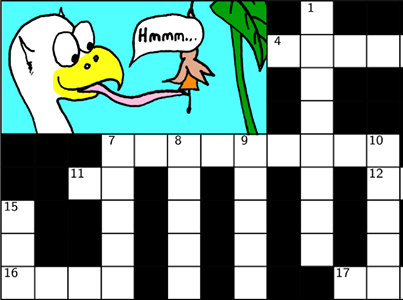
Mots Croisés (Crosswords)

crosswordpic

I was recently in Perth for a couple of weeks, so made the most of the opportunity to visit le forum in Fremantle.  It is a lovely little French bookstore in an almost abandoned small shopping mall at the edge of the shopping area of the city.

I came away with a large bundle of books, mostly for reading as a foreign language, but also a couple of crossword books for children.  People may have the impression that crossword books for 8-year olds would be easy for language learners, but that is not the case.  Children seem to be exposed to and know many more nouns than the typical language learner.  I worked my way through a few crosswords in my new Mots Fléchés book for 8-year olds and it revealed the huge gaps in my vocabulary.  Each crossword had a particular theme.  I did ok on common animals (lion, tigre, zebre, léopard, éléphant), European cities and words about Asia (sumo, sushi, sari, panda), but completely failed on words about the snow, medicine or the kitchen.

My other purchase, “Jeux de mots” for 8+, was easier, due to the dense French-style crossword grids that have clues like “the first and 4th letters of the alphabet”, “double vowel”,  “the first two letters of italien”,  “the second person singular of the present tense of avoir”.  (I’ve translated the clues here.)  These provide lots of hints for the other words of the puzzle.  There were also many more core vocabulary words like man, woman, place, with, pretty etc.

I’ve done other crosswords in French or for French in the past.  One book starts with small crossword triangles with simple words up to 3 letters long and 3 clues in total, and works its way up to 12 by 12 grids and the more difficult verb tenses.  I seem to have lost the original though, so I can’t tell you its name or publisher.  ELI has a book entitled “Jeux faciles en français”, which is for primary school children.  They have a page of vocabulary, such as the numbers from 1 to 10, then a join the word to the item, followed by a crossword and word search.  This pattern repeats for each set of vocabulary.  I remember enjoying this kind of activity as a 5-year-old, so perhaps it works for young kids.

I have a couple of books of vocabulary games including crosswords by Maurie N. Taylor, published by the National Textbook Company.  These are for English-speaking students of French, and are not immersive, but can help cement vocabulary.  However, I think that given the amount of vocabulary and language knowledge assumed in the books, that less English could have been used in the book to give more practice.

I also do crosswords in Dutch sometimes.  The children’s ones are possibly marginally easier for me than the simplest adult ones, but again, the adult ones usually provide more cross-clues, which offsets the slightly more difficult language.

I believe it is possible to create immersive crosswords for use at the earliest stages of language learning – certainly for European languages.  I do this in my comic book.  The crossword uses the episode’s target vocabulary and incidental cognate vocabulary, as well as the sentences in the story that have just been read, to provide reading practice and vocabulary production practice without reverting to English.