Category Archives: Reviews

These articles review books and language resources.

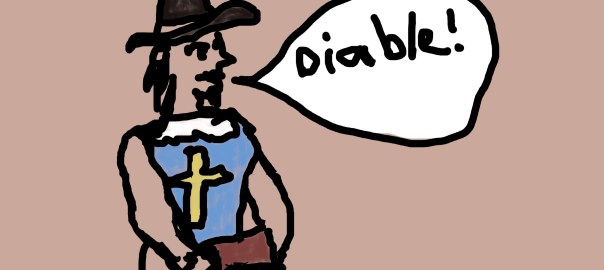
Book cover with musketeer holding a boot, saying "Diable !"

A Tale of Three Three Musketeers and Another One or Two

No, that is not a typo in my title. Thanks to my recent obsession with this novel, leading to the Bootstrapping the Three Musketeers book, with a second on the way, I thought I’d look at three different abridged versions of Les Trois Mousquetaires. I have one published by CLE International, who, in the copy I have, state that it is for a vocabulary of 700 words, at the top level of the Niveau 1. New editions call that CEFR level A1. I also borrowed the CIDEB version, which is aimed at B1, with no mention of vocabulary size, as is common in current publications. When looking online at Mousquetaires books, I found another one adapted by Frédéric de Lavenne de Choulot (FLC).

One thing I’ve noticed with these, as with the recent movies, is that writers select different scenes to include in their version. CLE and FLC both include d’Artagnan’s anger at being ridiculed for riding an old nag. Both the recent movies and CIDEB chose to exclude that scene. The movies also took many more liberties with the story.

OK, now to details…

The CLE version

The CLE version, which aims for a vocabulary of 700 words, has a text length of about 10,000 words of story. It is written in present tense, and the volume includes a brief biography of Dumas, vocabulary support, and some short questions at the end of the book, with solutions. The books of this series provide two types of vocabulary support: general vocabulary is defined in French in a footnote, whereas words that are specific to the story, such as épée, are listed at the back. There are several ink illustrations throughout the 64-page book. (I notice the new edition has new greyscale images.)

On my simple readability score, based on a sample of the first 115 words, it gets 13.15, due to long sentences in the introduction. The expected vocabulary size for 95% coverage is estimated to be 7,427 (based on types, not word families).

The CIDEB version

CIDEB always include lots of additional material, such as many exercises, images, and additional articles to read that are related to the story. The book is 128 pages long, with less than half of that being for the story. I estimate it to have about 13,000 words of story. In addition there is an imaginary interview with Dumas, historical information about the period, and information about movies made of the story. The vocabulary support is provided as footnotes in French.

The story itself is written in passé simple. Based on a sample of 125 words at the start of the story, it gets a score of 8.71, also having a vocabulary size score of 7,427 and an average sentence length of 12.1.

The FLC version

The caveat for this review is that I have only looked at the sample. Therefore I do not know what additional material may be found in the book. There appears to be some vocabulary support, though I cannot say what form it takes, since I have only looked at the sample, which doesn’t allow the links to be followed. I am uncertain why certain words were selected for vocabulary support. Given the target audience appearing to be English-speakers, I would think it pointless to define “armes” and “crient”, but perhaps some nuance was discussed about these words. I noted one minor typo, a missing circumflex on the “i” of “boîte”. That’s not a big issue, given that I’ve seen many errors in books published by major publishing houses (and have been guilty of a couple in my published papers and comics).

The text is in present tense and received 8.18 on my readability measure, with a lower sentence length in the sample of 113 words analysed. The expected vocabulary size at 95% is 5,010.

Summary and Another Mousquetaire

Based on my simple measure, the FLC book comes out in front as the easiest, but there’s not much in it. I might add that the original only scored 12.3 in a short sample from the introduction, due to many low frequency cognates giving it an expected vocabulary size of only 5,543. All three books are simpler than the original in some way, and based on my reading, they are all engaging. All are a similar length in terms of story at 10-16 thousand words. The readability score of the original does highlight a potential problem that happens in graded readers that are not catering for a specific language pair. A different, higher general frequency word may replace a low frequency French-English cognate, making the resulting text harder, not easier for someone with an English-speaking background (although it can help an English-speaker get more experience of those higher frequency words). I have noticed in the past that some vocabulary support is more difficult than the word being defined, due to its similarity to an English word.

Both the CLE and FLC are very much reading-focused, whereas CIDEB tends to turn each story into a bunch of lessons, which, while often interesting and useful, get in the way of reading the story. Depending on my mood, I’ll either skip all the extra material and read the story, potentially going back to read the extra things later, or I’ll look through the extra material as I go. The one activity that I do find useful and make use of in CIDEB books is the pre-chapter vocabulary activities. My favourites are the mix and match vocabulary to images. This is great for people with different vocabulary backgrounds, as there will be some words you know, and others that you can puzzle through, based on the images and the other words to be matched. The activities help increase familiarity with the words, which appear in the chapter to follow.

I have another musketeer story in my collection, not written by Dumas. It is L’autre mousquetaire by Rupert Besley, illustrated by Bob Moulder. This is from the Mary Glasgow Bibliobus set of books, which are no longer in print. It is a short comic about Pathos, a musketeer wannabe. I’ve noticed several phrases in it that come up frequently in the original book, as determined by my bootstrapping algorithm: parbleu! bah! diable ! morbleu ! pardieu ! These words don’t come up so much in the adapted versions, since they are not “useful” language and are mostly dated, but they are an essential part of the character of the original novel. Something to look forward to if you decide to tackle it.
A Personal Rating of French Novel Readability

Lately I’ve been reading a range of books in French and thought I’d keep track of how difficult each was. My categories are: comfortable enough, difficult but the story kept me reading, difficult and I wasn’t motivated to continue. The decision to not continue was often made in the first two pages, and may not reflect the difficulty of the remainder of the book. For context, I passed B1 years ago with 23.5/25 for Compréhension Ecrite, and I’ve continued to read sporadically since, with a burst this year thanks to access to French books in Libby. Here goes…

Easy enoughToo hard but I kept readingToo hard and I gave up
Winn-Dixie by Kate DiCamilloAmari et le Bureau des affaires surnaturelles by B.B. AlstonMaigret by George Simenon
Motel Calivista
(translated to Canadian French from English)
and
Les Trois Clés by Kelly Yang
Arsène Lupin (inspired by watching the TV series)
Love and Gelato by Jenna Evans WelchThe Sun is also a Star by Nicola Yoon
Repartir by Gordon KormanDragon Mountain by Katie and Kevin Tsang
Sabotage by Sigmund BrouwerLes Penderwick by Jeanne Birdsall.
Nish tome 1 by Isabelle Picard. I mainly put it here because of the québecois phrases, which are fine once you know what they mean. “Pis” is short for “puis” and is used pretty much like “and”.
La fabuleuse histoire de cinq orphelins inadoptable by Hana Tooke. This feels much harder than several of the above books.
M. Lemoncello by Chris Grabenstein. (I initially had this in the difficult and gave up category but have since read it.)
As-tu peur du loup ? by Véronique Drouin. (I initially had this in the difficult and gave up category but have since read it.)
Dark Rise by C.S. Pacat. This felt much harder than some of the others above.
Idéalis by Christopher Paolini. I really should give up on this book as it is way beyond my current level, and I have looked up more words than I normally allow. On the plus side, if you want science fiction vocabulary, you’ll find it in abundance here.

I will continue to update this page, since I think it will be useful for those wanting to choose books written for native speakers that are achievable. But what you should read depends on your current level.

For beginners, I recommend French comics written for language learners, followed by easy stories written for language learners (I like the Collection Découverte series by CLE International) and some very easy picture books for young children.

For early intermediate, look at stories written for language learners and start to explore comic books for native speakers of French based on your personal interests. There are a wide range to choose from.

The next phase is a mix of stories written for language learners and books written for middle grades. The J’aime Lire publications vary in how easy they are for a person with an English-speaking background to understand. Children’s novels translated from English to French are generally slightly easier than those that were originally written in French. If you have a favourite novel that you know well, reading it in French will be easier than reading a story that you don’t know well. Many people seem to like this approach but I prefer to read new things.

Penultimately, read novels for an adult audience. Again, translations will probably be easier on average than books originally written in French. Another approach is called “narrow reading”, where you focus on a single author or genre, so that you benefit from the larger percentage of vocabulary shared across books.

Finally, if it was your goal, try tackling the classic novels you are interested in, like Les Misérables.

(Page includes Amazon Affiliate links.)

Comic Books versus Text-Only Books for Language Learning

Recently I have been reading a few comics in French, mainly by French-Canadian authors, or translated by them. The target audience for most of them is children and young adults. It had me thinking again about how best to grade comics in terms of difficulty.

My experience in attempting to read various Japanese books for children or learners showed me that it is possible to read a picture book that is really just an illustrated vocabulary without knowing any of the words beforehand. At the other extreme, it is theoretically possible to read everything in a parallel text, since the translation is right there to refer to, just very slow if every sentence needs to be analysed. That is known as “intensive reading”, which has been shown to be less useful than “extensive reading” for language acquisition. Complete glosses similarly make it possible to read a text without prior knowledge of the language, albeit with lots of interruptions to look things up.

Translations and glosses aside, a comic book will be easier than its text presented without illustration, since the illustrations provide clues to what is happening. It is also easier than text describing the same scenes provided by illustrations – a point that was made elsewhere in favour of learning language from comic books. In other words, “a picture paints a thousand words”.

In general, there is more dialogue and less descriptive text in comics, compared to novels, so the sentences are shorter on average. (This also applies to scripts of plays.) In addition, the pictures give clues as to what the text is about. A further benefit is that it often provides more examples of speech than would be found in a novel – or at least, as a proportion of the text read. This can be useful for absorbing speech patterns, particularly for people who are not exposed to much speech directly.

While the shorter average sentence length means that comic book text will generally be scored as easier than text from novels by readability measures, I think that a measure of difficulty of a comic may need to consider whether concrete nouns are illustrated when used. For example, a picture containing a wild boar with the text clearly indicating that it is “un sanglier” could be almost as easy as reading a French-English cognate, such as “village”. Or perhaps it is roughly equivalent to having a gloss entry, albeit introduced in the story instead of in a footnote.

Either way, comic books should be easier to read than books that have no illustrations. See my list of easy comic books in French for some that are a good starting point for beginners.

Review: Kill the French

Today I came across the book Kill the French by Vincent Serrano Guerra in a list of recommendations on Amazon and thought I would have a look. It appears to follow similar principles to others that do strict vocabulary control, pioneered by Michael West in the early years of the 20th century: restrict to cognates, introduce frequently occurring words first, include repetition, and slowly build up the assumed vocabulary. The author has also followed the principle of spaced repetition with the goal that readers will retain vocabulary at optimum levels. So how does it compare to other books and comics that do the same thing? Let’s have a look.

I have analysed approximately the first 100 words, which covers the Day 1 text and the title of the Day 2 text. According to Style, it has an average sentence length of 8.8 words and an average word length of 4.3. Word lengths don’t really tell us much for French, since longer words tend to often be easy for those with an English-speaking background. Sentence lengths do, however, have a stronger impact on readability.

Other stats on the sample: vocabulary is 45 words out of 95 words of text, making a vocabulary density (type-token ratio) of 0.47. Naturally the author has made heavy use of cognates. Some of these are exact cognates, such as “lion”, and in other cases they are more challenging without context, such as “musée”. If we assume that all cognates are known, then the assumed vocabulary size for 95% coverage is 41 (when words are ranked in general frequency order), which is an excellent achievement. The only books in my collection that achieve that level or better are:

RankTitle
Required Vocabulary Size for 95% Coverage
1Gnomeville 2: Les pythons et les potions16
2Gnomeville 1: Introductions25
3Longman’s Modern French Course Part 135
4Gnomeville 3: Les six protections de la potion40
5Kill the French41

So from the perspective of readability in French for people with an English-speaking background, I put it at the same level as Gnomeville 3 initially, as they both have similar sentence lengths as well as vocabulary coverage.

Unfortunately, like many graded readers out there, the text of Kill the French is quite dull. I checked the 18th day in the sample to see if it was more interesting, having gained extra vocabulary. Sadly, no. I can’t comment on the final stories in the book, which may be more interesting, since I have only examined the sample.

So, here is my conclusion. If you are an absolute beginner in French and are a huge fan of spaced repetition-based learning and willing to put up with texts that are mildly interesting at best, then this is an excellent graded reader for getting you to become familiar with the 500 most frequent French words efficiently. It certainly beats just memorising vocabulary in isolation. The Gnomeville comics may be more exciting and fun, but unfortunately they currently only take you to a frequent vocabulary of about 30, until the author gets cracking with the rest of the series. Perhaps the best approach at this stage is to use both together.

The first day of Kill the French uses frequent words that are introduced in Gnomeville Episodes 1 to 3. All except “avec” are introduced in the first two episodes. Day 2 introduces two words occurring in Episode 1, one from Episode 2, and one that doesn’t feature in the Gnomeville series yet, since it is far less frequent in text. Gnomeville‘s first two episodes introduce the twenty most frequent words occurring in French newspapers, which is a slightly different frequency profile to spoken language, and somewhat different to other text corpora. Kill the French introduces words in an order that doesn’t resemble any specific corpus frequency list but they are still frequent words. For example, the second day includes the word “aussi”, which in movie vocabulary ranks about 91, in books at 78, and in the Minnesota spoken corpus, at 79. But, it is still a frequent word, and I know from personal experience that being a bit flexible about the order of introduced words makes it easier to produce a coherent story.

Given that the order of word introduction varies enough that words will be introduced in one book and not the other, it doesn’t really matter too much which you read first. You could, for example, read Day 1, then reward yourself with Episode 1, then after Day 2, do the same with Episode 2. Day 3 is where the two texts diverge the most in terms of vocabulary, but there is still overlap. After that, you are stuck with Kill the French. But at some point you might be able to switch to Première Étape: Basic French Readings: Alternate Series by Otto Bond (published 1937), if you can locate a copy. According to my stats the expected vocabulary works out to 316, but it is another principled graded reader, using cognates, frequent words, and slowly adding new words as you read. It’s also an entertaining read. However, from memory, it does use more difficult tenses typically found in French literature right from the start, so can be challenging grammatically. The average sentence length is also quite long, making it potentially daunting.

In summary, I recommend using Kill the French in the following manner: for the first three days, read the day’s material and follow it with an episode of Gnomeville. After that, if you can keep going with the spaced repetition from Kill the French for about 100 days, you then might be able to start reading Première Étape: Basic French Readings: Alternate Series, which is interesting right from the start with an initial vocabulary of 97 frequent words and Si Nous Lisions, which starts being interesting from Chapter 6 with a vocabulary of about 100 words. Best of luck!

Reading books for beginners

I’ve been looking at (and writing) phonics and other beginner books for learning to read and wanted to make a few notes here.

Most systematic controlled beginner reading books are based on phonics, slowly introducing the different letter-sound combinations in the English language. (I say English, as I haven’t looked thoroughly or found books for other languages). There is more than one systematic phonics system out there, starting with slightly different sets of letters and words, but they all achieve a similar goal of gently and methodically introducing children (and sometimes illiterate adults) to the skill of reading.

Amongst some interesting innovations I have seen are the book Cat and Rat by Doug Oglesby, Melinda Thompson, and Melissa Ferrell. This book tells the story, which is well indicated by the illustrations, first with pictures only (where the child tells the story in their own words), then by gradually adding more words each read. Designed by the authors to help a child with reading difficulties, it is no doubt useful for many in the same situation.

A second innovative book series I have seen are published by Usborne. I read Pirate Pat by Mairi Mackinnon, which is a book that allows a child to read with an adult, with each taking a page in turn. The child would be able to handle their pages after only two weeks of Phase 2 in the Letters & Sounds phonics system plus the word “I”. The alternating pages approach allows a more complicated story to be told than possible with the letters s a t p i n m d constrained to words of up to three letters in length.

Most other phonics readers start with stories that are told via the illustrations, but with captions or short sentences that are possible with the highly constrained set of words and letters. As a result, one ends up with variations on “The cat sat on the mat” (for which the earliest reference I have found is 1863), many stories being OK, but some being clever. Stories get a bit easier to write by the end of Phase 3. The constraints tend to continue in that authors try to ensure enough repetition of the target letter-sounds (grapheme-phonemes) of the stage, such as “A win at the well”, a story written to introduce “w”.

For all these beginner readers, it is crucial to have attractive illustrations and some narrative. After all, we want beginners to be motivated to read more.

French Comics for Beginners

Most pages I’ve seen that try to answer the question “What are the best French comics for beginners?” only include comics written for native speakers. That is fine, and it is easier to follow a francophone comic than a novel, thanks to the pictures. However, if Astérix is still beyond you, there are easier alternatives to start with.

Based on the principles of extensive reading, you want comics where you know the meaning of 95-98% of the words you read, to read fluently, enjoy what you’re reading, and gain language capability from exposure to lots of text. Of course, you also need to enjoy what you’re reading to benefit from it, so if something doesn’t appeal to you, it would be better to find something else to read.

Materials written for native speakers of French will have much richer vocabularies and grammatical constructions than those written for learners. If you want to start on something written for you the learner, rather than a francophone, here are a few options to look at.

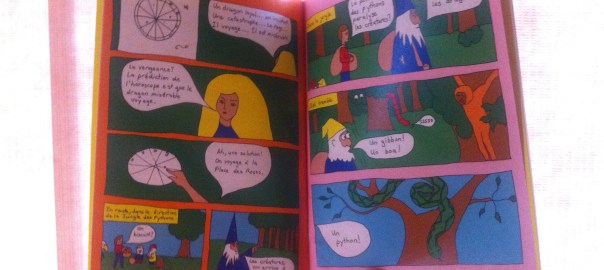
  1. Gnomeville episodes 1-3. These assume no knowledge of French and tell an entertaining tale about gnomes, a griffon and a mage going on a quest to capture a dragon. The focus is on introducing the most frequent words in French while using cognates (words that are the same in both languages, in this case, English and French) and pictures to make the story entertaining. Suits ages 8 and above. Available from Amazon as ebook or on Square as a physical comic book.
  2. Various offerings from My Generation of Polyglots. I’ve only looked at the sample of the graphic novel, which is of Chapter 7. It is more like a picture book in format than comic book/bande dessinée. The language is very simple and every word has a translation at the bottom of the page. There is only a small amount of text on each page, so it has a high picture to text ratio, making it a comfortable beginner book, despite it being a 110-page text. If the sample chapter is anything to go by, each chapter is a complete story. There are other comic books available at the website too. The language level seems to be tied to school levels 1 and 2. The stories appear to suit young adolescents. Definitely worth a look for beginners who want to read in French.
  3. languagecomics.com have a series of comics published on-line that are written for learners. There are a few available for free to try out and the rest can be accessed via a subscription. Episodes are a page or two long, with links for difficult words, as well as other resources. These also appear to be targeted at adolescent learners of French. Definitely worth trying if you find comics for native speakers daunting.
  4. Luc et Sophie. These are beginner comics, suited to 7-11 year olds who are learning French. I found them a bit annoying, but if you like young sibling rivalry antics, they may suit you. Vocabulary is found at the back of each short comic. If you feel daunted by long texts and want to feel a sense of achievement at finishing something, these very short comics will be an ideal start.
  5. Mary Glasgow’s Bibliobus books and others. Unfortunately these are out of print, but if you can get them (I scored a few second hand, and also borrowed some via inter-library loan), they are reasonably easy to read. Some are quite entertaining, while others are a little contrived or annoying. The contrivedness disappears as you go up the levels, as the authors have more freedom to express themselves. My favourites are Le chapeau rouge and Le gangster et le chat. Note that Bibliobus is also the name of a series of French books for French children, so make sure you are getting what you expect.
  6. The Lire Davantage series published by Heinemann has a comic book format for many of the books. As with the Glasgow ones, some are entertaining, while others are a bit dull or contrived. Yet others are informative non-fiction. I believe these are also out of print, but seem to be available secondhand. Probably suits ages 10+.
  7. There are a few textbooks that include a comic book format story in each lesson. Ça Bouge by Michael Sedunary is one of these, aimed at young adolescents and is fairly entertaining.
  8. ELI publish a magazine for learners of various ages/levels. Each issue of series Voilà (young children), C’est facile (A1-A2), Môme (A2-B1), and Jeunes (B1-B2), contain comics. If the format hasn’t changed since I last grabbed copies, it is two pages of comic in a 16-page magazine. The rest is filled with activities, quizzes, and articles.
  9. Aquila Communications have comics/bandes dessinnées for beginners to intermediate. Normally they only sell to schools but they might agree to sell to an individual if you contact them directly. Either way, you can read some pages from some books on the website for practice and to get an idea of what they’re like. I don’t have their comics but have enjoyed some of their books for low-intermediate to intermediate in the past.

It’s all down to how comfortable you feel with the language you don’t know. If you are confident, then dive straight into the classics: Lucky Luke, Tintin and Astérix. Then venture beyond those based on your tastes or language goals. But if they are still at your frustration level, start with those that are written for beginners and work your way up.

Once you are confident enough to read comics written for native speakers, it is worth having a look at those available to read for free from comicbookplus.com. I haven’t looked at many yet but the Baby Journal might be easier given it is aimed at children. The comics have ratings, which may make choosing easier. Le Fanchon de Soeur Bourgeoys dramatises a bit of history from the early days of Québec.

Note to authors of French comic books for learners: if I haven’t got your offerings on my list, please let me know. I’d be very happy to add them.

(Last updated 26th April, 2024. Now with affiliate links again (2025).)

Function word frustrations

I recently re-watched Dilili in Paris, which is a fabulous animation movie for children, with French dialogue that is slow enough for French language learners to follow. I originally watched the movie during the Melbourne French Film Festival and considered buying the movie later so I could try watching it without English subtitles.

Frustration 1: Memory

There is a frequently repeated phrase when Dilili meets new people: “Je suis heureuse de vous rencontrer”. It was semi-humorous, and certainly designed to be remembered, to teach how to be polite when meeting someone new. However, what I actually remembered after a week or two was: “Je suis heureuse __ vous rencontrer.” Despite being exposed to many occurrences, the function word was lost. Function words don’t provide semantic content and therefore appear to be harder to retain. There is certainly research evidence that concrete nouns are easier to remember than various other types of words. This movie brought that home to me in a big way.

Frustration 2: Resources

(Not really about function words…)

I bought the DVD of the movie, and then when viewing it, discovered that the subtitles could not be switch off, and that the only subtitles were in English. I don’t know who makes these decisions when preparing DVDs for sale, but perhaps they don’t really consider their audience carefully enough. A French movie sold in Australia would have various audience segments: French ex-pats – possibly including some French people who are hard of hearing, Australian francophiles, Australians learning French. To me, movies and TV episodes are highly useful for practising comprehension of the spoken language. Ideally it can be done at three levels of difficulty (with the example given for L2 referring to the language being learnt and L1 referring to the native language):

  1. L2 audio with L1 subtitles,
  2. L2 audio with L2 subtitles,
  3. L2 audio without subtitles

I even do this with DVDs that were originally in English. I’ve watched two entire series of Perry Mason with French audio, which was quite illuminating. If you are short of practice material, check your DVD collection for audio in your target language. You may be pleasantly surprised to find a good selection amongst your favourite shows.

Frustration 3: Vocabulary Size

(Function words are frequent words…)

One of the excellent things about some graded readers was that they were designed for a specific vocabulary size. For me, vocabulary makes all the difference between a readable text and an unreadable one.  CLE International used to publish books targeting a specific vocabulary size. For example, Niveau 1 had vocabularies of 400-700 words. Through extensive reading, I have successfully moved from 300-word vocabulary books to 700-1000 word ones, and I hope to continue to progress through further reading. However, as with other publishers, the publications have now been converted to CEFR levels: A1, A2 etc. and as far as I can tell, the subtleties of vocabulary size have been removed from the book information.

I have completed a CEFR B1 in French, yet I’m most comfortable reading A1 texts (and texts with less than 1000 word vocabularies) and with few exceptions they are not easy apart from the grammar, which is too easy for me, but the books are still sometimes challenging vocabulary-wise. What frustrates me is that A2 covers such a wide range of vocabularies, depending on the source material, from readable to incomprehensible. Published vocabulary sizes for A2, where they occur at all, vary from 400 to >1200 words. The level of frustration with some of these graded readers is the same as for texts written for native speakers. I oscillate between A1, A2, native texts and back again. The original memoirs of Céleste de Chabrillan are as easy and more exciting than many A2 texts.

CEFR is designed, as far as I can tell, to describe a person’s practical skill in a language, and for that it is useful. However, the jumps between levels are quite large, so that the defined levels are not very useful for the learner themselves. Some publishers solve this by dividing up levels. ELI uses A0, A1, A1.1. The Danish Teen Readers/Easy Readers also divide up the levels, and still appear to quote target vocabulary sizes. Indie publishers tend to ignore vocabulary size in their writing. However, writers and publishers should remember that:

  1. Extensive reading is at its best if learners are reading at a comfortable level while not being familiar with all vocabulary. Ideally learners should know 98% of the words in text they are reading.
  2. Readability of text largely consists of grammar and vocabulary components.
  3. The more readable AND interesting reading material is, the more learners will read, the better their vocabularies will become, and the better their skill in a language will be.
  4. Publishing vocabulary levels required for 95-98% coverage of the text will assist learners in finding materials of the right level for them at any point. Vocabulary levels should be (loosely) based on general word frequency.

This is why I write my comic books for language learners. This is why I research extensive reading, readability and language acquisition.

German reading resources

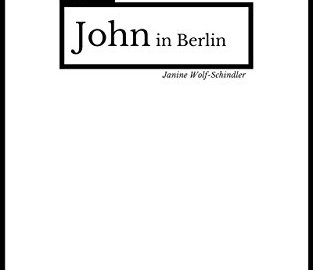
On my long to-do list is to not only write the Gnomeville beginner French comics, but to also write a series in German and another in Dutch, both for which I have some preliminary drafts. Meanwhile, I have found an excellent beginner comic in German by Janine Wolf-Schindler. The illustrations are crude but effective, the language simple, and there are translations discreetly placed at the bottom of the page. This is now my recommended first read in German. That may change when I find (or write) other resources, but it is a good start.

Learn German with a Comic. John in Berlin by Janine Wolf-Schindler.

I’ve yet to think about where this comic fits in the sequence of reading difficulty of available texts in German. There are ELI and La Spiga texts that are easy. After that there are teen readers, and various krimis. I’ll leave that analysis and discussion for another day.


Longmans’ Modern French Course Part 1 – review

I recently read through all of Longman’s Modern French Course Part 1 by Bertenshaw. This is another classic language book, published in 1923. The book provides short reading passages coupled with grammatical lessons that have been illustrated by the passages. Each of the 40 lessons also has illustrations relevant to the reading material. In the first two lessons the illustrations illustrate the relative position of the people and items under discussion. Another useful feature is that liaisons are marked to assist pronunciation. I presume that only the obligatory liaisons are shown, since forbidden liaisons are not illustrated or discussed.

The first passage is about 80 words long. Based on my rough readability calculations, the first 100 words are very easy, with a vocab score of 35, making it fit between my Episodes 2 and 3. Likewise, the sentences are quite short, leading to a rough readability score of 4.62, which places it after my first two episodes and slightly before readers such as Bonjour Luc, Histoires pour les grands, and A First French Reader by Whitmarsh.

The useful aspect of this book is its concise illustration of grammatical points. The stories are mostly not interesting, although there are a few tales and non-fiction passages that are a bit more appealing.

I thought I’d find out a bit about the author of this book. His full name was Thomas Handel Bertenshaw, he was born in 1859 and he died in 1929. In addition to publishing books on French and editing French stories, he published work about music theory, also under Longmans. Once more, music and language appear to go together.

Contes Dramatiques – Review

I promised to review Contes Dramatiques at some point, which was recommended to me via social media a while ago and I eventually acquired a copy of it. I finished reading it a few weeks ago.

On the plus side, it is a graded reader that starts relatively simply and then progresses as you work through the stories in the book. On the down side, they were the kind of stories that annoy me and until you get near the end of the book they are very short. The result was that it took me a long time to finish this book. However, that is just me. If you are a fan of Maupassant (not actually in the book), leprechaun trickery and other such stories, you may like this a lot more than I do. I will say in its favour though that the first story is a lot more interesting than the first stories of many other graded readers. It’s just that there was a sameness across the set of stories that made it tedious for me.

From a readability perspective I give it a 6.7 (based on the first ~100 words), which sits with various other graded readers including some A1 teen readers on the scale. So it is suitable reading for A1+ learners.