Category Archives: Resources

Resources for language learning and for producing language learning resources

Children’s books

While searching for books that are simple enough for me to read in Japanese, I’ve been musing about the attributes that make these suitable for language learners.
If starting from scratch you need repetitious text with obviously illustrated nouns. This describes some of the books I purchased. The downside of the simplest books is that they become an illustrated list of nouns (or adjectives like colours), and therefore have no narrative.
In Japanese you have the added complication of the writing system. Beginner books use hiragana only. Then there are some that have katakana with hiragana transliterations. Then there are a few that use both the alphabets without guides. At the next level kanji are included with hiragana guides. The level of support for kanji varies.

Mots Croisés (Crosswords)

crosswordpic

I was recently in Perth for a couple of weeks, so made the most of the opportunity to visit le forum in Fremantle.  It is a lovely little French bookstore in an almost abandoned small shopping mall at the edge of the shopping area of the city.

I came away with a large bundle of books, mostly for reading as a foreign language, but also a couple of crossword books for children.  People may have the impression that crossword books for 8-year olds would be easy for language learners, but that is not the case.  Children seem to be exposed to and know many more nouns than the typical language learner.  I worked my way through a few crosswords in my new Mots Fléchés book for 8-year olds and it revealed the huge gaps in my vocabulary.  Each crossword had a particular theme.  I did ok on common animals (lion, tigre, zebre, léopard, éléphant), European cities and words about Asia (sumo, sushi, sari, panda), but completely failed on words about the snow, medicine or the kitchen.

My other purchase, “Jeux de mots” for 8+, was easier, due to the dense French-style crossword grids that have clues like “the first and 4th letters of the alphabet”, “double vowel”,  “the first two letters of italien”,  “the second person singular of the present tense of avoir”.  (I’ve translated the clues here.)  These provide lots of hints for the other words of the puzzle.  There were also many more core vocabulary words like man, woman, place, with, pretty etc.

I’ve done other crosswords in French or for French in the past.  One book starts with small crossword triangles with simple words up to 3 letters long and 3 clues in total, and works its way up to 12 by 12 grids and the more difficult verb tenses.  I seem to have lost the original though, so I can’t tell you its name or publisher.  ELI has a book entitled “Jeux faciles en français”, which is for primary school children.  They have a page of vocabulary, such as the numbers from 1 to 10, then a join the word to the item, followed by a crossword and word search.  This pattern repeats for each set of vocabulary.  I remember enjoying this kind of activity as a 5-year-old, so perhaps it works for young kids.

I have a couple of books of vocabulary games including crosswords by Maurie N. Taylor, published by the National Textbook Company.  These are for English-speaking students of French, and are not immersive, but can help cement vocabulary.  However, I think that given the amount of vocabulary and language knowledge assumed in the books, that less English could have been used in the book to give more practice.

I also do crosswords in Dutch sometimes.  The children’s ones are possibly marginally easier for me than the simplest adult ones, but again, the adult ones usually provide more cross-clues, which offsets the slightly more difficult language.

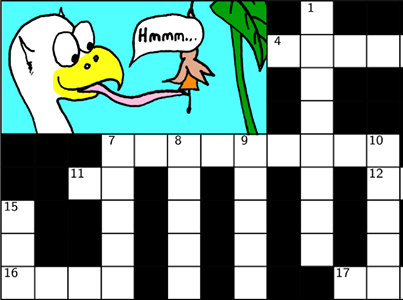
I believe it is possible to create immersive crosswords for use at the earliest stages of language learning – certainly for European languages.  I do this in my comic book.  The crossword uses the episode’s target vocabulary and incidental cognate vocabulary, as well as the sentences in the story that have just been read, to provide reading practice and vocabulary production practice without reverting to English.
Gnomeville Episode 1 is done!

Having given myself a hard deadline of Friday so it would be ready for launching at a concert of French music, it is done!

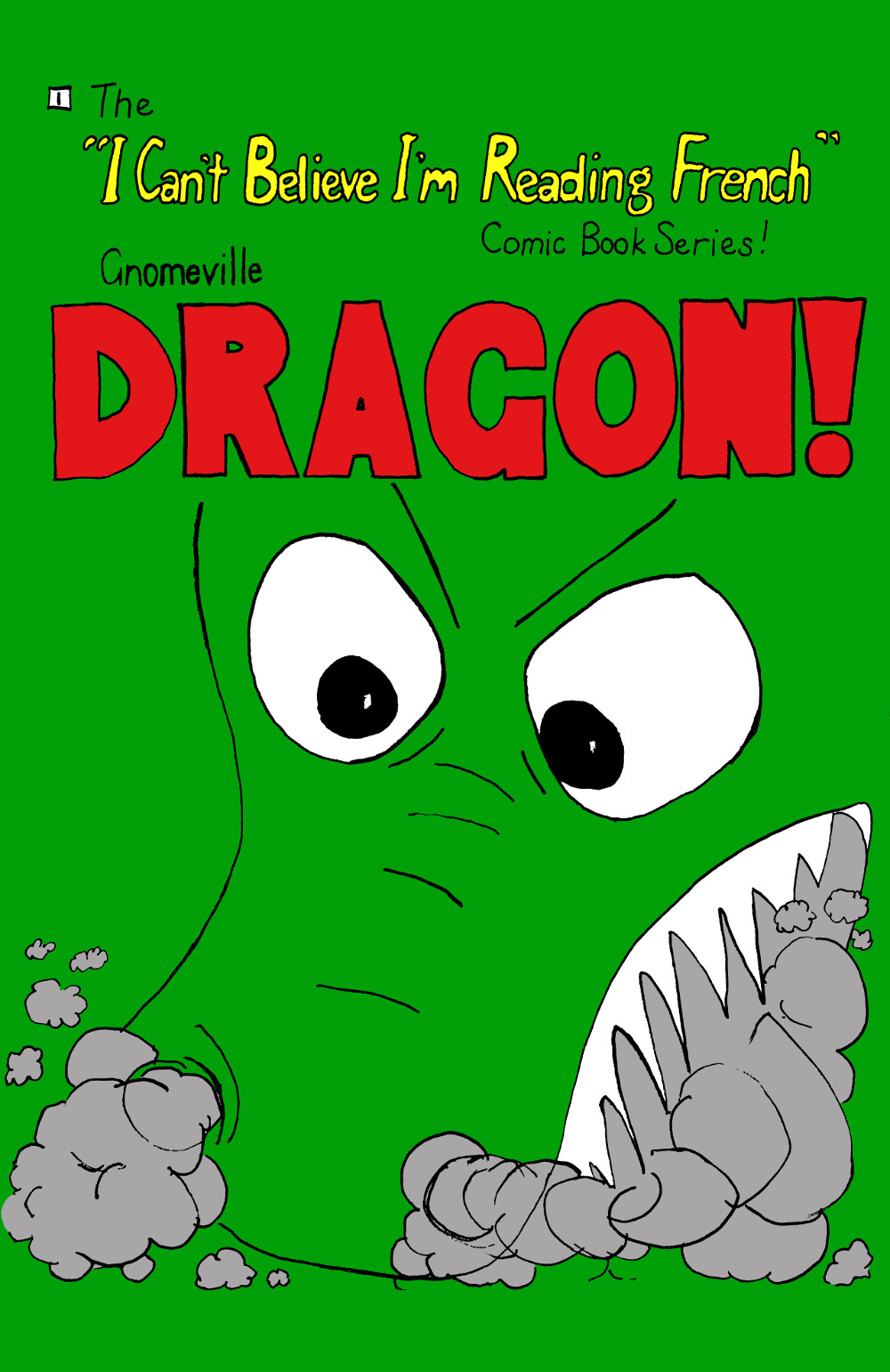
The “I Can’t Believe I’m Reading French” Comic Book Series, Episode 1: Gnomeville: Dragon!

Gnomeville comic book cover containing head of dragon with smoke billowing out of its mouth and the title "DRAGON!" in large red letters

  • 28-page booklet plus audio CD containing 3 stories in comic book format, a crossword, a song and a language summary.
  • Assumes no prior knowledge of French but a native or near-native English speaking background.
  • Introduces 12 of the twenty most commonly occurring words in French newspapers, one new word per page of the Gnomeville story.
  • Uses the words that are common to French and English to ensure that all words in the stories are familiar, such as “dragon”, “gnome”, “arrive”.
  • The Fido story provides further reading practice, ensuring each target word has been read at least 5 times.
  • The crossword allows you to actively use the language to increase retention
  • The songs provide further practice, including pronunciation
  • The narration provides pronunciation information and listening practice
  • The Taxi story is a nice easy story to read after the other stories.
  • The audio CD contains the stories read by a native speaker, plus two songs related to the stories.
  • $20 plus postage from Melbourne Australia
  • Currently only available from me directly, but stay tuned for updates.

Top French Movies

One of the ways that I pick up foreign language listening skills is watching movies and TV series in the language.  For Italian I took it one step further in that I made bingo sheets of common expressions to encourage listening instead of just reading subtitles.

I will probably do the same for French at some point.  Here is a list from 2011 that I found, of the top 10 French films.

  1. Bienvenue chez les Ch’tis
  2. La Grande vadrouille
  3. Astérix et Obélix : Mission Cléopâtre
  4. Les Visiteurs
  5. Le Petit monde de Don Camillo
  6. Corniaud
  7. Taxi 2
  8. 3 hommes et un couffin
  9. Les Bronzés 3 amis pour la vie

Oops, one missing from the top 10.  Maybe I misunderstood the last paragraph of the article.

Pronunciation songs

While preparing my choir for a concert of French music I have been inspired to write some rounds and short songs in French to help choristers to produce the correct vowel sounds, and to have a bit of an idea about how to pronounce French.  I’ve written one round for each vowel so far, and am now writing songs for various consonants.  Today I finished a song for the letter G.  I’ll probably publish these as a booklet for choirs and classes.