Tag Archives: writing

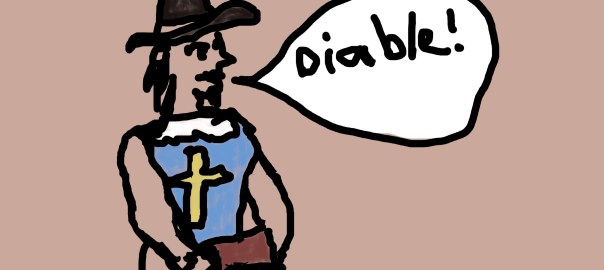
Book cover with musketeer holding a boot, saying "Diable !"

A Tale of Three Three Musketeers and Another One or Two

No, that is not a typo in my title. Thanks to my recent obsession with this novel, leading to the Bootstrapping the Three Musketeers book, with a second on the way, I thought I’d look at three different abridged versions of Les Trois Mousquetaires. I have one published by CLE International, who, in the copy I have, state that it is for a vocabulary of 700 words, at the top level of the Niveau 1. New editions call that CEFR level A1. I also borrowed the CIDEB version, which is aimed at B1, with no mention of vocabulary size, as is common in current publications. When looking online at Mousquetaires books, I found another one adapted by Frédéric de Lavenne de Choulot (FLC).

One thing I’ve noticed with these, as with the recent movies, is that writers select different scenes to include in their version. CLE and FLC both include d’Artagnan’s anger at being ridiculed for riding an old nag. Both the recent movies and CIDEB chose to exclude that scene. The movies also took many more liberties with the story.

OK, now to details…

The CLE version

The CLE version, which aims for a vocabulary of 700 words, has a text length of about 10,000 words of story. It is written in present tense, and the volume includes a brief biography of Dumas, vocabulary support, and some short questions at the end of the book, with solutions. The books of this series provide two types of vocabulary support: general vocabulary is defined in French in a footnote, whereas words that are specific to the story, such as épée, are listed at the back. There are several ink illustrations throughout the 64-page book. (I notice the new edition has new greyscale images.)

On my simple readability score, based on a sample of the first 115 words, it gets 13.15, due to long sentences in the introduction. The expected vocabulary size for 95% coverage is estimated to be 7,427 (based on types, not word families).

The CIDEB version

CIDEB always include lots of additional material, such as many exercises, images, and additional articles to read that are related to the story. The book is 128 pages long, with less than half of that being for the story. I estimate it to have about 13,000 words of story. In addition there is an imaginary interview with Dumas, historical information about the period, and information about movies made of the story. The vocabulary support is provided as footnotes in French.

The story itself is written in passé simple. Based on a sample of 125 words at the start of the story, it gets a score of 8.71, also having a vocabulary size score of 7,427 and an average sentence length of 12.1.

The FLC version

The caveat for this review is that I have only looked at the sample. Therefore I do not know what additional material may be found in the book. There appears to be some vocabulary support, though I cannot say what form it takes, since I have only looked at the sample, which doesn’t allow the links to be followed. I am uncertain why certain words were selected for vocabulary support. Given the target audience appearing to be English-speakers, I would think it pointless to define “armes” and “crient”, but perhaps some nuance was discussed about these words. I noted one minor typo, a missing circumflex on the “i” of “boîte”. That’s not a big issue, given that I’ve seen many errors in books published by major publishing houses (and have been guilty of a couple in my published papers and comics).

The text is in present tense and received 8.18 on my readability measure, with a lower sentence length in the sample of 113 words analysed. The expected vocabulary size at 95% is 5,010.

Summary and Another Mousquetaire

Based on my simple measure, the FLC book comes out in front as the easiest, but there’s not much in it. I might add that the original only scored 12.3 in a short sample from the introduction, due to many low frequency cognates giving it an expected vocabulary size of only 5,543. All three books are simpler than the original in some way, and based on my reading, they are all engaging. All are a similar length in terms of story at 10-16 thousand words. The readability score of the original does highlight a potential problem that happens in graded readers that are not catering for a specific language pair. A different, higher general frequency word may replace a low frequency French-English cognate, making the resulting text harder, not easier for someone with an English-speaking background (although it can help an English-speaker get more experience of those higher frequency words). I have noticed in the past that some vocabulary support is more difficult than the word being defined, due to its similarity to an English word.

Both the CLE and FLC are very much reading-focused, whereas CIDEB tends to turn each story into a bunch of lessons, which, while often interesting and useful, get in the way of reading the story. Depending on my mood, I’ll either skip all the extra material and read the story, potentially going back to read the extra things later, or I’ll look through the extra material as I go. The one activity that I do find useful and make use of in CIDEB books is the pre-chapter vocabulary activities. My favourites are the mix and match vocabulary to images. This is great for people with different vocabulary backgrounds, as there will be some words you know, and others that you can puzzle through, based on the images and the other words to be matched. The activities help increase familiarity with the words, which appear in the chapter to follow.

I have another musketeer story in my collection, not written by Dumas. It is L’autre mousquetaire by Rupert Besley, illustrated by Bob Moulder. This is from the Mary Glasgow Bibliobus set of books, which are no longer in print. It is a short comic about Pathos, a musketeer wannabe. I’ve noticed several phrases in it that come up frequently in the original book, as determined by my bootstrapping algorithm: parbleu! bah! diable ! morbleu ! pardieu ! These words don’t come up so much in the adapted versions, since they are not “useful” language and are mostly dated, but they are an essential part of the character of the original novel. Something to look forward to if you decide to tackle it.
Common One-Word Sentences in French, Revisited

I’ve been playing with my scripts lately, filtering French. Previously I have published a list of the top one-word sentences in a corpus of French classic texts, as well as my lists of very easy extracts, based on the language repertoire covered by my Gnomeville comics. Today, while waiting for my very inefficient scripts to finish processing my old download of the French texts from Project Gutenberg, I revisited the frequent one-word sentences. I decided to keep the exclamation marks and question marks this time, so it is clear whether something is being used as a question or not. Here is what is coming up so far…

  1. Ah !
  2. Oh !
  3. Eh !
  4. Hélas !
  5. Oui.
  6. Non !
  7. Non.
  8. Oui !
  9. Comment !
  10. Quoi !
  11. Bah !
  12. <name>. (most likely names of characters in a play, the first one being Bonaparte.)
  13. Pourquoi ?
  14. Bon !
  15. etc. (probably an artifact of how things were processed)
  16. Allons !
  17. Ha !
  18. Tiens !
  19. Hé !
  20. Moi.

There’s quite a bit in common with the previous list of one-word sentences. The exclamations that showed in the previous list (Diable ! Parbleu !) still occur in the top 30, so there isn’t a lot of change despite the much larger corpus. I suspect further changes to be quite minor as the processed corpus grows.

Beginner French Resources

tldr: Easy French sentences from classics here.

Years ago I was tinkering with creating my beginner comic book in French, and then researching what made things easy to read in French for those with English speaking background. I learnt that the two main aspects that characterise text difficulty are grammar and vocabulary, with other aspects usually having a much smaller role to play. Through my own research, inspired by my own frustration and anecdotal experience, I learnt that for French the typical readability measures that use word length or even how common a word is for vocabulary difficulty just don’t work for people with English speaking backgrounds. This is because so many of the longer “difficult” words in French are identical to those in English, or close enough not to matter. My experiment demonstrated that you may as well just use sentence length to decide on difficulty, being the simplest measure of grammatical complexity. Despite this, vocabulary matters. It’s just that the words that are difficult are differently distributed than for languages that don’t have this peculiar French-English relationship.

In another of my experiments, I tried to filter a large collection of French text to find extracts that are easy for English speakers. While the extracts that are very easy are not long, they do exist. It’s a matter of playing around with the constraints to get something sizeable. It should also be noted that the text I used consists of French classics, which can be challenging to read. Anyway, it’s been a while since I looked at this. The other day I created a page on this site that contains all the sentences and extracts I found that restrict themselves to the vocabulary and grammar of Episode 1 of my comic book, (le, la, les, de, du, des, et, est, se, que, and present tense third person singular of -er verbs) plus cognates and names. I hope it is useful. More to come.

Comic Books versus Text-Only Books for Language Learning

Recently I have been reading a few comics in French, mainly by French-Canadian authors, or translated by them. The target audience for most of them is children and young adults. It had me thinking again about how best to grade comics in terms of difficulty.

My experience in attempting to read various Japanese books for children or learners showed me that it is possible to read a picture book that is really just an illustrated vocabulary without knowing any of the words beforehand. At the other extreme, it is theoretically possible to read everything in a parallel text, since the translation is right there to refer to, just very slow if every sentence needs to be analysed. That is known as “intensive reading”, which has been shown to be less useful than “extensive reading” for language acquisition. Complete glosses similarly make it possible to read a text without prior knowledge of the language, albeit with lots of interruptions to look things up.

Translations and glosses aside, a comic book will be easier than its text presented without illustration, since the illustrations provide clues to what is happening. It is also easier than text describing the same scenes provided by illustrations – a point that was made elsewhere in favour of learning language from comic books. In other words, “a picture paints a thousand words”.

In general, there is more dialogue and less descriptive text in comics, compared to novels, so the sentences are shorter on average. (This also applies to scripts of plays.) In addition, the pictures give clues as to what the text is about. A further benefit is that it often provides more examples of speech than would be found in a novel – or at least, as a proportion of the text read. This can be useful for absorbing speech patterns, particularly for people who are not exposed to much speech directly.

While the shorter average sentence length means that comic book text will generally be scored as easier than text from novels by readability measures, I think that a measure of difficulty of a comic may need to consider whether concrete nouns are illustrated when used. For example, a picture containing a wild boar with the text clearly indicating that it is “un sanglier” could be almost as easy as reading a French-English cognate, such as “village”. Or perhaps it is roughly equivalent to having a gloss entry, albeit introduced in the story instead of in a footnote.

Either way, comic books should be easier to read than books that have no illustrations. See my list of easy comic books in French for some that are a good starting point for beginners.

Musing about Ratings

My comics get the full range of ratings and that’s ok. Sure, the first time I got a 1-star rating it hurt, and I did some soul searching to try to figure out why someone would do that. But it is a reader’s right to rate as they will.

A year or two ago I read a BookBub blog written by a successful independent author. He was very passionate in his belief that nobody should give low ratings to books, even if that is a sincere rating. It can have a negative impact on the author, both in their ability and motivation to create, and on their income. In my experience, my motivation to follow my creative spark is easily impacted by both negative and positive comments that I receive. Fortunately the positive comments can counteract the negative ones.

Having gone through the academic life of submitting research papers to be reviewed, I have developed a more philosophical stance regarding ratings. As long as someone is given feedback that they can act on in order to improve, a negative review is ok. Therefore my preference is this. Give a 1-star rating if you honestly feel that way and want to express that for whatever reason, but please give a review with it, so the author has some idea about why you feel that way. It can be just one or two words. Here are some one-word examples:

  • boring
  • dated
  • unoriginal
  • clichéed
  • inconsistent
  • blokey
  • girly
  • kid-lit
  • misleading
  • plotless
  • characterless
  • suspenseless
  • unedited
  • illiterate
  • ungrammatical

Given one of these one-word reviews, the author will know whether to work on plot, characterisation, writing, or factual content. If the review is “blokey”, “girly”, “kid-lit” or similar, the story may still be ok. Perhaps its nature wasn’t clearly indicated in the blurb for the story, leading to the wrong audience finding the work. The better the blurb gives clues as to the type of work, the greater the chance that reviews received will be higher, since those who are not the intended audience will give it a miss, and its intended audience will be more likely to find it.

Personal Experiments in Extensive Reading

As mentioned in my previous post about learning Japanese, I’ve been applying extensive reading principles to improving my Japanese language skills. At best, in Japanese, I can be described as a “false beginner”, as I don’t have the skills yet to pass the lowest level Japanese Language Proficiency Test. I have dabbled in learning the language whenever I have found a fun resource (Let’s Learn Japanese TV series, Kimono text books); completed a half-semester beginner course, which taught Hiragana and some introductory phrases; and visited Japan briefly three times, each trip providing immersive language learning experiences.

I don’t recall exactly when I started, but it was either from December or early January, I attempted to read something in Japanese for ten minutes per day. I keep a database of my language books, and used data in that to produce an approximate order of difficulty for attempting the books, and probably read through about 80 booklets, plus the chapters of Kimono level 1, and the starting chapters of Kimono level 2. I stopped about a week ago, as it was frustratingly difficult, and I had other things occupying my mind. For the moment I am filling the gap by playing Kana Quest, which is keeping my kana recognition alive.

So in a way, this has been an experiment in seeing how well extensive reading goes in a language where you are still at the beginning stages. In a couple of readability studies I’ve led, I’ve used a 5-point scale to indicate how easy something is to read:

  1. Very easy, understood everything
  2. Easy, a few words were not known, but it didn’t impact reading comprehension
  3. Not easy, but it was possible to follow the story
  4. Difficult, a dictionary is needed to make sense of it
  5. Very difficult, a dictionary won’t help

Number 5 is rarely chosen by anyone, and it has been argued that maybe it doesn’t happen. However, if I were to attempt to read something in Chinese, a dictionary won’t help me, as I don’t know how to look up hanzu characters based on stroke count. Sure I might get there if I persist, but life is too short for that. So I guess Number 5 is more about lacking willpower when encountering very difficult text.

In terms of optimal language learning, ratings of 2-3 are ideal, since new language is being encountered, but the reading is not at the frustration level.

I “extensively read” in a few languages. In Dutch, my mother tongue (but not my best language, which is English), I can comfortably read novels written for children.  I would need a dictionary for anything technical if it was important for me to understand the nuances of meaning, but I would still be able to “follow the story” for most texts I come across.

In French, a language I have studied both in courses and on my own, I am also at the stage where most texts would not be classed as difficult. For German, I read graded readers up to B1 level, giving me texts in the target zone. Thanks to my Dutch background and some study of the language, it would not take too much for me to be able to read texts for native German speakers and be able to “follow the story”.

Now we come to Japanese. The booklets I read went from rating 1 to rating 4. Naturally, the rating 4 ones led to frustration and reduced willpower to continue. My approach to reading them was to read straight through, and then afterward, allow myself to look up a word or two that seemed to be important for understanding, or that had occurred a few times in my reading. I will make the following observations of my experience.

  • My vocabulary definitely improved, but I think that stopping will lead to much of it being forgotten again
  • My ability to recognize kanji improved, and I think that this may actually last a bit longer in my memory than the pronunciation, particularly where there is some obvious logical connection between the ideogram and the meaning, eg. the words for “above” and “below”.
  • Illustrated books that are basically an illustrated vocabulary are very easy to read, even if you don’t know any of the words beforehand and forget most of them afterwards. However, it can be challenging to make them interesting.
  • Booklets with illustrations and repeated sentences can be easy. For example, where the concrete noun, such as a type of animal, is substituted into a template sentence, and the sentence has an illustration of the concrete noun on the page. Even if the sentence isn’t fully understood, the substituted noun will be.
  • Where it is clear from the illustrations what is being said, the meaning of the text can be deduced.
  • In languages that I can read reasonably well I don’t like to read stories that I already know, but I was grateful for the known stories presented in Japanese, to allow me to deduce what the text meant. While the text may have been just as difficult as other stories, the fact that the story was already known meant that the text was better understood and learnt from.
  • What also fascinated me was how focused and absorbed I was in the reading and sense-making task – much as I have observed young children when they are following a story in a book that is being read to them. It was as though my entire brain was switched on – until I got to that frustration point recently.
  • Attractive illustrations make the experience much more enjoyable.

A take home lesson for me is: once an alphabet is known, it is possible to read something, such as illustrated vocabulary books. My Japanese collection includes colour+object combinations, transport, trains, illustrated loanwords in katakana, cities and countries. The difficulty is perhaps learning the alphabet in an absence of known vocabulary. In our first languages we have clues from words we know, such as B for banana. For languages we haven’t learnt yet, authors would need to resort to other tricks such as loanwords, cognates, international words and names and place names.This is one of the tricks I use in my comic book series for French.

The Kimono series simplifies the reading a little by rendering all words that would be in katakana in romaji (our regular western latin alphabet), but spelt as it would be when rendered in katakana. I like this idea for slowly ramping up the difficulty. Books for Japanese native speakers also slowly ramp things up. Children’s books might be in hiragana, hiragana plus katakana with hiragana support, or kana and kanji with support, depending on the target age group.

One study I read about extensive reading and vocabulary acquisition examined what happened if you re-read stories. Each time you re-read you pick up more of the vocabulary. I think I will explore this next, and see how many re-readings of the easier books will make it easier for me to advance to the more difficult ones. Stay tuned for the answer!


Function word frustrations

I recently re-watched Dilili in Paris, which is a fabulous animation movie for children, with French dialogue that is slow enough for French language learners to follow. I originally watched the movie during the Melbourne French Film Festival and considered buying the movie later so I could try watching it without English subtitles.

Frustration 1: Memory

There is a frequently repeated phrase when Dilili meets new people: “Je suis heureuse de vous rencontrer”. It was semi-humorous, and certainly designed to be remembered, to teach how to be polite when meeting someone new. However, what I actually remembered after a week or two was: “Je suis heureuse __ vous rencontrer.” Despite being exposed to many occurrences, the function word was lost. Function words don’t provide semantic content and therefore appear to be harder to retain. There is certainly research evidence that concrete nouns are easier to remember than various other types of words. This movie brought that home to me in a big way.

Frustration 2: Resources

(Not really about function words…)

I bought the DVD of the movie, and then when viewing it, discovered that the subtitles could not be switch off, and that the only subtitles were in English. I don’t know who makes these decisions when preparing DVDs for sale, but perhaps they don’t really consider their audience carefully enough. A French movie sold in Australia would have various audience segments: French ex-pats – possibly including some French people who are hard of hearing, Australian francophiles, Australians learning French. To me, movies and TV episodes are highly useful for practising comprehension of the spoken language. Ideally it can be done at three levels of difficulty (with the example given for L2 referring to the language being learnt and L1 referring to the native language):

  1. L2 audio with L1 subtitles,
  2. L2 audio with L2 subtitles,
  3. L2 audio without subtitles

I even do this with DVDs that were originally in English. I’ve watched two entire series of Perry Mason with French audio, which was quite illuminating. If you are short of practice material, check your DVD collection for audio in your target language. You may be pleasantly surprised to find a good selection amongst your favourite shows.

Frustration 3: Vocabulary Size

(Function words are frequent words…)

One of the excellent things about some graded readers was that they were designed for a specific vocabulary size. For me, vocabulary makes all the difference between a readable text and an unreadable one.  CLE International used to publish books targeting a specific vocabulary size. For example, Niveau 1 had vocabularies of 400-700 words. Through extensive reading, I have successfully moved from 300-word vocabulary books to 700-1000 word ones, and I hope to continue to progress through further reading. However, as with other publishers, the publications have now been converted to CEFR levels: A1, A2 etc. and as far as I can tell, the subtleties of vocabulary size have been removed from the book information.

I have completed a CEFR B1 in French, yet I’m most comfortable reading A1 texts (and texts with less than 1000 word vocabularies) and with few exceptions they are not easy apart from the grammar, which is too easy for me, but the books are still sometimes challenging vocabulary-wise. What frustrates me is that A2 covers such a wide range of vocabularies, depending on the source material, from readable to incomprehensible. Published vocabulary sizes for A2, where they occur at all, vary from 400 to >1200 words. The level of frustration with some of these graded readers is the same as for texts written for native speakers. I oscillate between A1, A2, native texts and back again. The original memoirs of Céleste de Chabrillan are as easy and more exciting than many A2 texts.

CEFR is designed, as far as I can tell, to describe a person’s practical skill in a language, and for that it is useful. However, the jumps between levels are quite large, so that the defined levels are not very useful for the learner themselves. Some publishers solve this by dividing up levels. ELI uses A0, A1, A1.1. The Danish Teen Readers/Easy Readers also divide up the levels, and still appear to quote target vocabulary sizes. Indie publishers tend to ignore vocabulary size in their writing. However, writers and publishers should remember that:

  1. Extensive reading is at its best if learners are reading at a comfortable level while not being familiar with all vocabulary. Ideally learners should know 98% of the words in text they are reading.
  2. Readability of text largely consists of grammar and vocabulary components.
  3. The more readable AND interesting reading material is, the more learners will read, the better their vocabularies will become, and the better their skill in a language will be.
  4. Publishing vocabulary levels required for 95-98% coverage of the text will assist learners in finding materials of the right level for them at any point. Vocabulary levels should be (loosely) based on general word frequency.

This is why I write my comic books for language learners. This is why I research extensive reading, readability and language acquisition.

Ford & Hicks’s Elementary New French Reader – a review

Ford & Hicks published this reader back in 1939, with the intention of making an easier graded reader than their other book, “A New French Reader”, by using present tense to start with, and introducing the other verb tenses in later stories.

The stories are mostly interesting, with a couple sourced from books I have not encountered before (“Deux jeunes aviateurs” and “Le secret du château”). It also includes Cosette, which had me sighing “not again”, since every publisher does stories from Les Misérables. However, Ford & Hicks may have been one of the first to make a simplified reader from it, so I shouldn’t grumble. What I will grumble about is the extract from Comte de Monte Cristo. You may recall in my review of Otto Bond’s series, that the escape episode of this was a highlight, and made me want to read more.

In the Ford & Hicks version, we get the initial backstory in English before reading the scene that led to the unjust incarceration of Dantès. The story then includes more English breaks between sections of French, and given the Otto Bond version, I don’t see the purpose of these interruptions to immersive reading. The Ford & Hicks version covers more of the story, and at the end summarises the remaining plot. Then they end the summary with the statement “The interest of the story weakens after the discovery of the treasure”. Unlike Bond’s version, which had me wanting to read on, this version annoyed me with the English interruptions and further annoyed me by taking away my interest in reading more of the story.

Recent trends in language acquisition research have focused on “translanguaging”, which seems to be what I’ve done most of my life, which is mixing languages together in order to keep communicating fluently with my level of knowledge (of Dutch). There seem to be benefits to doing so, but I’m starting to think it might not be so good for reading. This is the opposite of my previous thoughts on the topic, where I supervised the building of prototype bilingual ereaders that present foreign language stories, having the most difficult parts presented in the native language of the person reading it.

What may be more beneficial is reading foreign language text that resembles the native language of the speaker. That is, using cognates, simple non-idiomatic forms of expression and sentence structures that are not too unusual. This is what happens with stories in French written for native English speakers such as my Gnomeville series (Episode 1 and Episode 2 currently available), and the books by Otto Bond, and Ford & Hicks. It also happens to a large extent in stories by non-native writers. For example, I’ve seen some English graded readers written by a Chinese author, where the English is very Chinese in style, so would not be classed as “good English”. However, as long as it is known to not be “English” English, it is probably helpful to start with for people with a Chinese-speaking background. Then there should be a transition to more English-like English at a later stage. I’m somewhat more forgiving of this idea currently than I was previously.

It’s never as authentic as a native speaker

I have my moments of doubt with my French comic book project. It is virtually impossible to write something that is absolutely correct French in terms of the expressions used if one is not a native speaker. Grammar is relatively easy to get right, apart from minor slip-ups, but having something sound like natural French, especially while intentionally writing in a constrained vocabulary is almost impossible.

I’ve been attempting to get Episode 3 of my comic book ready this month, spurred on by a potential launch date at the language-themed concert I’m involved with, happening tomorrow, as well as #inktober. However, before finalising my comic it was important to get it checked by a native speaker of French. This happened today, and as usual there are errors that need to be fixed, and unlike text that is free to vary without consequences, this means making decisions about whether to leave out phrases or whole sentences, find an alternative French-English cognate, or an alternative way of saying the same thing. As I also try to ensure there are a certain number of repetitions of key words, phrases, or grammatical points, further changes also need to be made. Then there’s the crossword… As a result, I will need to delay the release of Episode 3 for a bit longer.

Unfortunately, despite multiple checks by francophone proofreaders, some things do get missed. I appear to have an error in Episode 2, which has already been published. I may need to set up an errata page here, and perhaps release a second edition at some point. It’s all a little discouraging, but I’m not giving up yet.

A Lesson in Suspense

Reading graded readers can be quite educational on how to write good stories. Previously I wrote an article about a graded reader “Hall of Shame“, in which I highlighted various problems I had observed within the genre, and then provided a summary of recommendations on how to write better graded readers. Elsewhere I wrote another summary of advice on writing graded readers (I called them Easy Readers in my earlier posts.)

In this article I’d like to talk about suspense. I think I was in my twenties when I first really thought about suspense at all when reading. A fine simple example that crystallised it for me was Dirk Gently’s Detective Agency by Douglas Adams. Two memorable simple bits of suspense occurred in it. The first is the sofa stuck in the staircase, which is explained toward the end of the story. The second, which amazed me in its simplicity was explaining two of three things, and not answering the third one until late in the book. I was reading on, wondering what the third thing was. This illustrated that it didn’t really matter what the suspense is, as long as it’s suspense. It doesn’t need to be figuring out who committed a crime, or whether the romance concludes happily. It can be pretty much anything.

The next observation, which inspired the way I’ve organised my Gnomeville comics, was the use of cliff-hangers. I was reading a collection of X-Men comics, and noticed that they always ended with a cliffhanger and unanswered questions. By never fully ending the story, people get hooked and need to read the next issue. Soap operas seem to work the same way. It struck me that this is a very good strategy for graded readers, since we want to motivate people to keep reading to improve their language skill.

I buy and read graded readers by other authors, and I was struck by the contrast suspense made between two otherwise very similar stories by the same author, Sylvie Lainé.

Voyage en France tells of an English couple who go to France, because Louis is reminded of a creative project he commenced with his best friend decades earlier, who later moved to France, and with whom he had lost contact. The project was a movie about an old man trying to find an old friend, echoing the current situation. Louis wants to see how the story will end, by finding his old friend. We read the story of Louis and Melba as they follow a series of clues to find Louis’s old friend. This suspense worked for me, as I wanted to know how the story would end. I also wanted to know whether they tried to finish the movie, but that question wasn’t answered. I read the story quickly, despite many chapters of fairly mundane travel activities, all because of the suspense.

Contrast the above story with Voyage à Marseille. This contains the same two main characters, doing the same things, that is, travelling through France to get to a destination. However, it lacks the suspense of wondering whether they will find the person they are looking for. The first bit of excitement happens quite late, the disappearance of the car, and is resolved quite quickly. There is another unanswered question that had potential as a simple bit of suspense, the title of the biography of Louis’s friend that they were visiting. Unfortunately that wasn’t answered in the final chapter. It took me a lot longer to finish this story, because there wasn’t anything I wanted to know the answer to.

So, when writing graded readers, please provide suspense. It makes a lot of difference to the reading experience.