Tag Archives: easy french

Picture Books for Beginners in French

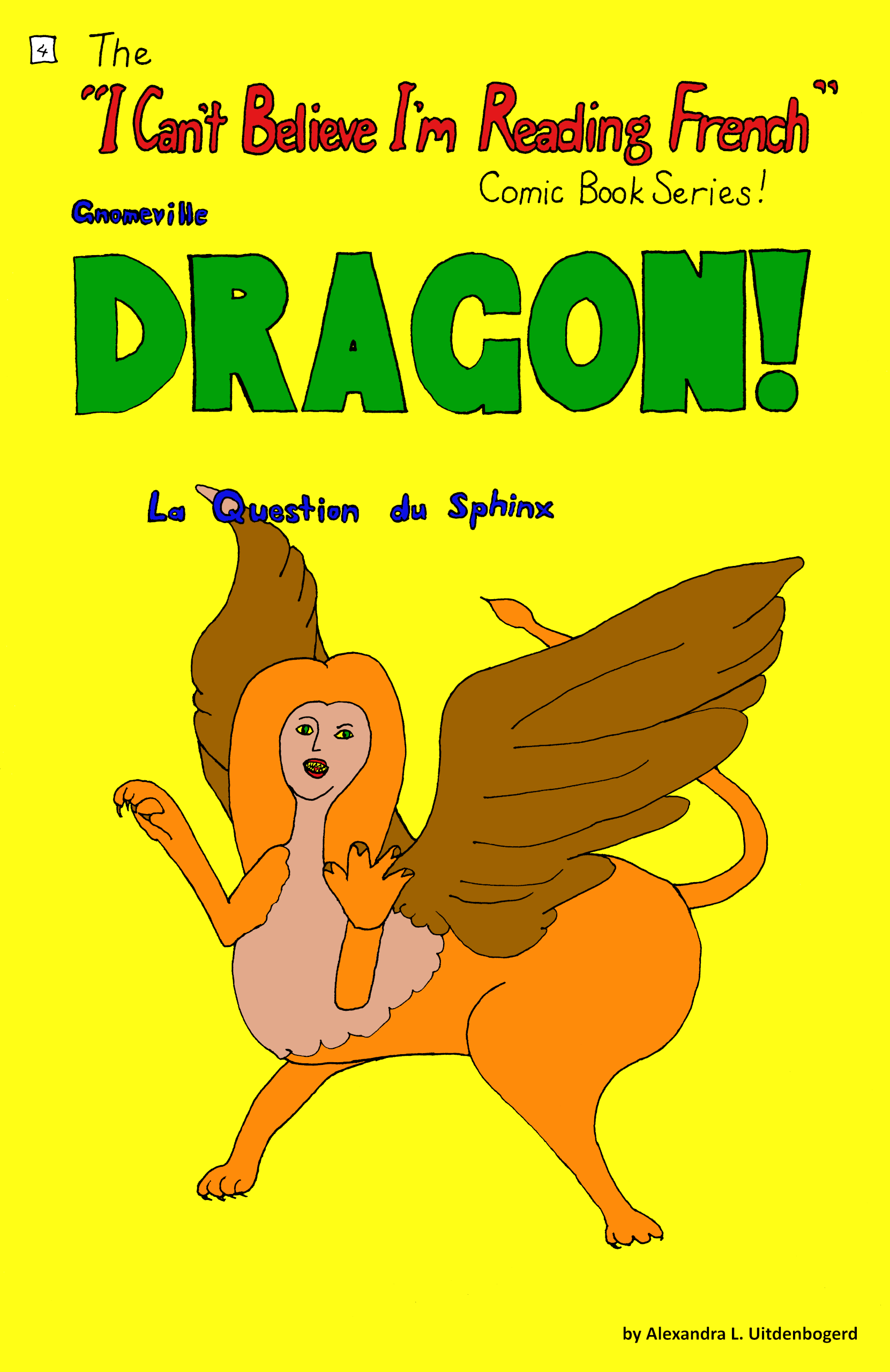
A while back, while reading what I could (which is not very much) in Japanese, I noticed that once you knew the writing system, you could immediately read some picture books that are just illustrated dictionaries, as long as there is a direct correspondence between the text and the image. With this in mind, I thought I would compile a list of picture books that beginners in French can read right now. While I don’t have any that completely fall into that category, I have some that are easy for those who have the vocabulary of Episode 2 of the “I can’t believe I’m reading French” Gnomeville comic book series, being the 20 most frequently occurring words in French newspapers.

As the Gnomeville comic book series focuses on frequent words, which tend to be function words, learners don’t get exposed to common concrete nouns, adjectives and verbs, which tend to be much lower down the word frequency list. However, research suggests that concrete nouns are easier to learn and remember than function words. So, it might be valuable to read picture books in parallel with the comics. I don’t think it is worth memorising what you read, but with repeated exposure – especially with pictures – the words will become familiar.

With all that preamble out of the way, here is my list. I only have a few items so far, but will add any I find later. The episode numbers indicate the assumed vocabulary, where the only words that are not within that vocabulary are clearly defined by the illustrations. Where there is an asterisk (*) after the episode number, it means you need an additional word or two for complete coverage.

TitleAuthorLenghRead After EpisodeComments
Un chatRoger Paré110w2This short book adds a new item to the picture with each page. Annoyingly, it appears to be out of print, but if you access Libby via your library, you might be able to read it there.
Un éléphantRoger Paré110w2This short book adds a new item to the picture with each page. Annoyingly, it appears to be out of print, but if you access Libby via your library, you might be able to read it there.
Le vertAnna C. Peterson31w1*This short book introduces various items that are green. You could read this after Episode 1, assuming you recognise the cognate couleur and note that cet means “this”. Once again, this is not available on-line, but can probably be read via Libby, which is where I found it.
The rest of the series uses a bit more vocabulary but would be easy for those who have studied French for a few weeks.
Une maisonAnnette Smith24w1*This is a level 1 book in the GB+ nouveaux lecteurs series. The pictures illustrate the nouns. All you need for this one is un, une, and voici (here is).
De grosse chosesAnnette Smith34w1*This is a level 1 book in the GB+ nouveaux lecteurs series. The pictures illustrate the nouns. All you need for this one is un, une, est, and gros/grosse (big). The title includes “choses”, meaning “things”.
MamanAnnette Smith16w1*This is a level 1 book in the GB+ nouveaux lecteurs series. The pictures illustrate the verbs. All you need to know is that “maman” means mum/mom.
Les animauxAnnette Smith35w2*This is a level 1 book in the GB+ nouveaux lecteurs series. The pictures illustrate the nouns. All you need for this one is le, la, l’, les, est, d’, and ici (here). The title includes the cognate “animaux” (animals).
MoiAnnette Smith16w3This is a level 1 book in the GB+ nouveaux lecteurs series. The pictures illustrate the verbs. All you need for this one is je. The title means “me”.
Je me déguiseAnnette Smith32w3*This is a level 1 book in the GB+ nouveaux lecteurs series. The pictures illustrate the nouns. All you need for this one is je, un, and suis (am). The title means “I disguise myself”.
Nous sortonsAnnette Smith39w4*This is a level 1 book in the GB+ nouveaux lecteurs series. The pictures illustrate the nouns. All you need for this one is nous, à, la, au, de, l’, and allons (go). The title means “We go out.”

(This page includes Amazon affiliate links.)

Publishers of Graded Readers in French

I thought I would put links to the publishers I’m aware of who sell graded readers in French. As usual, some have disappeared, but some still exist.

Wayside Publishing have some beginner readers that work well for those with an English speaking background. They have strict vocabulary control, using a very small vocabulary, lots of French-English cognates, and repetition. The smallest vocabulary, in Édi l’elephant, is 55 words in a text of 2100 words.

TPRS Books also has a range of books that follow the same approach of small vocabularies and much repetition, with some using base vocabularies below 100 in size.

CLE International have over 300 graded readers, some targeting specific age groups, and covering levels from A1 to B2. Their rebranded Lectures Découverte series (was Collection Découverte) are generally easier than A2 readers from other publishers (and other series) in my experience and their A1.1 stories are very easy compared to those typically labelled A1. I’m slightly frustrated that vocabulary sizes are no longer published, since they are quite relevant to the person reading, if not for the person assessing language level.

CIDEB also have a good range of graded readers (in multiple languages).

Editions Maison des Langues have a small range of graded readers. I get the feeling that they used to have more, since I’m sure I have read some that are not listed on this page. I have read and enjoyed the Alex Leroc series and various other books. From memory the A2 offerings felt more difficult than the CIDEB ones of the same level.

ELI have materials in multiple languages, and publish some beginner books that claim to be based on 100 words of vocabulary. I have a few of their books. The children’s A1 books are much easier than their adult A1 books, which I found quite challenging (in German). Note that if you are learning multiple languages, some of these stories are published in additional languages.

Hachette have their LFF range of graded readers, going from A1 to B2. It looks that they currently sell via specific distributors in different countries. I’ve read some of their A1 Albert et Folio books, which are easy A1 stories. I think the adolescent A1 stories are slightly harder. I’ve also read some of the A2 stories for adolescents. The B1 stories start to use passé simple.

Didier have a small collection of graded readers from A1 to B2. I’ve read Victor Hugo habite chez moi, which was pretty cute from memory. The Didier website is pretty horrible to navigate though.

Egmont has their Easy Readers, which are stories that have been adapted to learners. They are available via Languages Direct, who also sell readers from other publishers.

Teen Readers was a Danish publishing house that published graded readers in several languages. They seem to have disappeared since I last looked. You can buy some books online at Amazon and elsewhere. Similarly for Oxford University Press and Cambridge University Press. They used to have graded reader series suited to those with an English-speaking background. Some may be findable in the secondhand market.

National Textbook Company also seems to have disappeared, sadly. They had some beginner and intermediate level readers that were quite good.

In addition to these major publishing houses, there are independent authors publishing stories for people learning French. I have links to representative works in my list of French graded readers.
Beginner French Resources

tldr: Easy French sentences from classics here.

Years ago I was tinkering with creating my beginner comic book in French, and then researching what made things easy to read in French for those with English speaking background. I learnt that the two main aspects that characterise text difficulty are grammar and vocabulary, with other aspects usually having a much smaller role to play. Through my own research, inspired by my own frustration and anecdotal experience, I learnt that for French the typical readability measures that use word length or even how common a word is for vocabulary difficulty just don’t work for people with English speaking backgrounds. This is because so many of the longer “difficult” words in French are identical to those in English, or close enough not to matter. My experiment demonstrated that you may as well just use sentence length to decide on difficulty, being the simplest measure of grammatical complexity. Despite this, vocabulary matters. It’s just that the words that are difficult are differently distributed than for languages that don’t have this peculiar French-English relationship.

In another of my experiments, I tried to filter a large collection of French text to find extracts that are easy for English speakers. While the extracts that are very easy are not long, they do exist. It’s a matter of playing around with the constraints to get something sizeable. It should also be noted that the text I used consists of French classics, which can be challenging to read. Anyway, it’s been a while since I looked at this. The other day I created a page on this site that contains all the sentences and extracts I found that restrict themselves to the vocabulary and grammar of Episode 1 of my comic book, (le, la, les, de, du, des, et, est, se, que, and present tense third person singular of -er verbs) plus cognates and names. I hope it is useful. More to come.

It’s not too late for your free beginner French comic from Amazon

Episode 2 of the Gnomeville beginner French comic book series is still available for free on Amazon until Friday. Episode 1 is still discounted on Amazon.com and Amazon.co.uk in a countdown deal that increases every couple of days. I hope you enjoy it!