Tag Archives: books

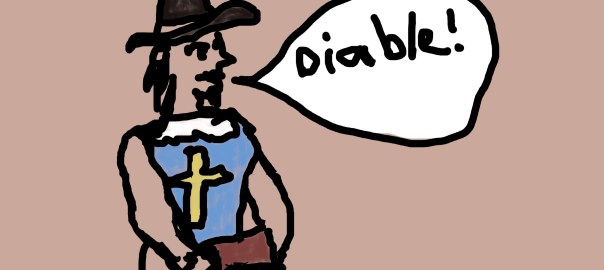
Book cover with musketeer holding a boot, saying "Diable !"

A Tale of Three Three Musketeers and Another One or Two

No, that is not a typo in my title. Thanks to my recent obsession with this novel, leading to the Bootstrapping the Three Musketeers book, with a second on the way, I thought I’d look at three different abridged versions of Les Trois Mousquetaires. I have one published by CLE International, who, in the copy I have, state that it is for a vocabulary of 700 words, at the top level of the Niveau 1. New editions call that CEFR level A1. I also borrowed the CIDEB version, which is aimed at B1, with no mention of vocabulary size, as is common in current publications. When looking online at Mousquetaires books, I found another one adapted by Frédéric de Lavenne de Choulot (FLC).

One thing I’ve noticed with these, as with the recent movies, is that writers select different scenes to include in their version. CLE and FLC both include d’Artagnan’s anger at being ridiculed for riding an old nag. Both the recent movies and CIDEB chose to exclude that scene. The movies also took many more liberties with the story.

OK, now to details…

The CLE version

The CLE version, which aims for a vocabulary of 700 words, has a text length of about 10,000 words of story. It is written in present tense, and the volume includes a brief biography of Dumas, vocabulary support, and some short questions at the end of the book, with solutions. The books of this series provide two types of vocabulary support: general vocabulary is defined in French in a footnote, whereas words that are specific to the story, such as épée, are listed at the back. There are several ink illustrations throughout the 64-page book. (I notice the new edition has new greyscale images.)

On my simple readability score, based on a sample of the first 115 words, it gets 13.15, due to long sentences in the introduction. The expected vocabulary size for 95% coverage is estimated to be 7,427 (based on types, not word families).

The CIDEB version

CIDEB always include lots of additional material, such as many exercises, images, and additional articles to read that are related to the story. The book is 128 pages long, with less than half of that being for the story. I estimate it to have about 13,000 words of story. In addition there is an imaginary interview with Dumas, historical information about the period, and information about movies made of the story. The vocabulary support is provided as footnotes in French.

The story itself is written in passé simple. Based on a sample of 125 words at the start of the story, it gets a score of 8.71, also having a vocabulary size score of 7,427 and an average sentence length of 12.1.

The FLC version

The caveat for this review is that I have only looked at the sample. Therefore I do not know what additional material may be found in the book. There appears to be some vocabulary support, though I cannot say what form it takes, since I have only looked at the sample, which doesn’t allow the links to be followed. I am uncertain why certain words were selected for vocabulary support. Given the target audience appearing to be English-speakers, I would think it pointless to define “armes” and “crient”, but perhaps some nuance was discussed about these words. I noted one minor typo, a missing circumflex on the “i” of “boîte”. That’s not a big issue, given that I’ve seen many errors in books published by major publishing houses (and have been guilty of a couple in my published papers and comics).

The text is in present tense and received 8.18 on my readability measure, with a lower sentence length in the sample of 113 words analysed. The expected vocabulary size at 95% is 5,010.

Summary and Another Mousquetaire

Based on my simple measure, the FLC book comes out in front as the easiest, but there’s not much in it. I might add that the original only scored 12.3 in a short sample from the introduction, due to many low frequency cognates giving it an expected vocabulary size of only 5,543. All three books are simpler than the original in some way, and based on my reading, they are all engaging. All are a similar length in terms of story at 10-16 thousand words. The readability score of the original does highlight a potential problem that happens in graded readers that are not catering for a specific language pair. A different, higher general frequency word may replace a low frequency French-English cognate, making the resulting text harder, not easier for someone with an English-speaking background (although it can help an English-speaker get more experience of those higher frequency words). I have noticed in the past that some vocabulary support is more difficult than the word being defined, due to its similarity to an English word.

Both the CLE and FLC are very much reading-focused, whereas CIDEB tends to turn each story into a bunch of lessons, which, while often interesting and useful, get in the way of reading the story. Depending on my mood, I’ll either skip all the extra material and read the story, potentially going back to read the extra things later, or I’ll look through the extra material as I go. The one activity that I do find useful and make use of in CIDEB books is the pre-chapter vocabulary activities. My favourites are the mix and match vocabulary to images. This is great for people with different vocabulary backgrounds, as there will be some words you know, and others that you can puzzle through, based on the images and the other words to be matched. The activities help increase familiarity with the words, which appear in the chapter to follow.

I have another musketeer story in my collection, not written by Dumas. It is L’autre mousquetaire by Rupert Besley, illustrated by Bob Moulder. This is from the Mary Glasgow Bibliobus set of books, which are no longer in print. It is a short comic about Pathos, a musketeer wannabe. I’ve noticed several phrases in it that come up frequently in the original book, as determined by my bootstrapping algorithm: parbleu! bah! diable ! morbleu ! pardieu ! These words don’t come up so much in the adapted versions, since they are not “useful” language and are mostly dated, but they are an essential part of the character of the original novel. Something to look forward to if you decide to tackle it.
Publishers of Graded Readers in French

I thought I would put links to the publishers I’m aware of who sell graded readers in French. As usual, some have disappeared, but some still exist.

Wayside Publishing have some beginner readers that work well for those with an English speaking background. They have strict vocabulary control, using a very small vocabulary, lots of French-English cognates, and repetition. The smallest vocabulary, in Édi l’elephant, is 55 words in a text of 2100 words.

TPRS Books also has a range of books that follow the same approach of small vocabularies and much repetition, with some using base vocabularies below 100 in size.

CLE International have over 300 graded readers, some targeting specific age groups, and covering levels from A1 to B2. Their rebranded Lectures Découverte series (was Collection Découverte) are generally easier than A2 readers from other publishers (and other series) in my experience and their A1.1 stories are very easy compared to those typically labelled A1. I’m slightly frustrated that vocabulary sizes are no longer published, since they are quite relevant to the person reading, if not for the person assessing language level.

CIDEB also have a good range of graded readers (in multiple languages).

Editions Maison des Langues have a small range of graded readers. I get the feeling that they used to have more, since I’m sure I have read some that are not listed on this page. I have read and enjoyed the Alex Leroc series and various other books. From memory the A2 offerings felt more difficult than the CIDEB ones of the same level.

ELI have materials in multiple languages, and publish some beginner books that claim to be based on 100 words of vocabulary. I have a few of their books. The children’s A1 books are much easier than their adult A1 books, which I found quite challenging (in German). Note that if you are learning multiple languages, some of these stories are published in additional languages.

Hachette have their LFF range of graded readers, going from A1 to B2. It looks that they currently sell via specific distributors in different countries. I’ve read some of their A1 Albert et Folio books, which are easy A1 stories. I think the adolescent A1 stories are slightly harder. I’ve also read some of the A2 stories for adolescents. The B1 stories start to use passé simple.

Didier have a small collection of graded readers from A1 to B2. I’ve read Victor Hugo habite chez moi, which was pretty cute from memory. The Didier website is pretty horrible to navigate though.

Egmont has their Easy Readers, which are stories that have been adapted to learners. They are available via Languages Direct, who also sell readers from other publishers.

Teen Readers was a Danish publishing house that published graded readers in several languages. They seem to have disappeared since I last looked. You can buy some books online at Amazon and elsewhere. Similarly for Oxford University Press and Cambridge University Press. They used to have graded reader series suited to those with an English-speaking background. Some may be findable in the secondhand market.

National Textbook Company also seems to have disappeared, sadly. They had some beginner and intermediate level readers that were quite good.

In addition to these major publishing houses, there are independent authors publishing stories for people learning French. I have links to representative works in my list of French graded readers.

A Personal Rating of French Novel Readability

Lately I’ve been reading a range of books in French and thought I’d keep track of how difficult each was. My categories are: comfortable enough, difficult but the story kept me reading, difficult and I wasn’t motivated to continue. The decision to not continue was often made in the first two pages, and may not reflect the difficulty of the remainder of the book. For context, I passed B1 years ago with 23.5/25 for Compréhension Ecrite, and I’ve continued to read sporadically since, with a burst this year thanks to access to French books in Libby. Here goes…

Easy enoughToo hard but I kept readingToo hard and I gave up
Winn-Dixie by Kate DiCamilloAmari et le Bureau des affaires surnaturelles by B.B. AlstonMaigret by George Simenon
Motel Calivista
(translated to Canadian French from English)
and
Les Trois Clés by Kelly Yang
Arsène Lupin (inspired by watching the TV series)
Love and Gelato by Jenna Evans WelchThe Sun is also a Star by Nicola Yoon
Repartir by Gordon KormanDragon Mountain by Katie and Kevin Tsang
Sabotage by Sigmund BrouwerLes Penderwick by Jeanne Birdsall.
Nish tome 1 by Isabelle Picard. I mainly put it here because of the québecois phrases, which are fine once you know what they mean. “Pis” is short for “puis” and is used pretty much like “and”.
La fabuleuse histoire de cinq orphelins inadoptable by Hana Tooke. This feels much harder than several of the above books.
M. Lemoncello by Chris Grabenstein. (I initially had this in the difficult and gave up category but have since read it.)
As-tu peur du loup ? by Véronique Drouin. (I initially had this in the difficult and gave up category but have since read it.)
Dark Rise by C.S. Pacat. This felt much harder than some of the others above.
Idéalis by Christopher Paolini. I really should give up on this book as it is way beyond my current level, and I have looked up more words than I normally allow. On the plus side, if you want science fiction vocabulary, you’ll find it in abundance here.

I will continue to update this page, since I think it will be useful for those wanting to choose books written for native speakers that are achievable. But what you should read depends on your current level.

For beginners, I recommend French comics written for language learners, followed by easy stories written for language learners (I like the Collection Découverte series by CLE International) and some very easy picture books for young children.

For early intermediate, look at stories written for language learners and start to explore comic books for native speakers of French based on your personal interests. There are a wide range to choose from.

The next phase is a mix of stories written for language learners and books written for middle grades. The J’aime Lire publications vary in how easy they are for a person with an English-speaking background to understand. Children’s novels translated from English to French are generally slightly easier than those that were originally written in French. If you have a favourite novel that you know well, reading it in French will be easier than reading a story that you don’t know well. Many people seem to like this approach but I prefer to read new things.

Penultimately, read novels for an adult audience. Again, translations will probably be easier on average than books originally written in French. Another approach is called “narrow reading”, where you focus on a single author or genre, so that you benefit from the larger percentage of vocabulary shared across books.

Finally, if it was your goal, try tackling the classic novels you are interested in, like Les Misérables.

(Page includes Amazon Affiliate links.)

Comic Books versus Text-Only Books for Language Learning

Recently I have been reading a few comics in French, mainly by French-Canadian authors, or translated by them. The target audience for most of them is children and young adults. It had me thinking again about how best to grade comics in terms of difficulty.

My experience in attempting to read various Japanese books for children or learners showed me that it is possible to read a picture book that is really just an illustrated vocabulary without knowing any of the words beforehand. At the other extreme, it is theoretically possible to read everything in a parallel text, since the translation is right there to refer to, just very slow if every sentence needs to be analysed. That is known as “intensive reading”, which has been shown to be less useful than “extensive reading” for language acquisition. Complete glosses similarly make it possible to read a text without prior knowledge of the language, albeit with lots of interruptions to look things up.

Translations and glosses aside, a comic book will be easier than its text presented without illustration, since the illustrations provide clues to what is happening. It is also easier than text describing the same scenes provided by illustrations – a point that was made elsewhere in favour of learning language from comic books. In other words, “a picture paints a thousand words”.

In general, there is more dialogue and less descriptive text in comics, compared to novels, so the sentences are shorter on average. (This also applies to scripts of plays.) In addition, the pictures give clues as to what the text is about. A further benefit is that it often provides more examples of speech than would be found in a novel – or at least, as a proportion of the text read. This can be useful for absorbing speech patterns, particularly for people who are not exposed to much speech directly.

While the shorter average sentence length means that comic book text will generally be scored as easier than text from novels by readability measures, I think that a measure of difficulty of a comic may need to consider whether concrete nouns are illustrated when used. For example, a picture containing a wild boar with the text clearly indicating that it is “un sanglier” could be almost as easy as reading a French-English cognate, such as “village”. Or perhaps it is roughly equivalent to having a gloss entry, albeit introduced in the story instead of in a footnote.

Either way, comic books should be easier to read than books that have no illustrations. See my list of easy comic books in French for some that are a good starting point for beginners.