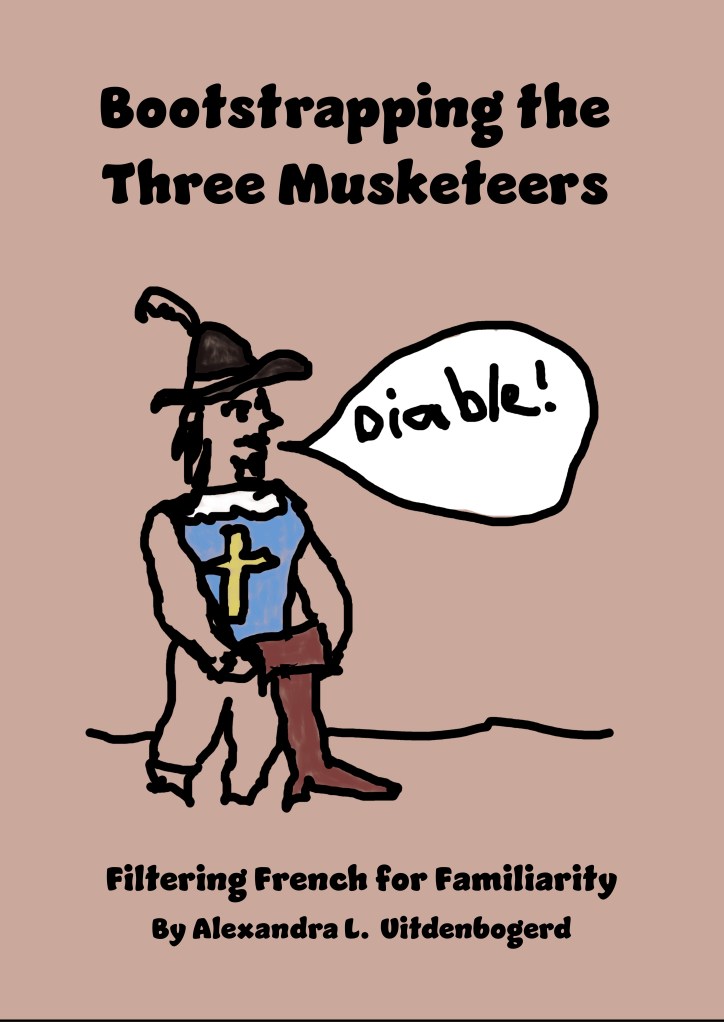
Those who have visited my blog this year will know that I have put up some “filtered French”, such as a list of the most common one-word sentences in French classic literature, and sentences that fit the highly constrained vocabulary of my comic books. After musing on language acquisition, in particular how babies learn, not to mention our experience of picking up a few words and phrases in a foreign language by ear, I thought I’d try a different approach. This has resulted in producing a book (with more volumes to come) where I filter Les trois mousquetaires, and add vocabulary one word at a time based on which word will complete the most sentences. Using a combination of manual and automatic filtering, I have created extracts that have sufficient repetition in their vocabulary for people to become familiar with the words.
It has been fascinating to see what happens as I add each new word. The algorithm tends to find dialogue first, gradually increasing in average sentence length, then short non-dialogue sentences – after the 93rd word of vocabulary was added.
Anyway, if you’d like to have a look, it’s on Amazon, with a substantial preview.
A while back, while reading what I could (which is not very much) in Japanese, I noticed that once you knew the writing system, you could immediately read some picture books that are just illustrated dictionaries, as long as there is a direct correspondence between the text and the image. With this in mind, I thought I would compile a list of picture books that beginners in French can read right now. While I don’t have any that completely fall into that category, I have some that are easy for those who have the vocabulary of Episode 2 of the “I can’t believe I’m reading French” Gnomeville comic book series, being the 20 most frequently occurring words in French newspapers.
As the Gnomeville comic book series focuses on frequent words, which tend to be function words, learners don’t get exposed to common concrete nouns, adjectives and verbs, which tend to be much lower down the word frequency list. However, research suggests that concrete nouns are easier to learn and remember than function words. So, it might be valuable to read picture books in parallel with the comics. I don’t think it is worth memorising what you read, but with repeated exposure – especially with pictures – the words will become familiar.
With all that preamble out of the way, here is my list. I only have a few items so far, but will add any I find later. The episode numbers indicate the assumed vocabulary, where the only words that are not within that vocabulary are clearly defined by the illustrations. Where there is an asterisk (*) after the episode number, it means you need an additional word or two for complete coverage.
This short book adds a new item to the picture with each page. Annoyingly, it appears to be out of print, but if you access Libby via your library, you might be able to read it there.
This short book adds a new item to the picture with each page. Annoyingly, it appears to be out of print, but if you access Libby via your library, you might be able to read it there.
Le vert
Anna C. Peterson
31w
1*
This short book introduces various items that are green. You could read this after Episode 1, assuming you recognise the cognate couleur and note that cet means “this”. Once again, this is not available on-line, but can probably be read via Libby, which is where I found it. The rest of the series uses a bit more vocabulary but would be easy for those who have studied French for a few weeks.
This is a level 1 book in the GB+ nouveaux lecteurs series. The pictures illustrate the nouns. All you need for this one is un, une, and voici (here is).
De grosse choses
Annette Smith
34w
1*
This is a level 1 book in the GB+ nouveaux lecteurs series. The pictures illustrate the nouns. All you need for this one is un, une, est, and gros/grosse (big). The title includes “choses”, meaning “things”.
Maman
Annette Smith
16w
1*
This is a level 1 book in the GB+ nouveaux lecteurs series. The pictures illustrate the verbs. All you need to know is that “maman” means mum/mom.
Les animaux
Annette Smith
35w
2*
This is a level 1 book in the GB+ nouveaux lecteurs series. The pictures illustrate the nouns. All you need for this one is le, la, l’, les, est, d’, and ici (here). The title includes the cognate “animaux” (animals).
Moi
Annette Smith
16w
3
This is a level 1 book in the GB+ nouveaux lecteurs series. The pictures illustrate the verbs. All you need for this one is je. The title means “me”.
Je me déguise
Annette Smith
32w
3*
This is a level 1 book in the GB+ nouveaux lecteurs series. The pictures illustrate the nouns. All you need for this one is je, un, and suis (am). The title means “I disguise myself”.
Nous sortons
Annette Smith
39w
4*
This is a level 1 book in the GB+ nouveaux lecteurs series. The pictures illustrate the nouns. All you need for this one is nous, à, la, au, de, l’, and allons (go). The title means “We go out.”

 Gnomeville