Monthly Archives: March 2025

Beginner French Resources

tldr: Easy French sentences from classics here.

Years ago I was tinkering with creating my beginner comic book in French, and then researching what made things easy to read in French for those with English speaking background. I learnt that the two main aspects that characterise text difficulty are grammar and vocabulary, with other aspects usually having a much smaller role to play. Through my own research, inspired by my own frustration and anecdotal experience, I learnt that for French the typical readability measures that use word length or even how common a word is for vocabulary difficulty just don’t work for people with English speaking backgrounds. This is because so many of the longer “difficult” words in French are identical to those in English, or close enough not to matter. My experiment demonstrated that you may as well just use sentence length to decide on difficulty, being the simplest measure of grammatical complexity. Despite this, vocabulary matters. It’s just that the words that are difficult are differently distributed than for languages that don’t have this peculiar French-English relationship.

In another of my experiments, I tried to filter a large collection of French text to find extracts that are easy for English speakers. While the extracts that are very easy are not long, they do exist. It’s a matter of playing around with the constraints to get something sizeable. It should also be noted that the text I used consists of French classics, which can be challenging to read. Anyway, it’s been a while since I looked at this. The other day I created a page on this site that contains all the sentences and extracts I found that restrict themselves to the vocabulary and grammar of Episode 1 of my comic book, (le, la, les, de, du, des, et, est, se, que, and present tense third person singular of -er verbs) plus cognates and names. I hope it is useful. More to come.

It’s not too late for your free beginner French comic from Amazon

Episode 2 of the Gnomeville beginner French comic book series is still available for free on Amazon until Friday. Episode 1 is still discounted on Amazon.com and Amazon.co.uk in a countdown deal that increases every couple of days. I hope you enjoy it!

Freebie French Beginner Comic ebook Soon

Just a heads up. On Monday 17th March, Episode 2 of the Gnomeville beginner French comic book series will be available for free on Amazon for five days. Episode 1 will also be available at the minimum 0.99 price on Amazon.com and Amazon.co.uk in a countdown deal that increases every couple of days. Mark the date in your calendar!

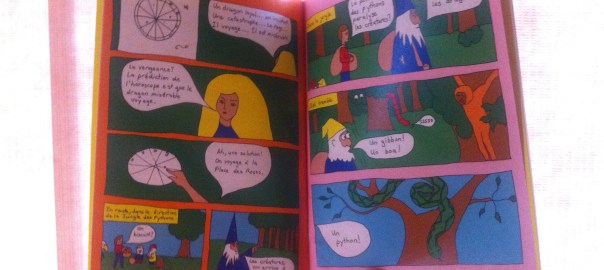
Excerpt from Episode 2 of Gnomeville: Dragon! – a series of comic books written in French for beginners with an English speaking background. Episode 2 only assumes that you know the following words that are covered in Episode 1: le, la, les, et, est, de, du, des, un, une, que, se. The story so far is summarised on the first page of Episode 2.

Comic Books versus Text-Only Books for Language Learning

Recently I have been reading a few comics in French, mainly by French-Canadian authors, or translated by them. The target audience for most of them is children and young adults. It had me thinking again about how best to grade comics in terms of difficulty.

My experience in attempting to read various Japanese books for children or learners showed me that it is possible to read a picture book that is really just an illustrated vocabulary without knowing any of the words beforehand. At the other extreme, it is theoretically possible to read everything in a parallel text, since the translation is right there to refer to, just very slow if every sentence needs to be analysed. That is known as “intensive reading”, which has been shown to be less useful than “extensive reading” for language acquisition. Complete glosses similarly make it possible to read a text without prior knowledge of the language, albeit with lots of interruptions to look things up.

Translations and glosses aside, a comic book will be easier than its text presented without illustration, since the illustrations provide clues to what is happening. It is also easier than text describing the same scenes provided by illustrations – a point that was made elsewhere in favour of learning language from comic books. In other words, “a picture paints a thousand words”.

In general, there is more dialogue and less descriptive text in comics, compared to novels, so the sentences are shorter on average. (This also applies to scripts of plays.) In addition, the pictures give clues as to what the text is about. A further benefit is that it often provides more examples of speech than would be found in a novel – or at least, as a proportion of the text read. This can be useful for absorbing speech patterns, particularly for people who are not exposed to much speech directly.

While the shorter average sentence length means that comic book text will generally be scored as easier than text from novels by readability measures, I think that a measure of difficulty of a comic may need to consider whether concrete nouns are illustrated when used. For example, a picture containing a wild boar with the text clearly indicating that it is “un sanglier” could be almost as easy as reading a French-English cognate, such as “village”. Or perhaps it is roughly equivalent to having a gloss entry, albeit introduced in the story instead of in a footnote.

Either way, comic books should be easier to read than books that have no illustrations. See my list of easy comic books in French for some that are a good starting point for beginners.